From Sahara to Rose Valley: Ksar Lbour, Amazigh Culture, and Kasbah El Kabbaba
Leaving the dunes of Erg Chebbi behind felt a little like waking from a dream with sand still clinging to our shoes. The road west stretched out ahead of us, trading waves of gold for rock and scrub, and eventually for something altogether more unexpected: roses.
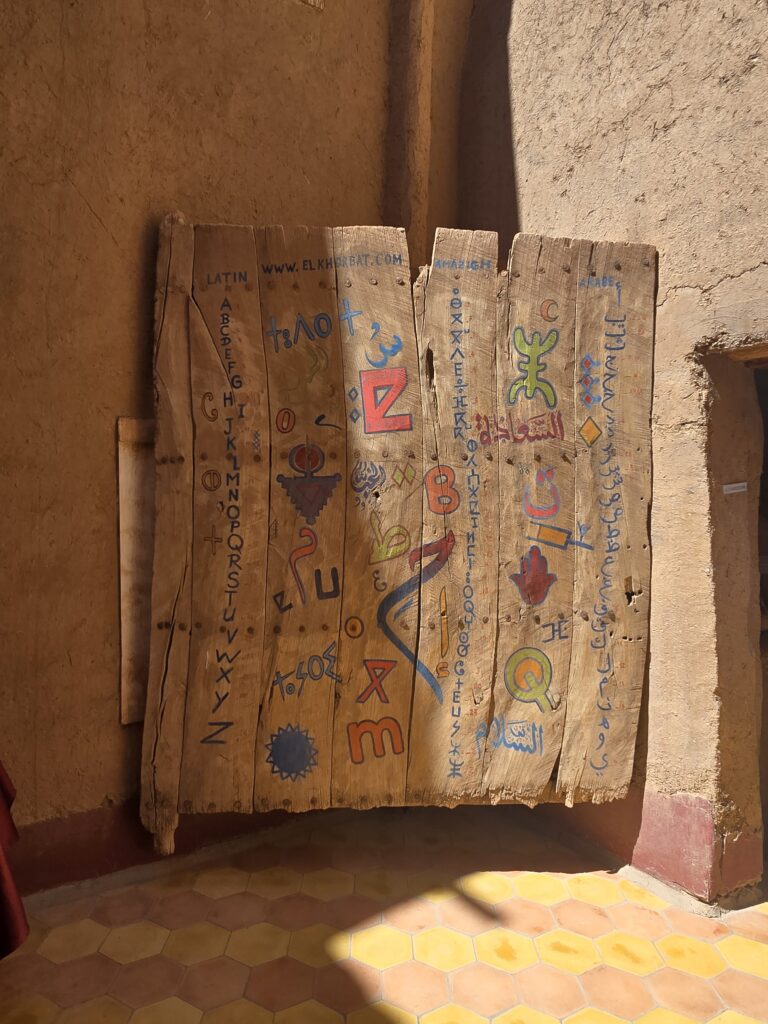
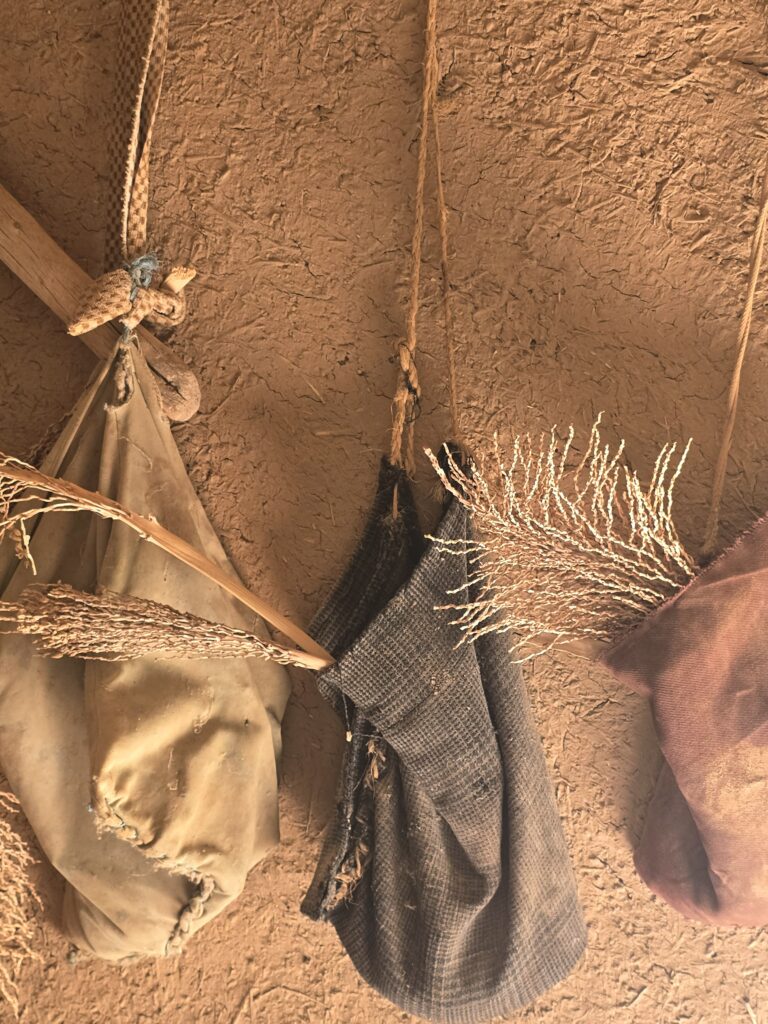
Our first stop on the long road from the Sahara to Marrakech was Ksar Lbour, an old fortified complex that now houses a small Amazigh museum. By this point in the trip, we’d seen Amazigh symbols everywhere—on rugs, jewelry, doorways—but here we finally had the chance to understand them. In a series of cool, whitewashed rooms, we wandered past traditional clothing, tools, jewelry, and household objects, each one quietly filling in pieces of a culture that predates the borders on any modern map. It was a compact, focused visit, but it gave context to so much of what we’d been seeing without fully grasping.
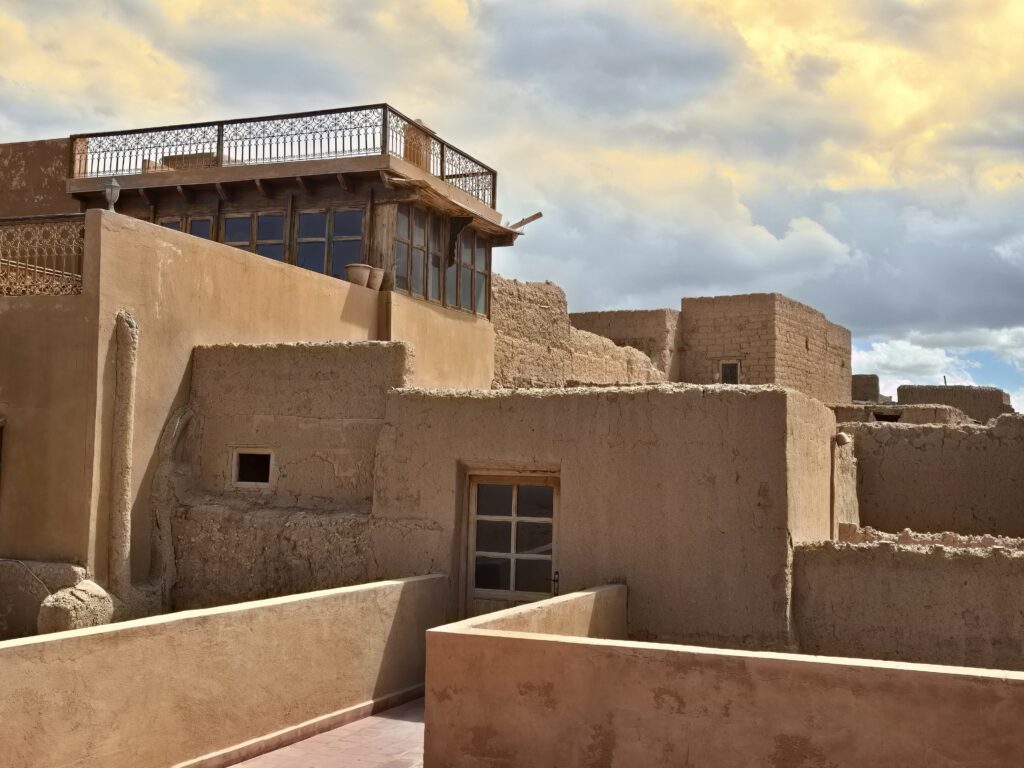
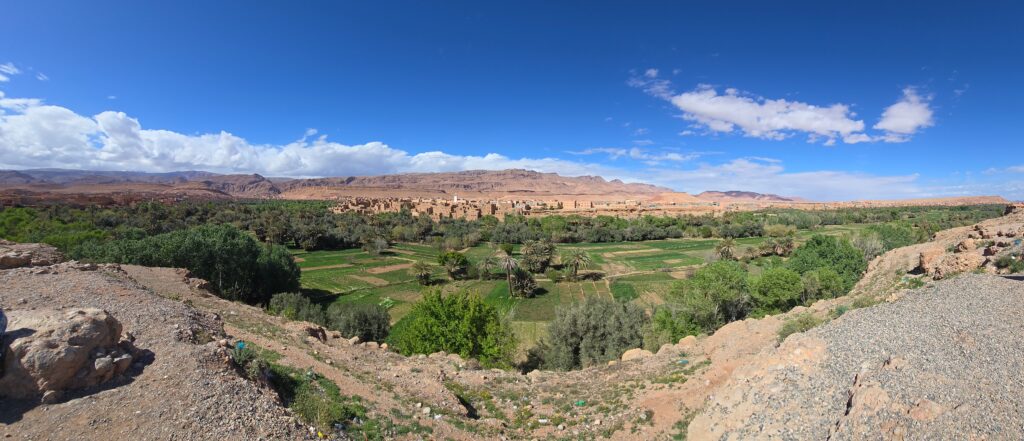
After the museum, we climbed up to a terrace for lunch, the kind of slow, unhurried meal that seems to happen naturally in Morocco. From our table, the view spilled out over the ksar and the patchwork of fields beyond, a reminder that even out here in what looks like arid country from the road, life has found its footholds. We lingered over simple, satisfying dishes—salads bright with herbs, grilled meats, fresh bread—letting the heat of the early afternoon soften the edges of the day before getting back in the car.
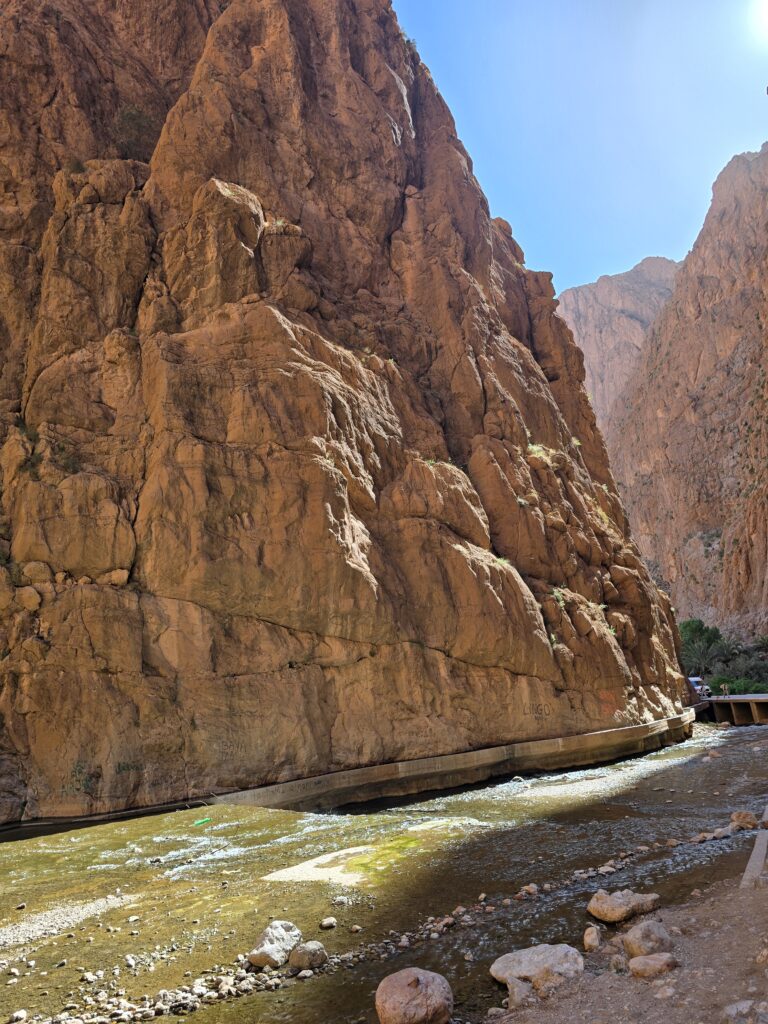
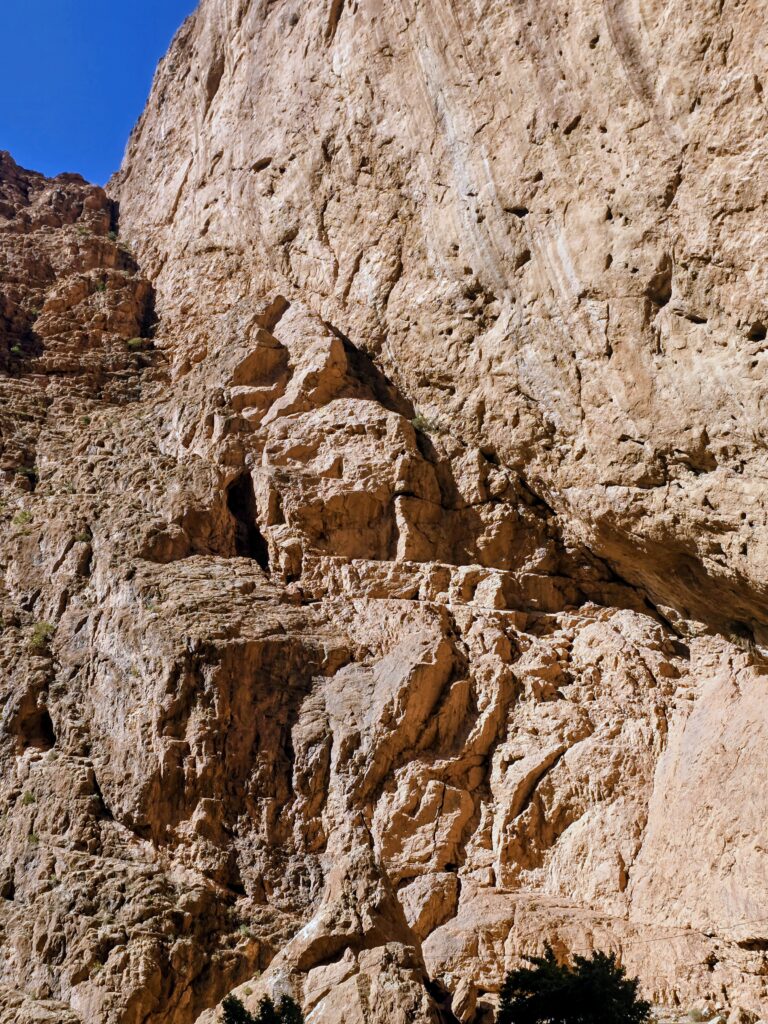
From there, the road wound into the Dades region, where we made a brief stop in a narrow canyon. Here, a ribbon of clear water runs through a cleft in the rock, its source seeming to emerge straight from the mountain itself. The walls rose steeply on either side, cool and shadowed, the air suddenly damp after so many hours of dry heat. It was a small, quiet place—locals picnicking on the rocks, children splashing at the edges—but standing there, watching water appear almost magically from stone, felt like catching a glimpse of how this entire landscape manages to sustain life.
As we continued, the landscape began to shift again, this time into the Valley of Roses. The name sounds romantic, and in late spring it earns it: fields of Damask roses, low and dense, thread their way along the valley floor. We stopped at a small cooperative to learn how those delicate flowers become the rose water and oils that show up in so many Moroccan bathrooms and beauty rituals. What could easily have been a touristy detour turned out to be something more thoughtful. The women there spoke about ethical production and fair pay, about harvest seasons and distillation methods, about resisting the pressure to over‑pick or dilute their products just to meet demand. It was a reminder that even something as seemingly frivolous as a bottle of rose water can be a lifeline for a community when it’s done right.
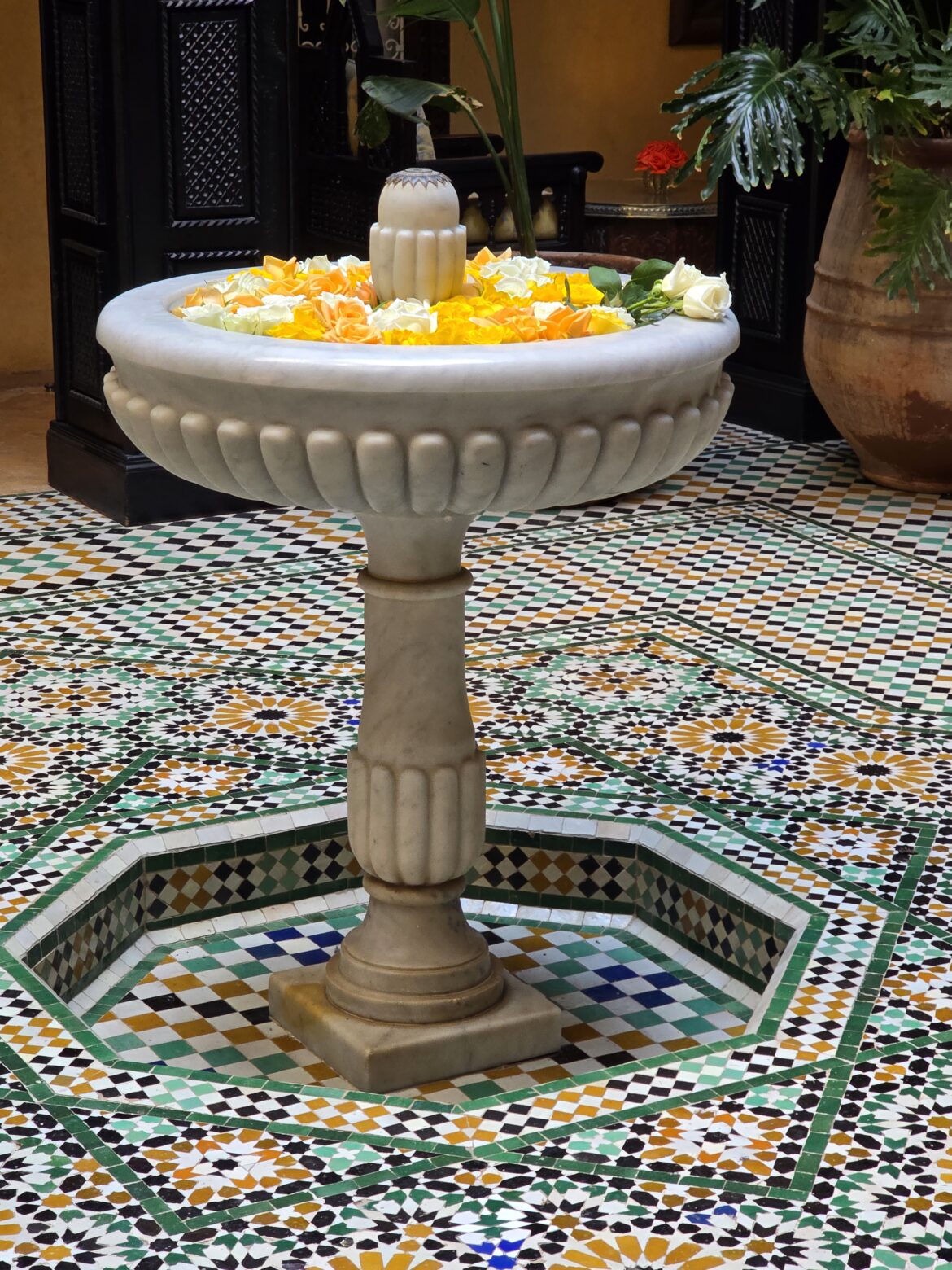
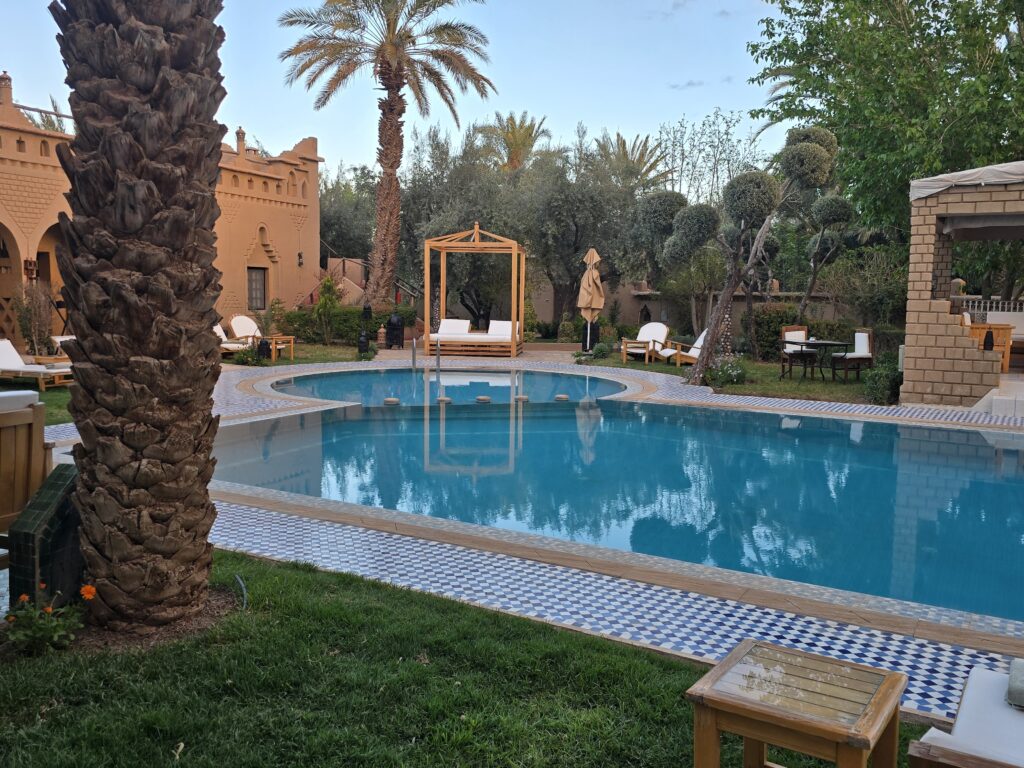
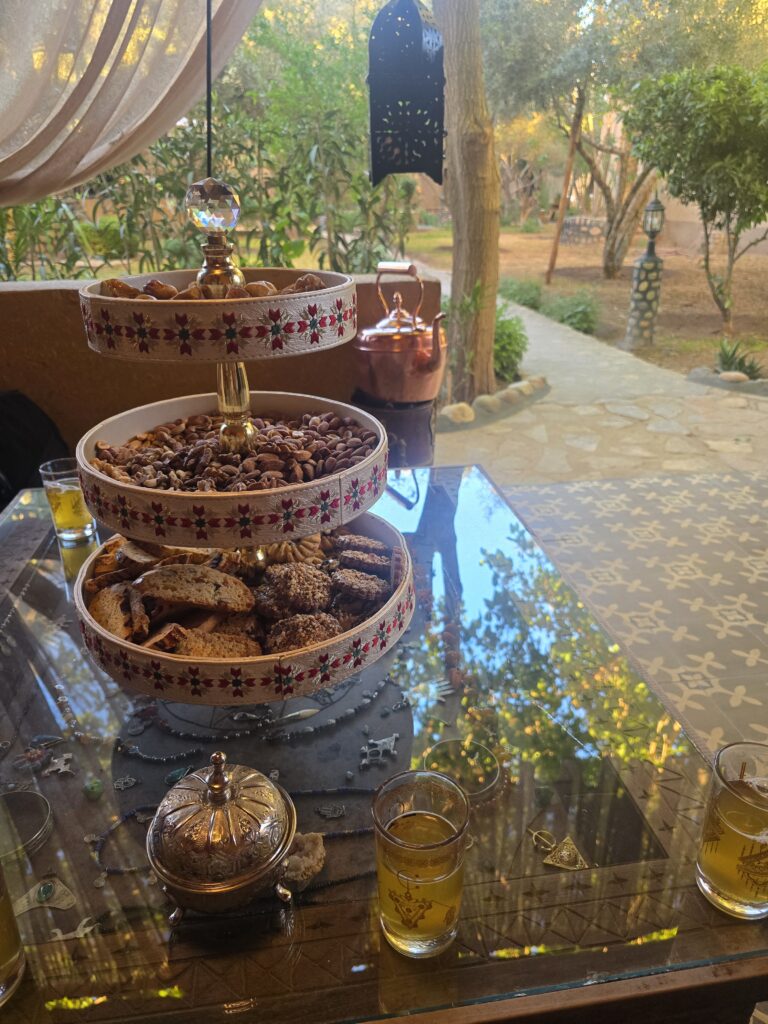
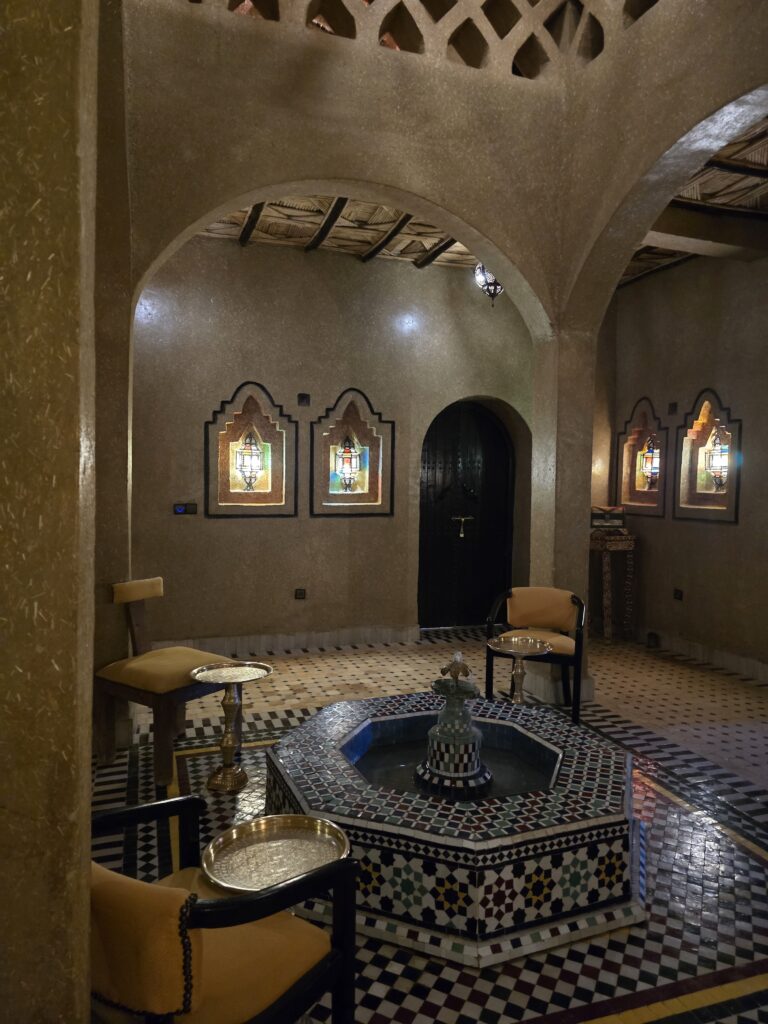
By late afternoon, the harshness of the day had softened and the light went honey‑colored. We turned off the main road toward our stop for the night: Ksar (Kasbah) El Kabbaba. Arriving there felt like stepping into a “midnight in the oasis” scene some novelist might have dreamed up—only this one came with Wi‑Fi and spa services. High walls concealed a lush courtyard, all palms and climbing vines and shaded corners. Somewhere a fountain trickled; the air itself seemed cooler, softer, perfumed faintly with blossoms and earth.
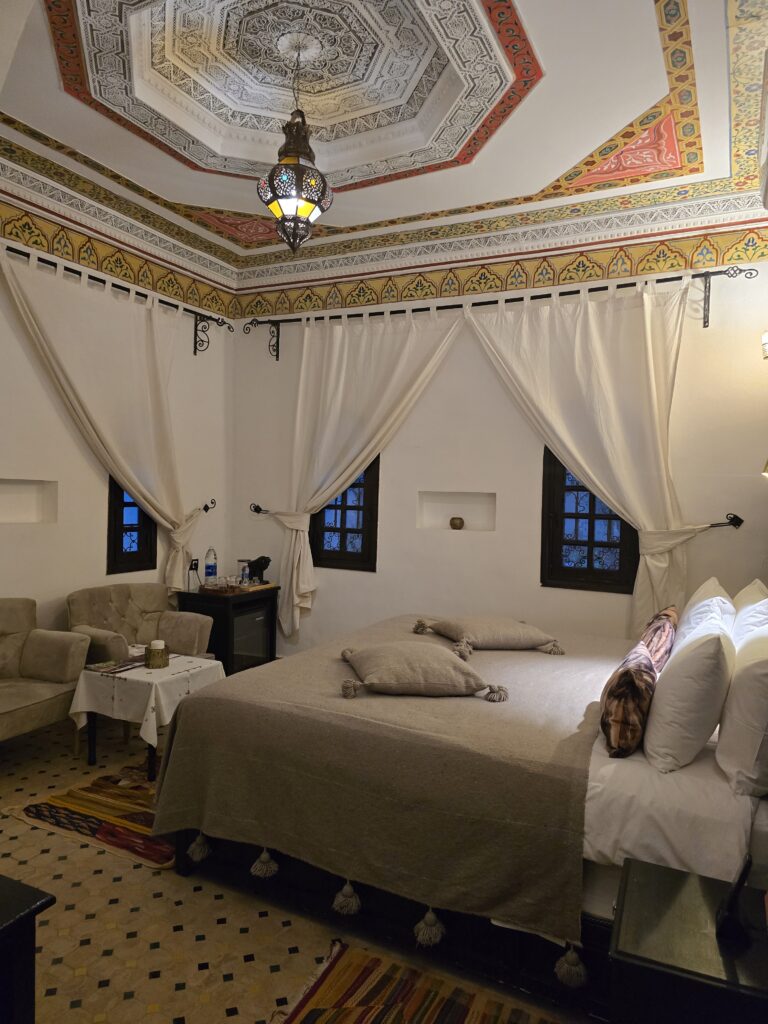
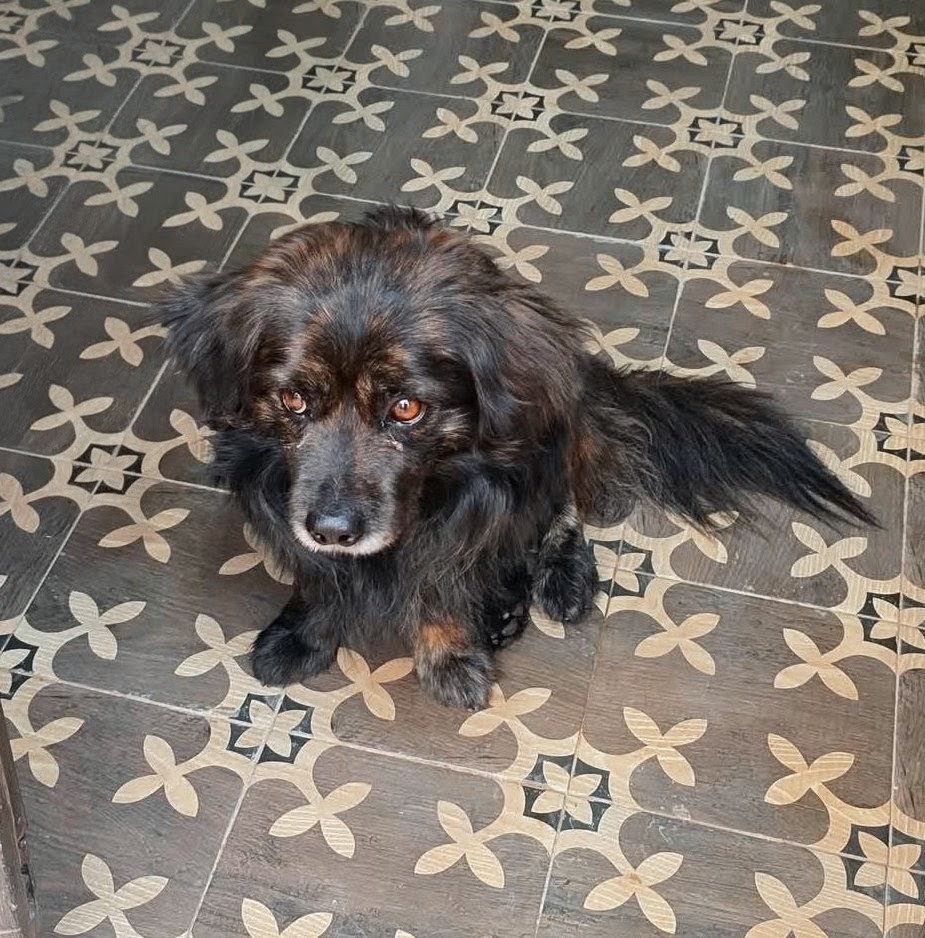
We settled into our rooms, let our shoulders drop a notch, and gave in to a bit of indulgence. There were spa treatments to unknot muscles that had been faithfully absorbing every kilometer of the road, and then, as the sky darkened, glasses of wine in the courtyard, the leaves overhead turning from green to silhouettes. At some point we were introduced to Oreo, the kasbah’s resident dog and unofficial welcoming committee, who clearly considered the gardens his personal kingdom and accepted our attention like a benevolent ruler.
Dinner was late by our usual standards but perfectly timed for this particular place. We sat down to Cornish hen, roasted and seasoned in that distinctly Moroccan way that’s both comforting and just a little exotic to our palates, accompanied by a spread of elevated sides—vegetables and grains that took familiar ingredients and turned them into something quietly memorable. It was the kind of meal that doesn’t shout for attention but stays with you anyway.
As we finally headed to bed, the kasbah hushed around us, its thick walls holding in the cool of the night. The desert dunes felt far away, Marrakech still somewhere ahead on the road, and we were suspended for a moment in between—in an oasis of roses, palm trees, and one very content dog named Oreo.
From Kasbahs to the Red City: High Atlas Crossing and Arrival in Marrakech
The next morning came too quickly, but it was time to trade our oasis for the road again and continue on toward Marrakech. What sounded, on paper, like a straightforward transfer day turned out to be anything but. Morocco had a few more surprises queued up for us in the form of movie sets, mud‑brick fortresses, and yet another reminder of how often this landscape doubles as somewhere else entirely.
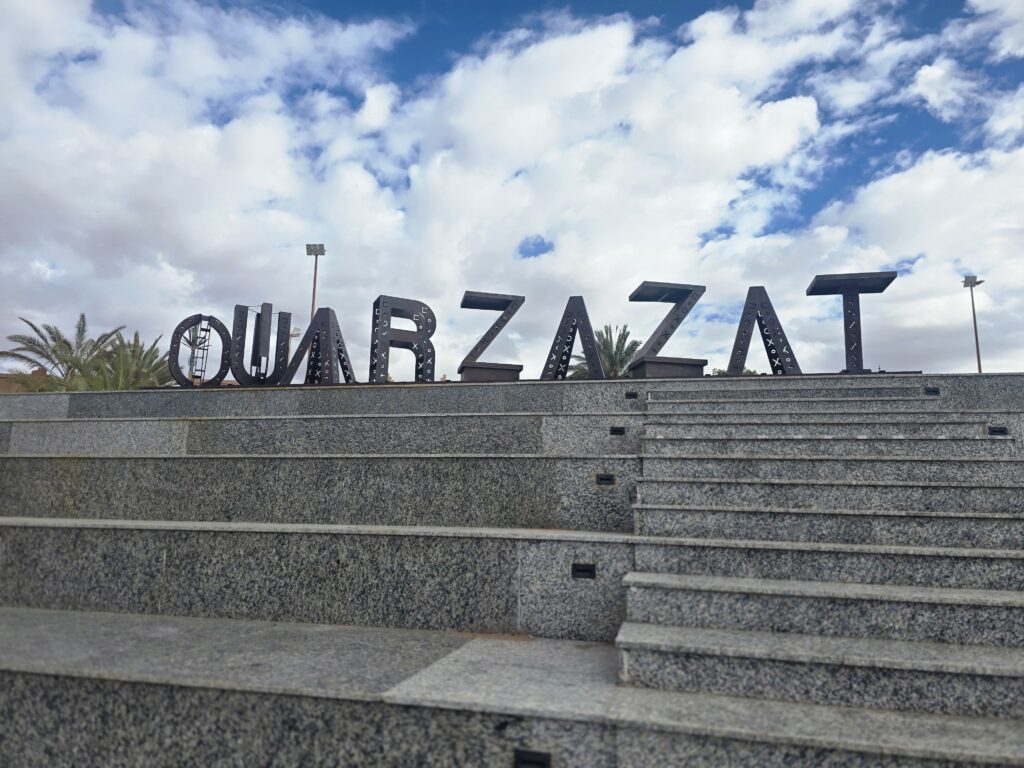
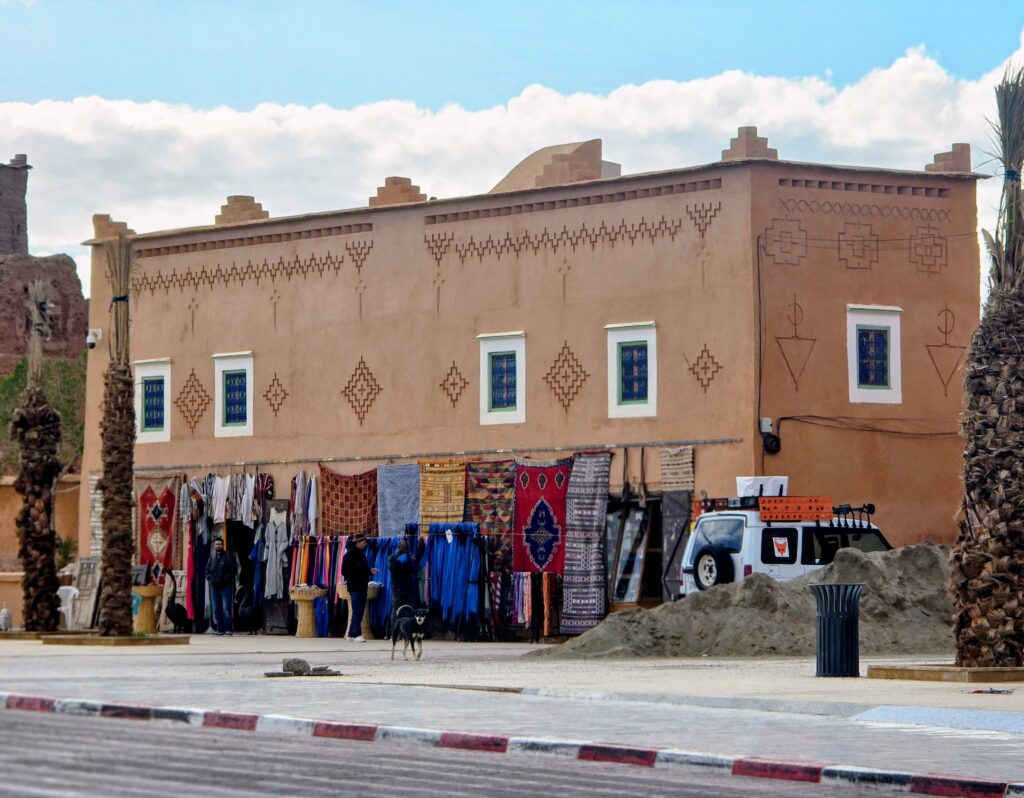
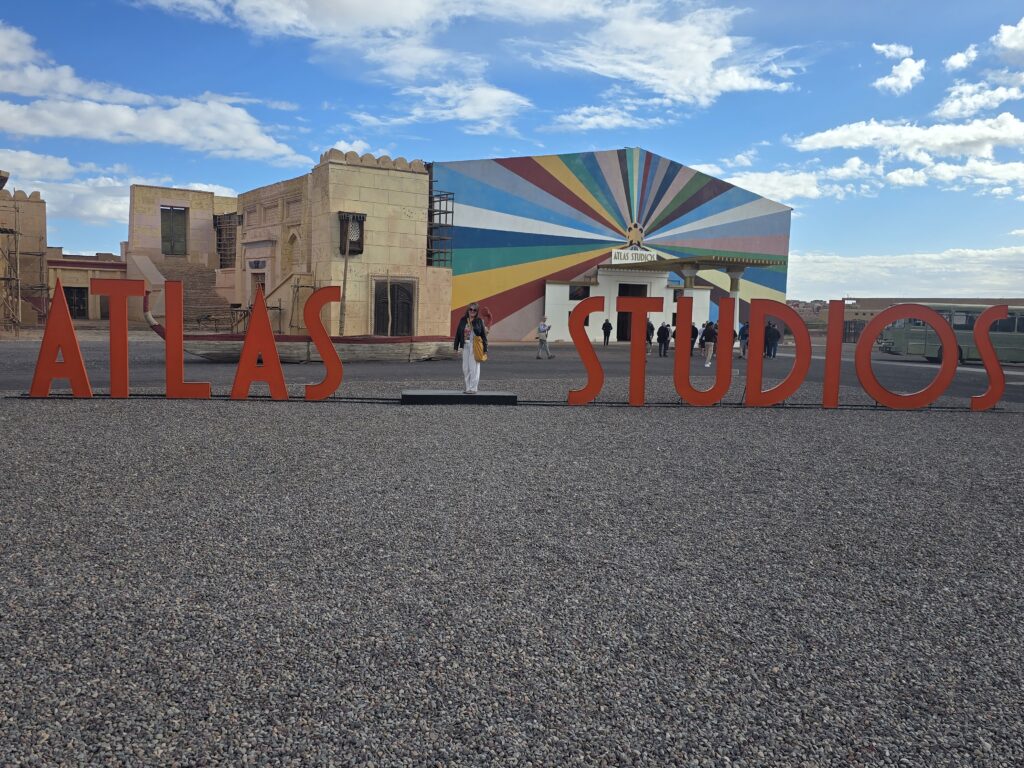
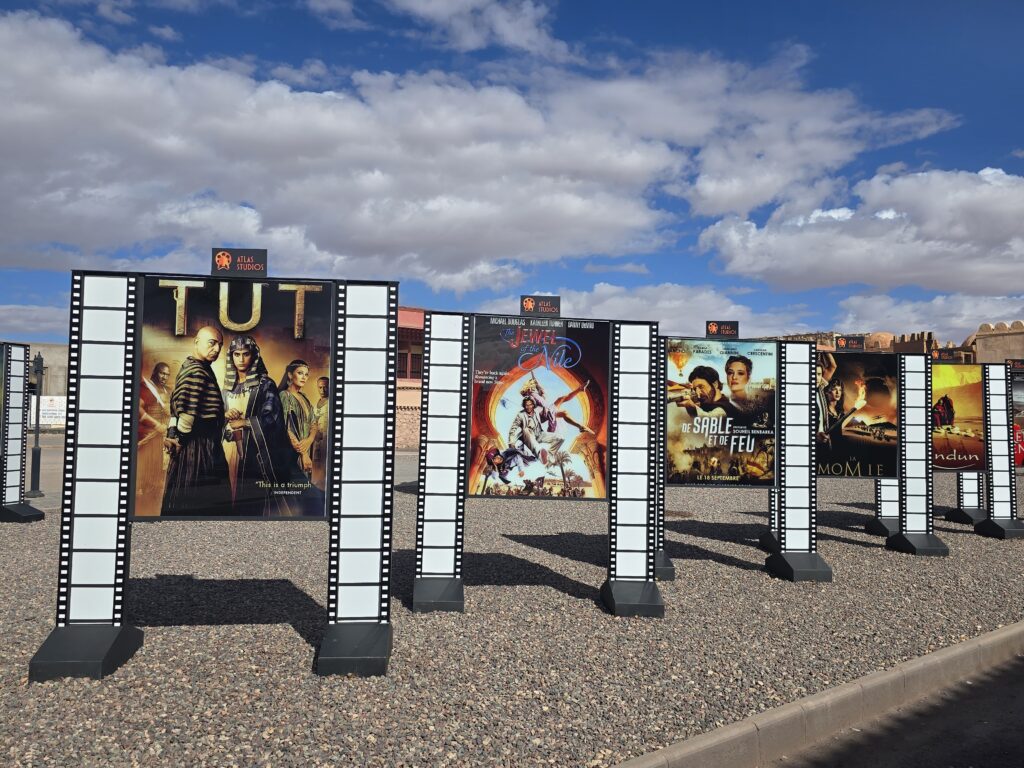
Our first major stop was Ouarzazate, often called the “Hollywood of Africa.” On the outskirts of town sits Atlas Studios, where entire worlds have been built and dismantled in service of film and television. Walking through its sun‑baked backlots felt like flipping channels in real time: one minute we were in an ancient city, the next in a fantasy realm or a biblical epic. Facades that had looked convincing enough on screen revealed themselves up close to be clever illusions—wood, plaster, and paint standing in for stone and history. It was oddly thrilling to realize how many scenes we recognized without quite being able to place them, all stitched together here in the middle of Morocco.
Back on the road, we made a brief vista stop to glimpse Ait Benhaddou from a distance, its iconic kasbah rising in tiers above the valley like something conjured by a storyteller. Even from afar it was clear why filmmakers love it: the way the light hits the mud‑brick walls, the contrast between the fortified village and the ribbon of green below, the sense that time moves differently there.
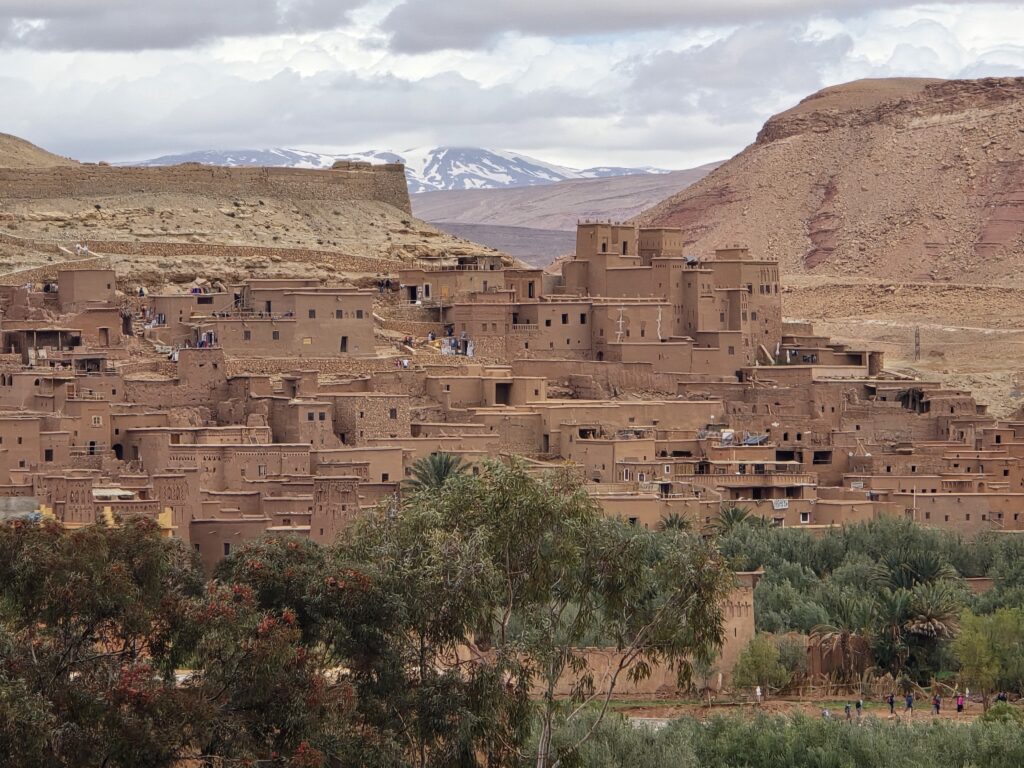
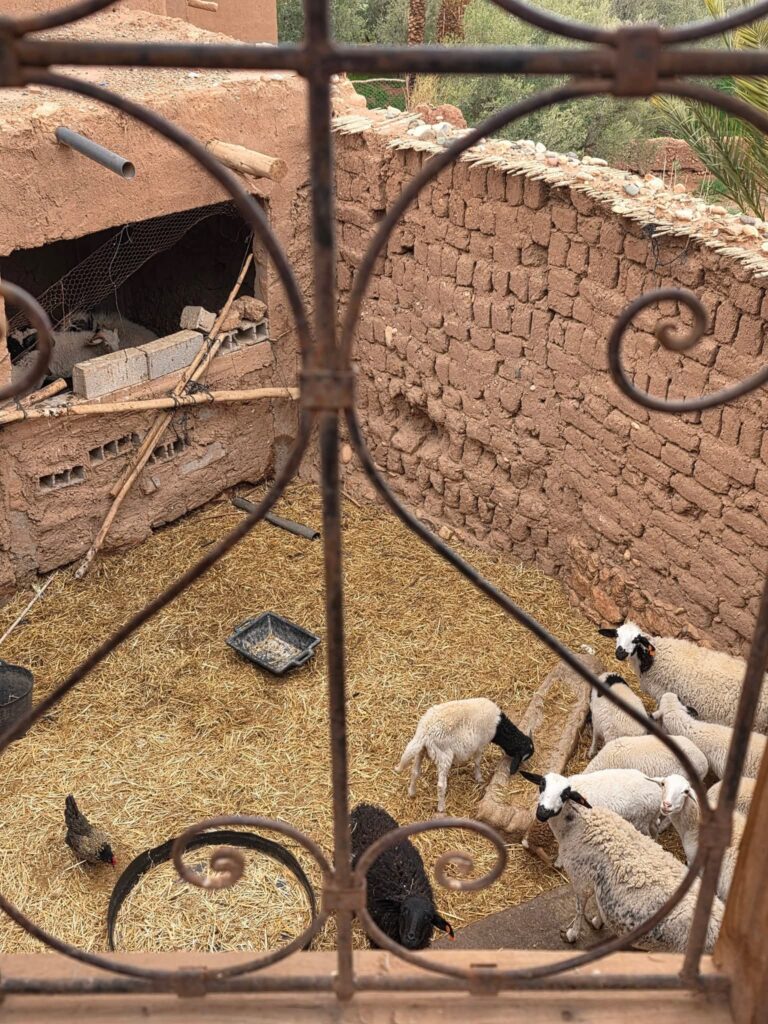
A short drive later, we were at the base of it ourselves, meeting up with another private guide who would walk us into the small valley and across an impromptu bridge—simple planks laid over the shallow water—to reach the ksar. Inside, the maze of alleys and passageways opened gradually, revealing low doorways, inner courtyards, and terraces that had sheltered generations. As we climbed, our guide explained what kasbah life used to look like: extended families living behind thick earthen walls, crops stored above, animals below, everything designed for defense and self‑sufficiency.
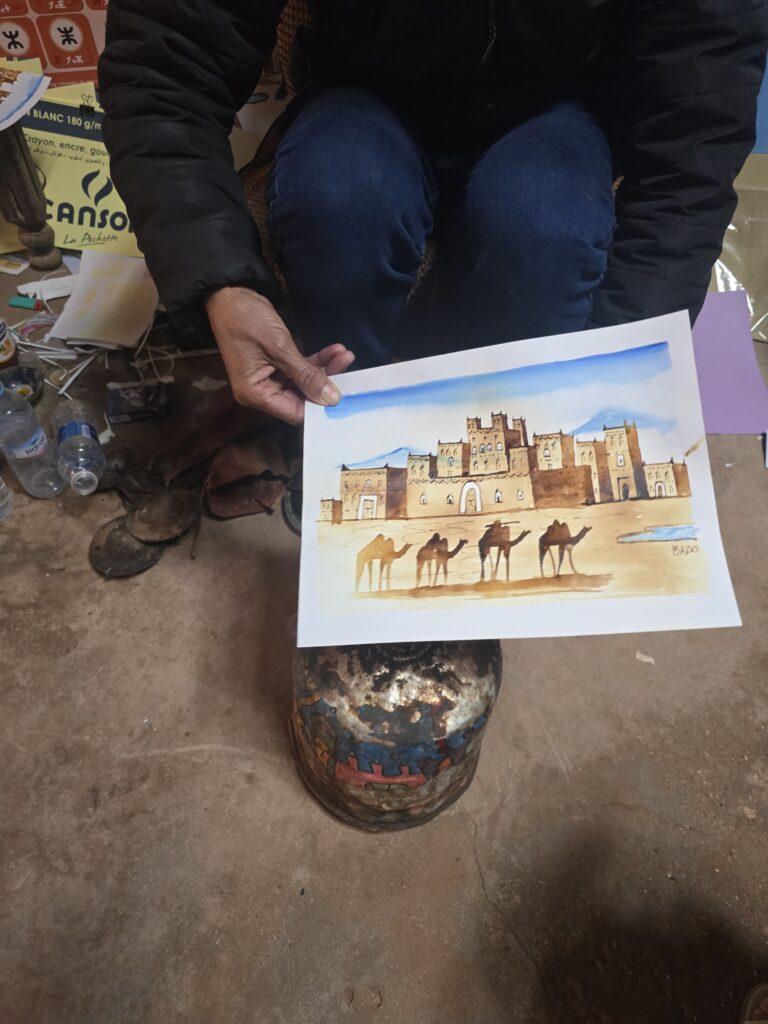
Along the way, we ducked into a modest workshop where we were introduced to a traditional “secret message” painting technique: scenes rendered in what appeared to be simple brown ink, their hidden colors only revealed when heat is applied.
The higher we climbed, the wider the view became. At the summit, the kasbah fell away beneath us and the horizon stretched out in every direction: desert, river, and small settlements stitched together under an enormous sky. Standing there, it was easy to understand why Ait Benhaddou has become a cinematic favorite, a backdrop for everything from Gladiator to Game of Thrones. Our guide pointed out specific spots—“That was a marketplace,” “That gate was a city entrance”—as if pulling still frames from memory. Enthusiastically, he mentioned that he’d been an extra in more than a dozen films shot there, his own life woven into the on‑screen stories that had brought so many visitors to this remote corner of Morocco.
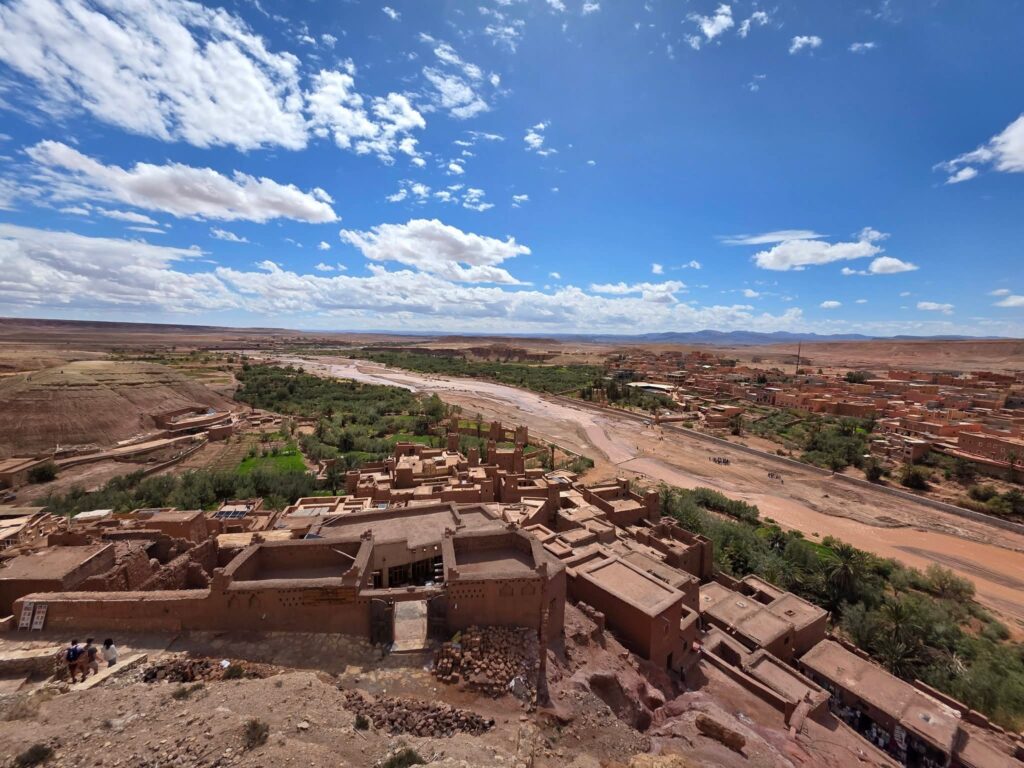
We left Ait Benhaddou with the sun beginning its slow descent and turned our attention to the last major barrier between us and Marrakech: the High Atlas. The road began to climb and coil, trading broad valleys for tight switchbacks and ever‑shifting views. This was the kind of drive that makes you grateful for both a good driver and Soufiane was the best.
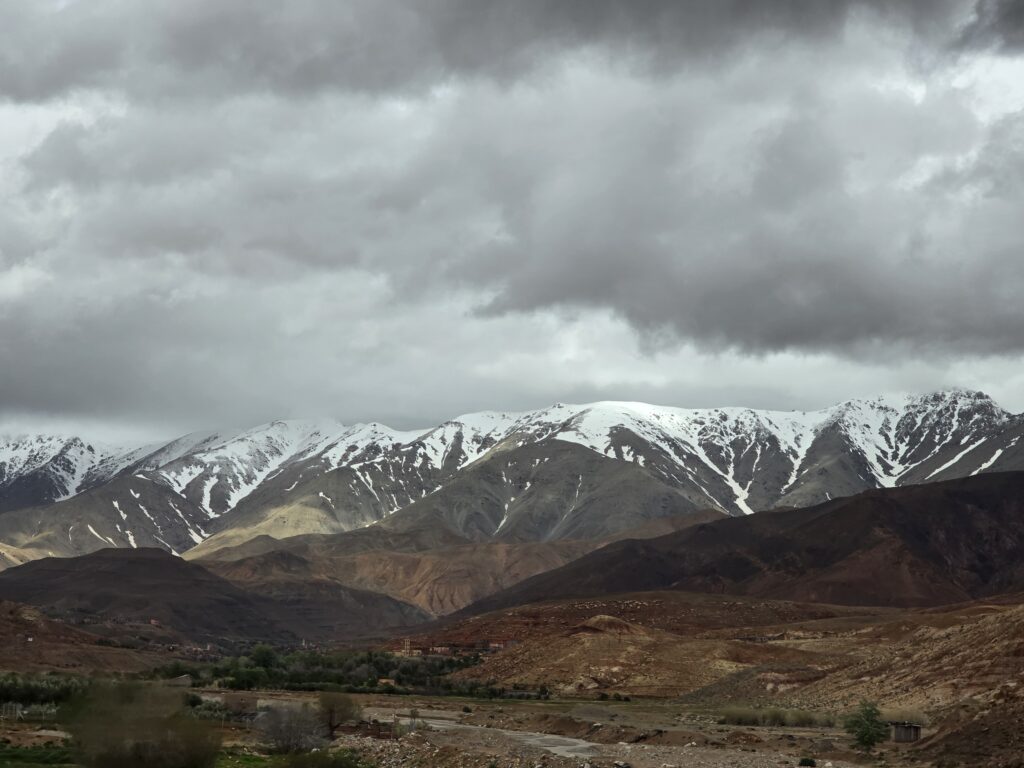
Eventually the road began to unspool again, descending in long, looping curves. Somewhere on that final stretch, the landscape shifted one more time, the mountains easing back and the world flattening out just enough to hint at a city ahead. Our driver pointed toward a faint, spreading smudge on the horizon: Marrakech.
Catching those first glimpses felt a little like seeing the next chapter of a book you’re not allowed to read yet. After days of dunes, canyons, roses, and kasbah walls, the idea of five nights in a city—this city—suddenly felt both exciting and slightly overwhelming. We rolled into Marrakech as the light softened, minarets and palm trees beginning to silhouette against the sky, the hum of traffic and life rising to meet us.
This is where we would settle in for nearly a week, using the city as our base to explore its medina, gardens, palaces, and food scene—and to slip away for a windswept day trip to Essaouira on the Atlantic coast. If the road from the Sahara had been about movement and contrast, Marrakech would be about immersion.
Marrakech Day 1: Riad Nashira, Bacha Coffee, Souks, and Majorelle Garden
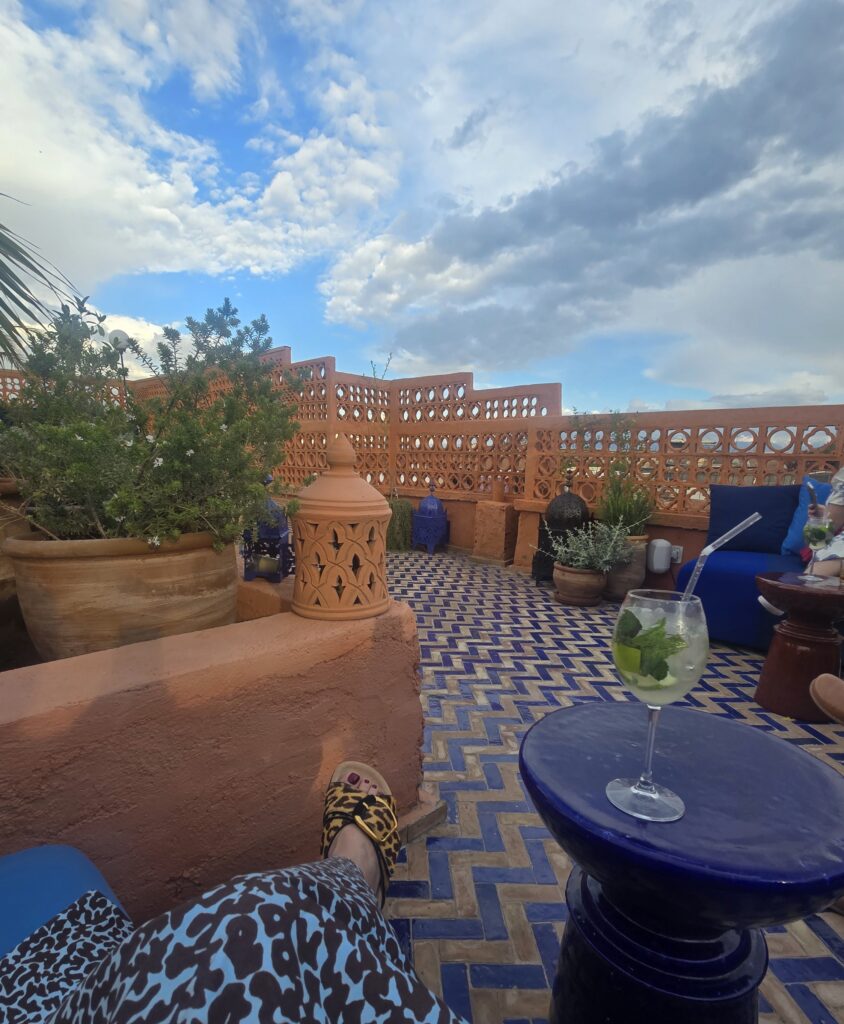
Tucked deep in an almost hidden alley, Riad Nashira didn’t immediately announce itself as anything special. One moment we were navigating narrow lanes and dodging scooters; the next, a door opened and we stepped into a completely different world. Inside was a calm, elegant courtyard where tea and pastries appeared as if by magic, a softly lit restaurant, a cozy bar with a fireplace, a small pool, spa, and a gorgeous rooftop with bar, dining area, and hot tub. It was the perfect staging area for the days ahead—a serene, architectural exhale in contrast to the bright, buzzing chaos that awaited us outside.
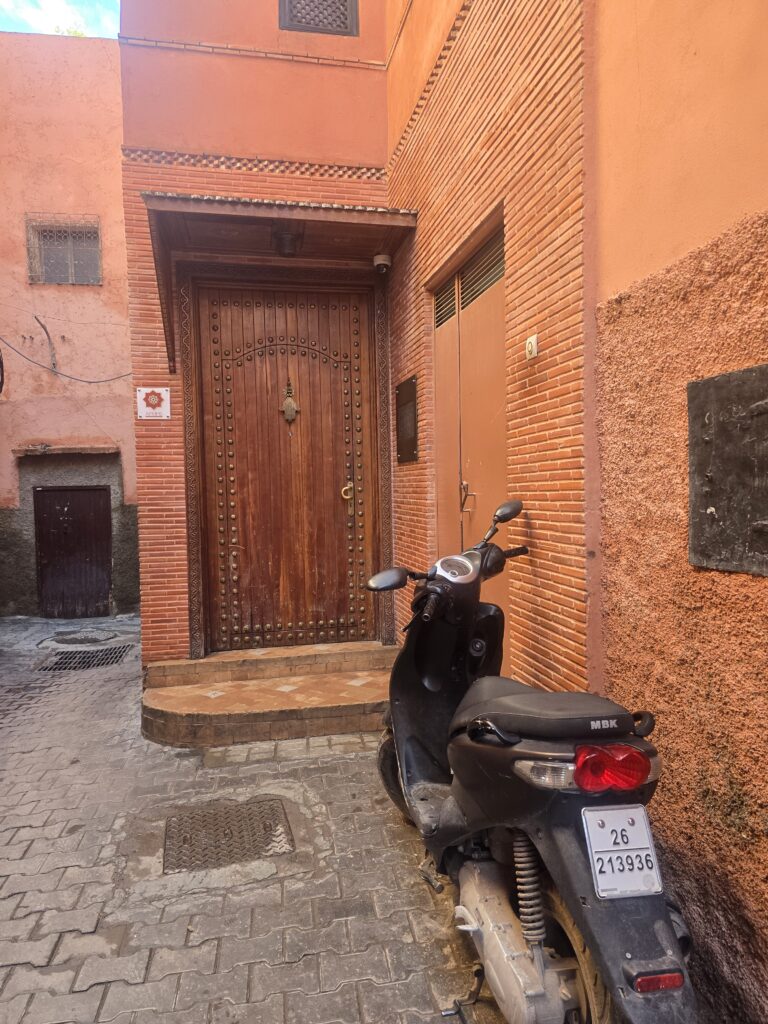
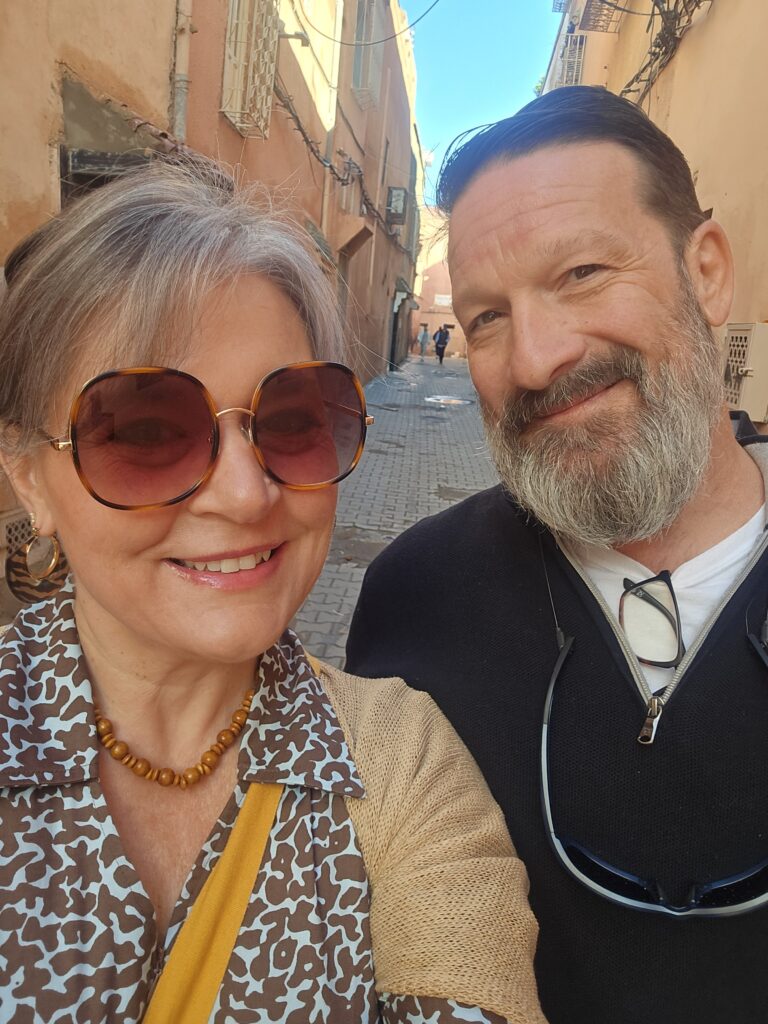
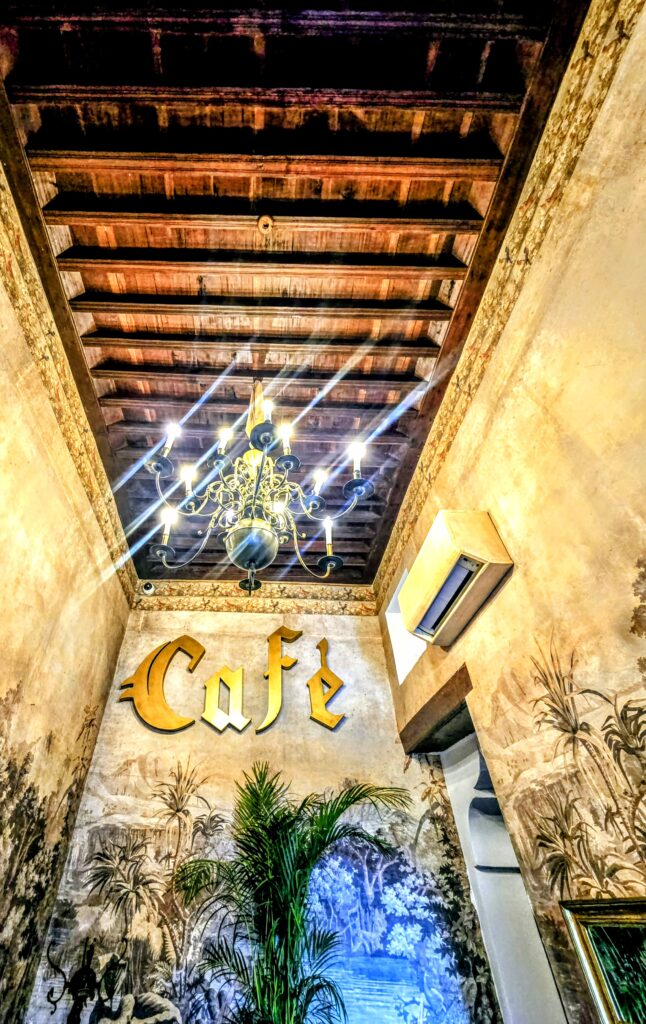
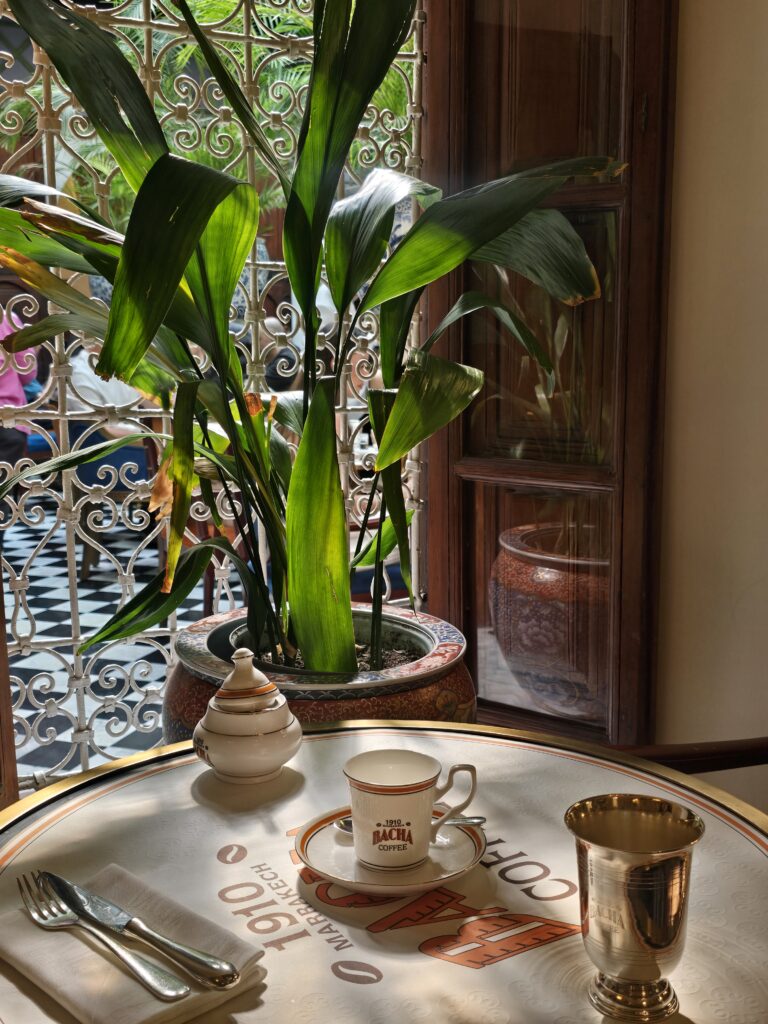
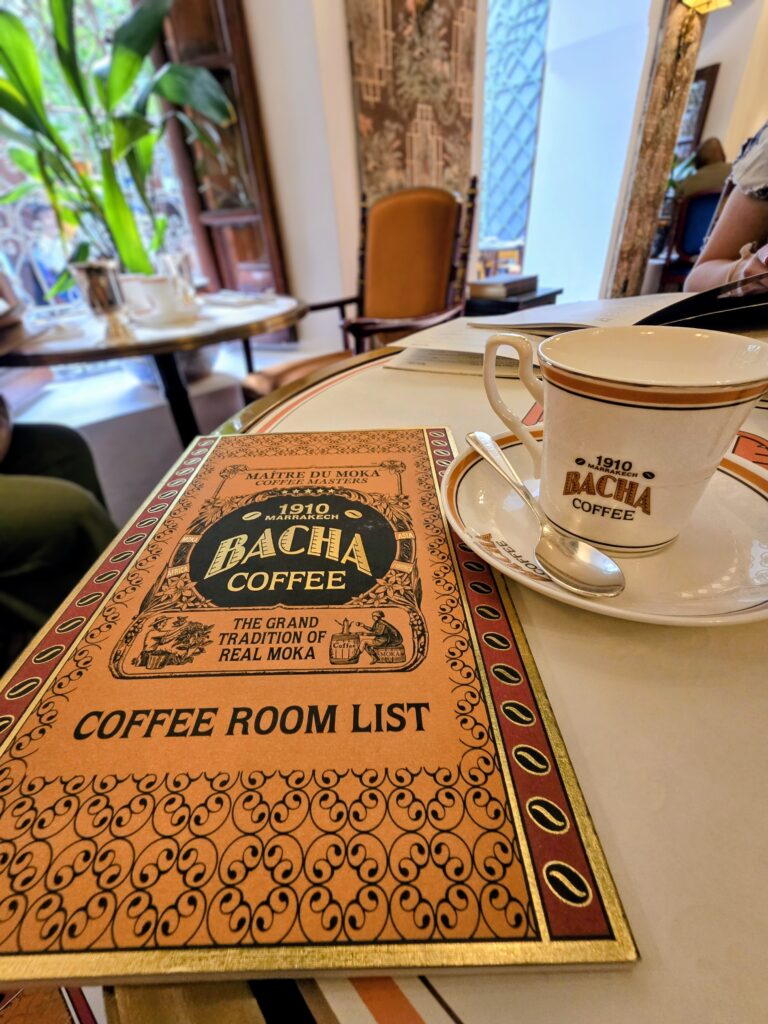
On our first morning in Marrakech, Soufiane had the Mercedes waiting at the most vehicle‑accessible point near the riad, and within minutes we were linked up with our private guide for the day. He started our medina tour with a bang, steering us straight to Dar El Bacha. Instead of heading directly into the museum galleries, he made a beeline for Bacha Coffee, slipping in early to beat the crowds and put our names down. We knew of Bacha Coffee from social media, but seeing it in person—the polished wood, the gleaming coffee canisters, the sense of occasion—still felt like a surprise.
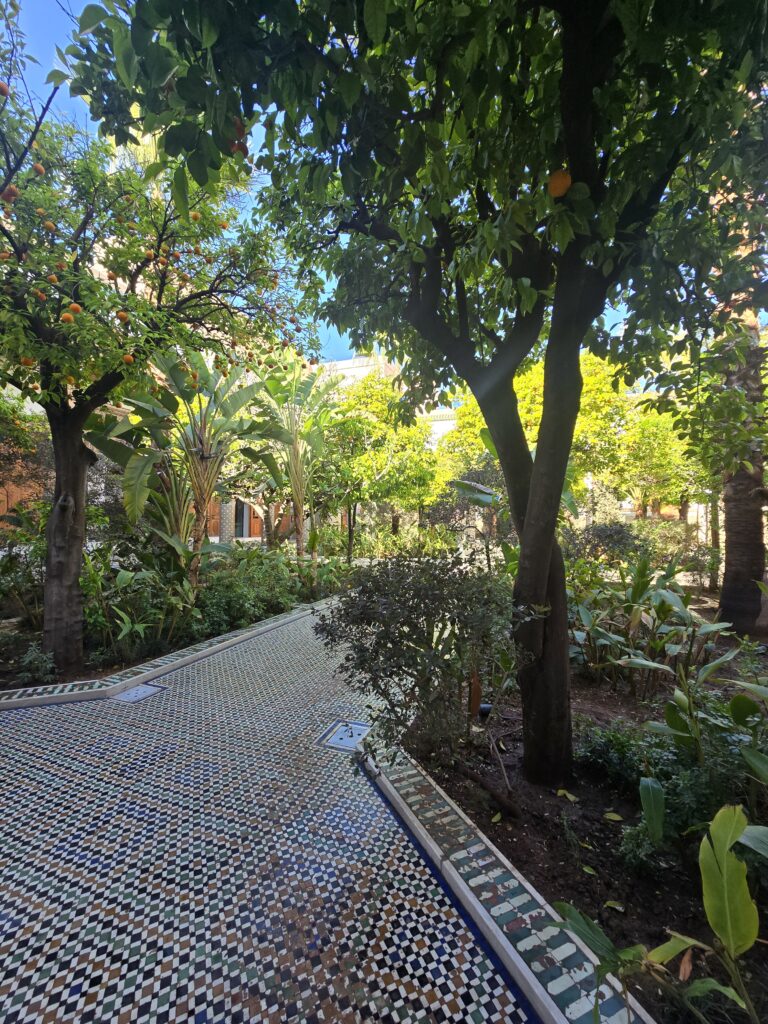
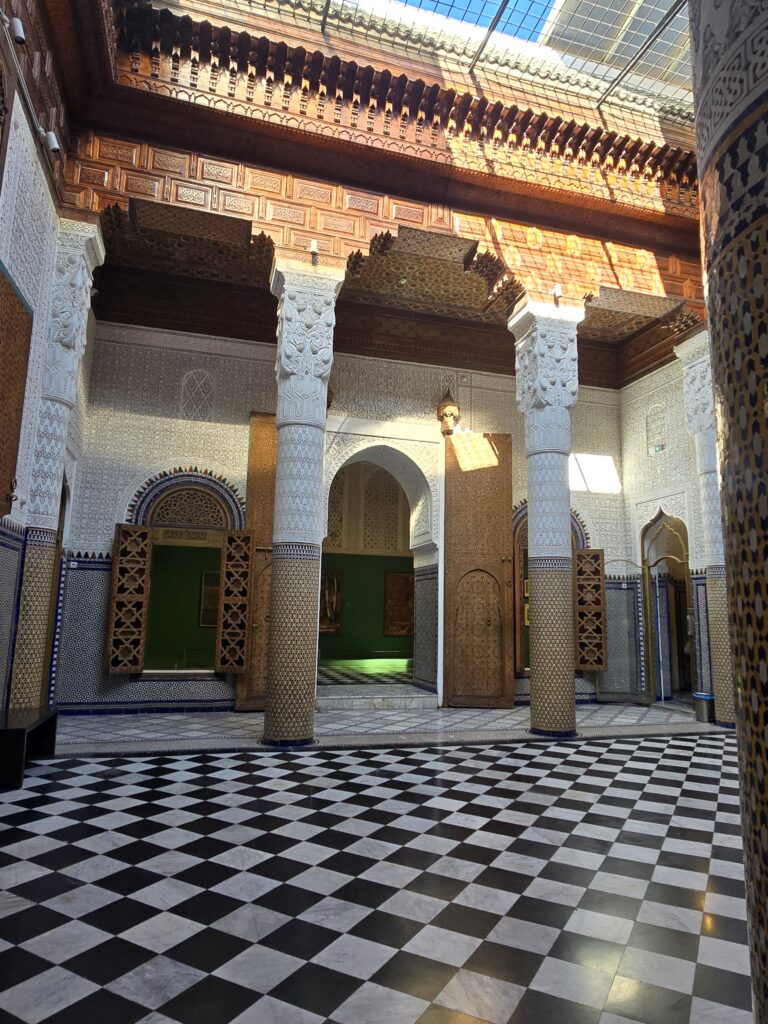
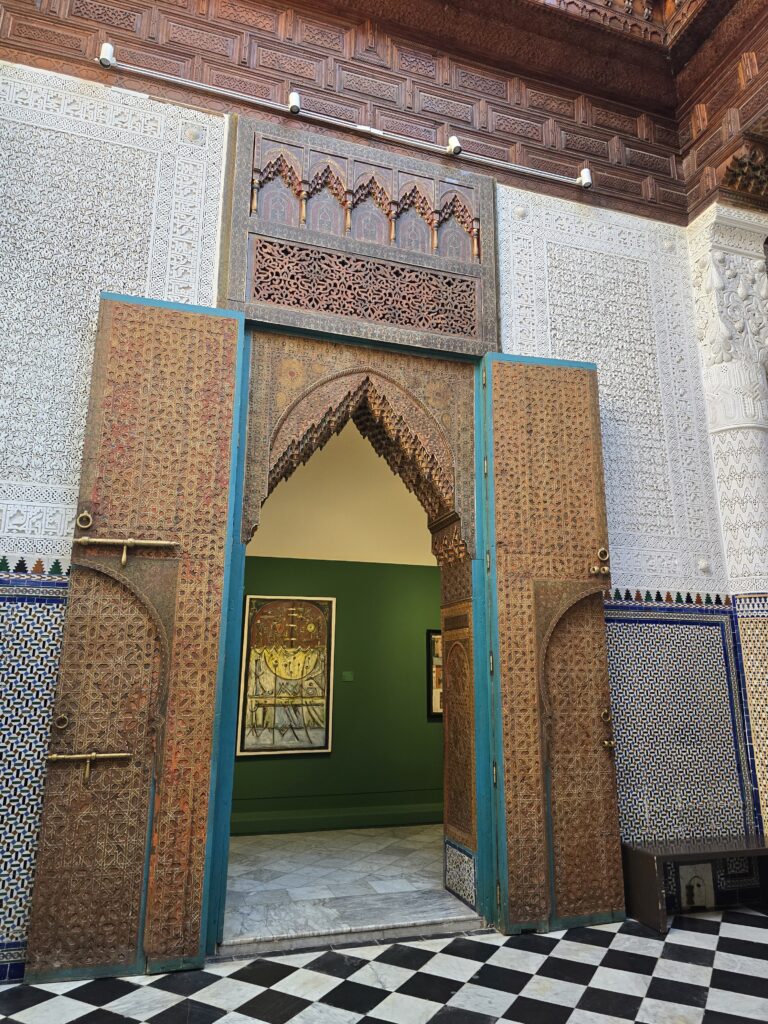
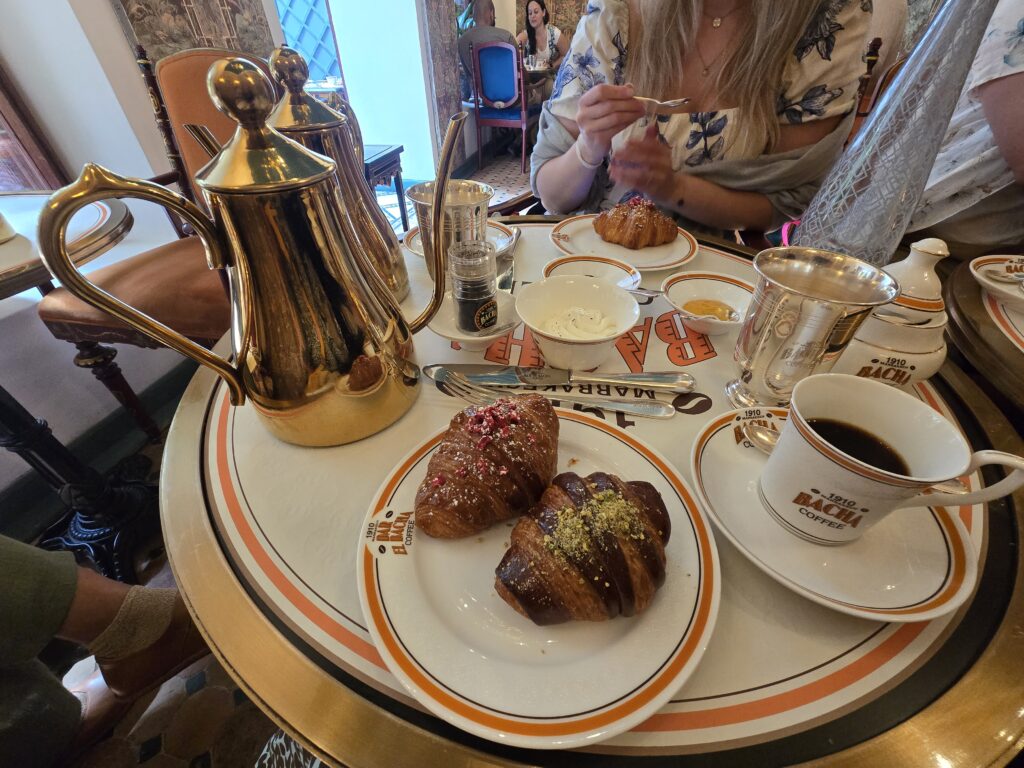
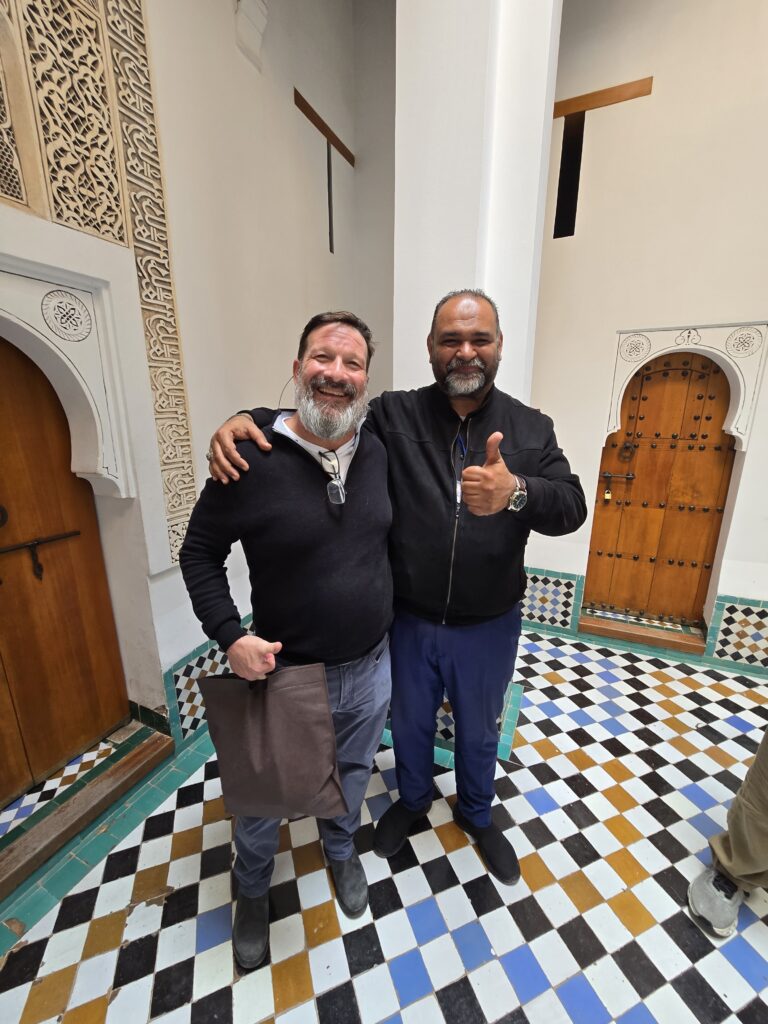
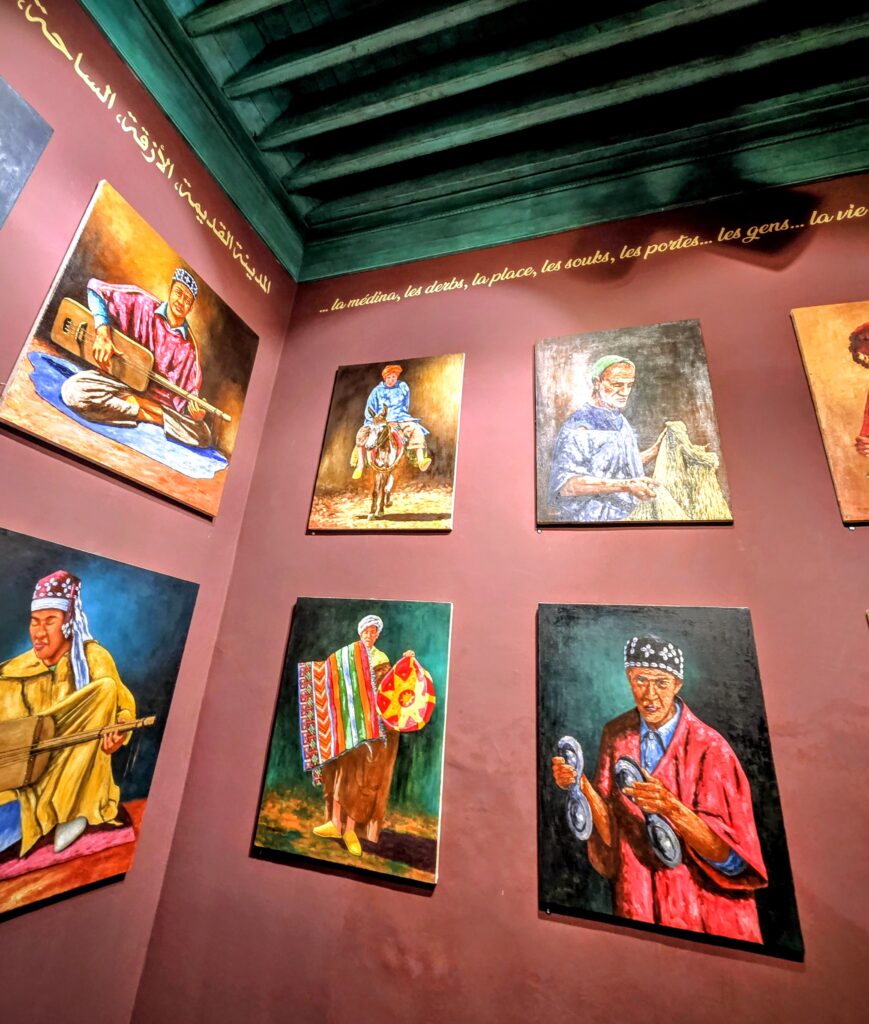
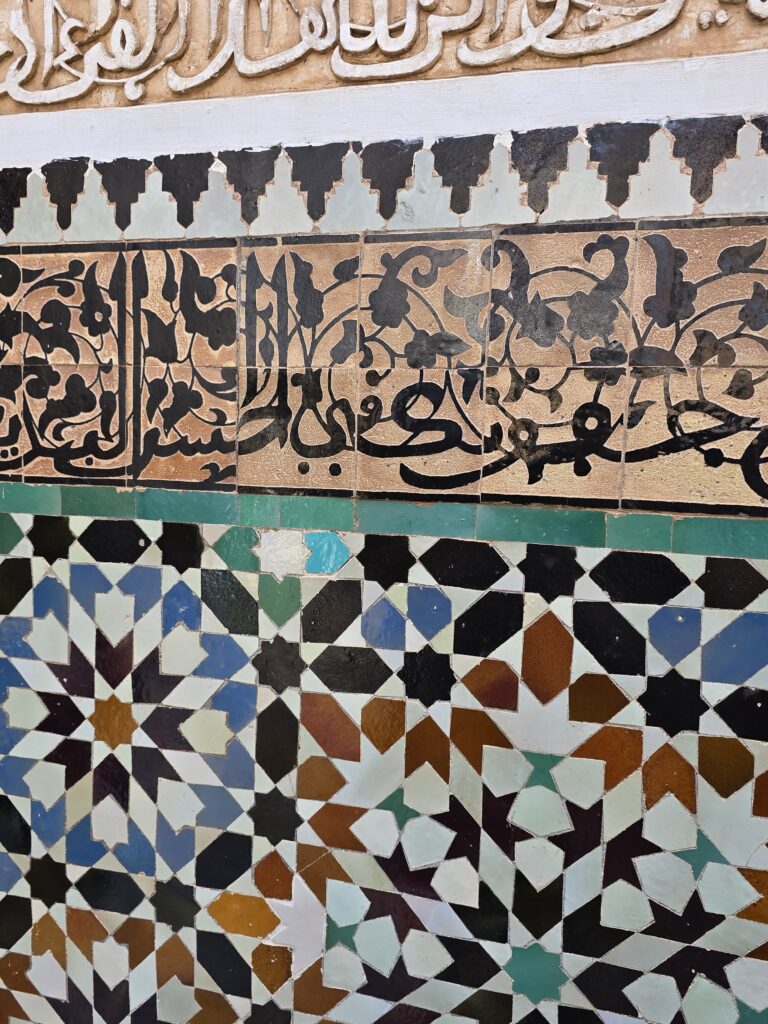
With our buzzer in hand, we left the line behind and began exploring Dar El Bacha itself. The museum unfolded in a series of tiled courtyards and rooms, each one layered with pattern and color: carved cedar ceilings, intricate zellige, sunlit spaces that made even the shadows feel decorative. By the time our table was ready and we circled back for coffee, it felt like we’d already been given a primer in Marrakech’s particular brand of beauty. Each of us chose a different coffee from the extensive menu, and we lingered over our individual pots, sipping slowly while sharing pistachio and rose‑cardamom croissants that tasted every bit as decadent as they sound.
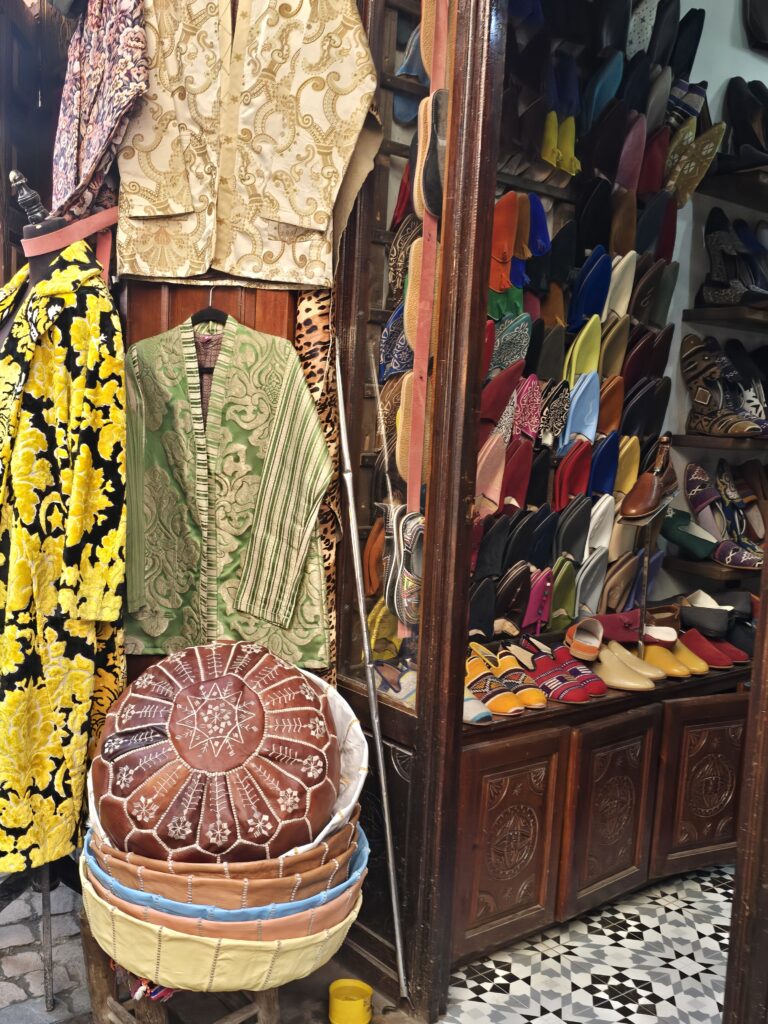
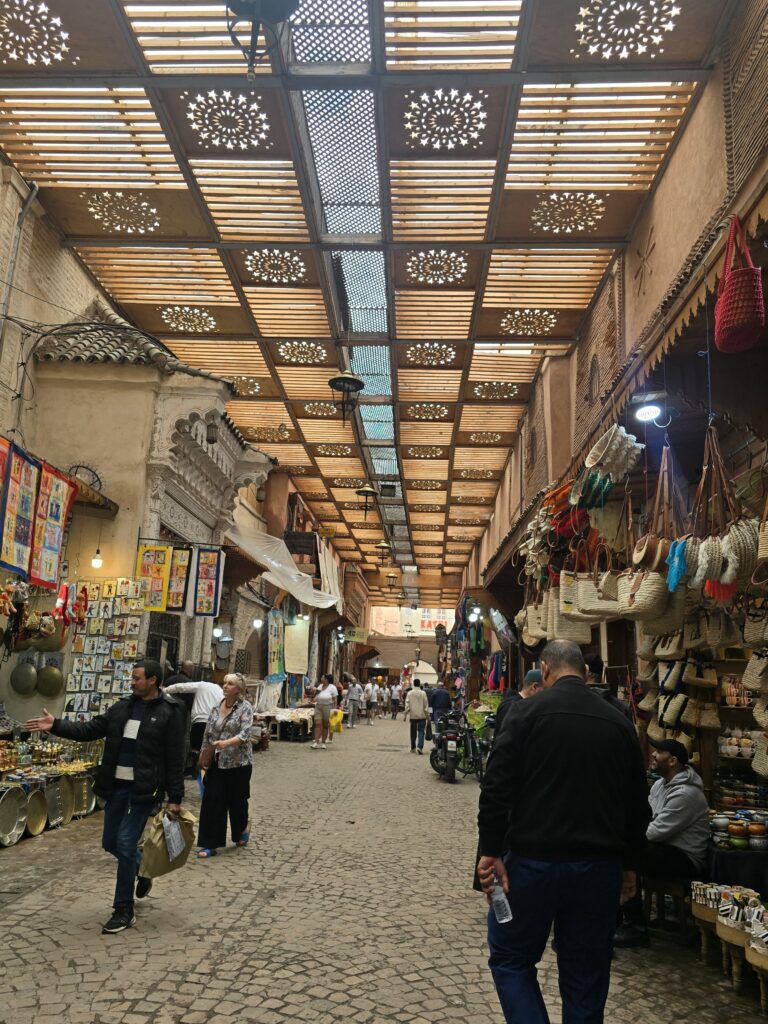
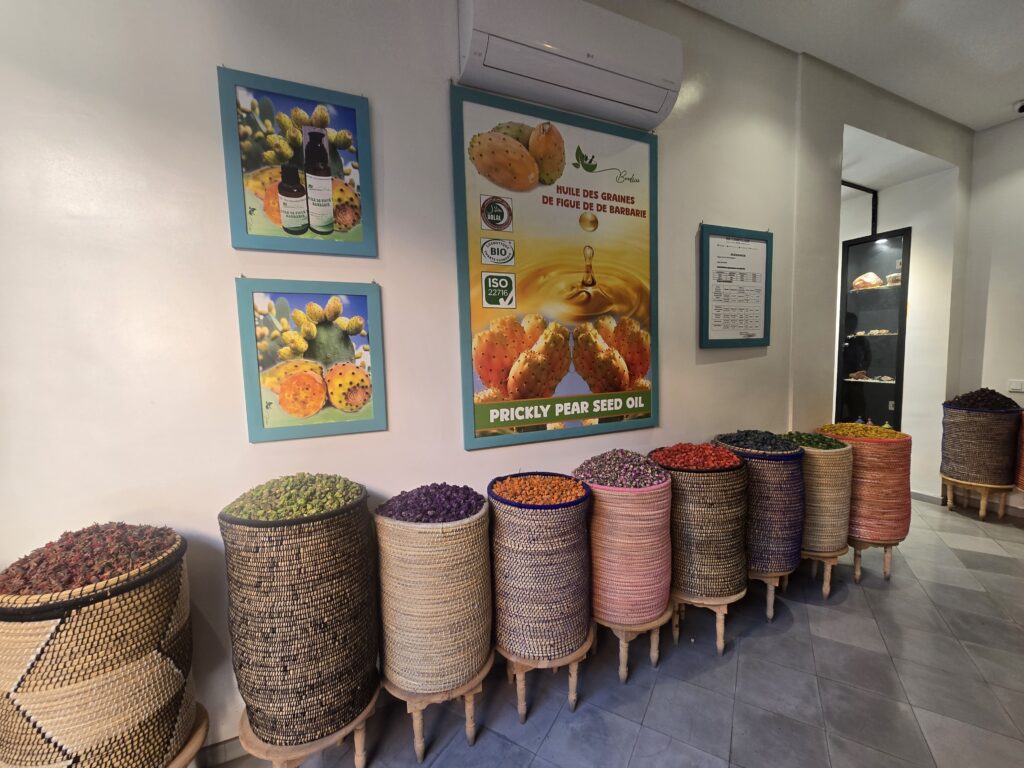
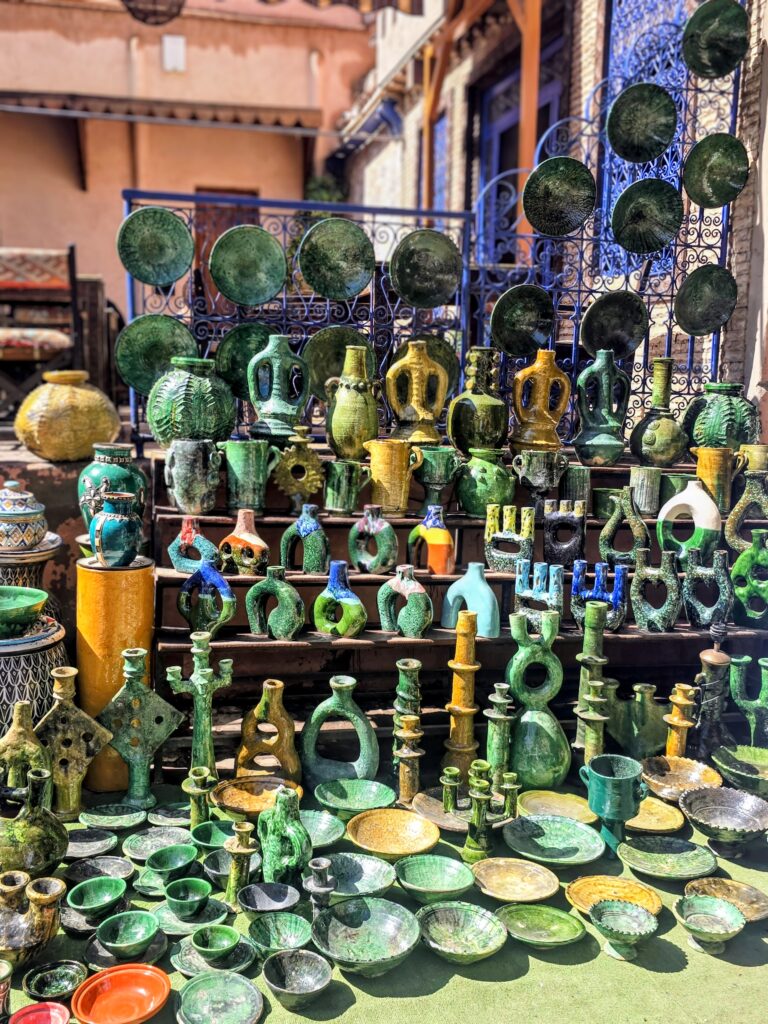
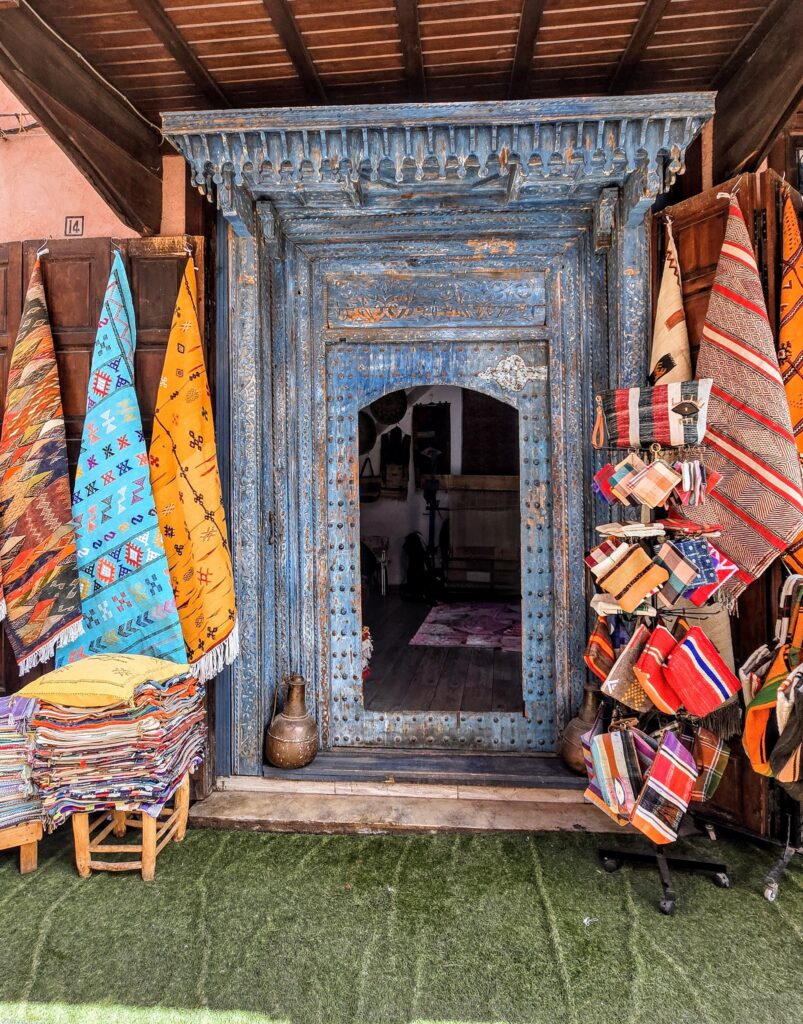
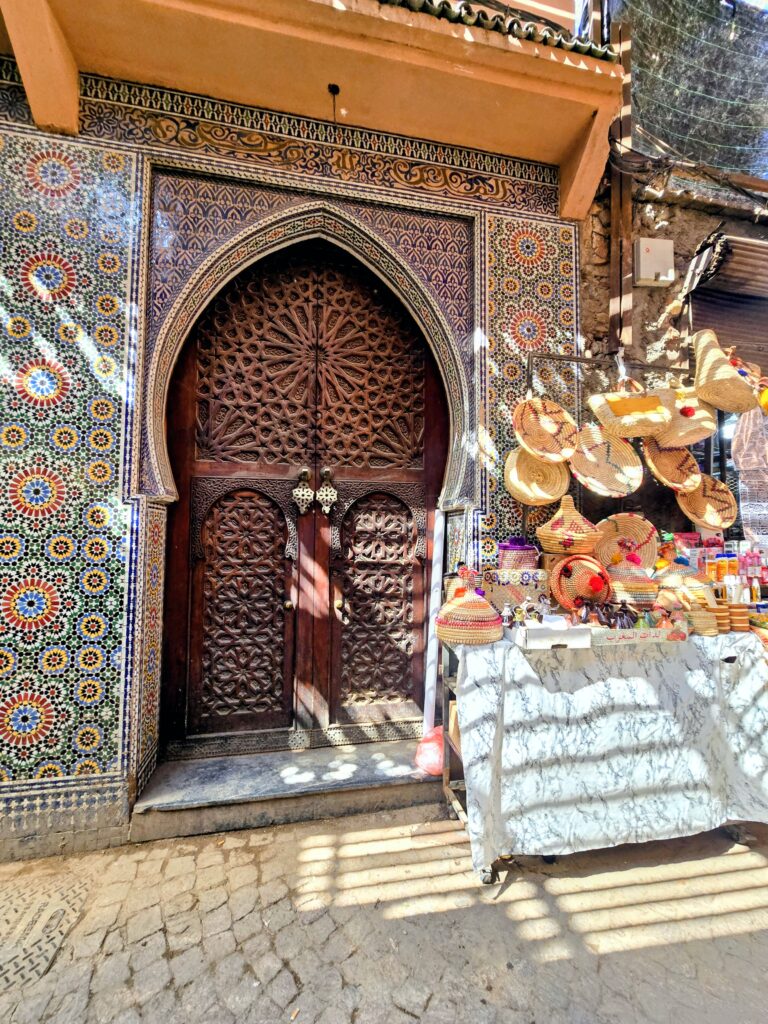
From there, we slipped into the souks. Our guide led us through a warren of alleys and covered passages, past stalls piled high with everything from brass lanterns to leather slippers. We stopped often: to gasp over displays of deep green pottery, to learn about herbs, spices, and natural remedies in an old‑fashioned apothecary, to watch artisans at work in tiny, overcrowded workshops. It was sensory overload in the best way—the smell of cumin and orange blossom, the clanging of metal, the flash of color at every turn.
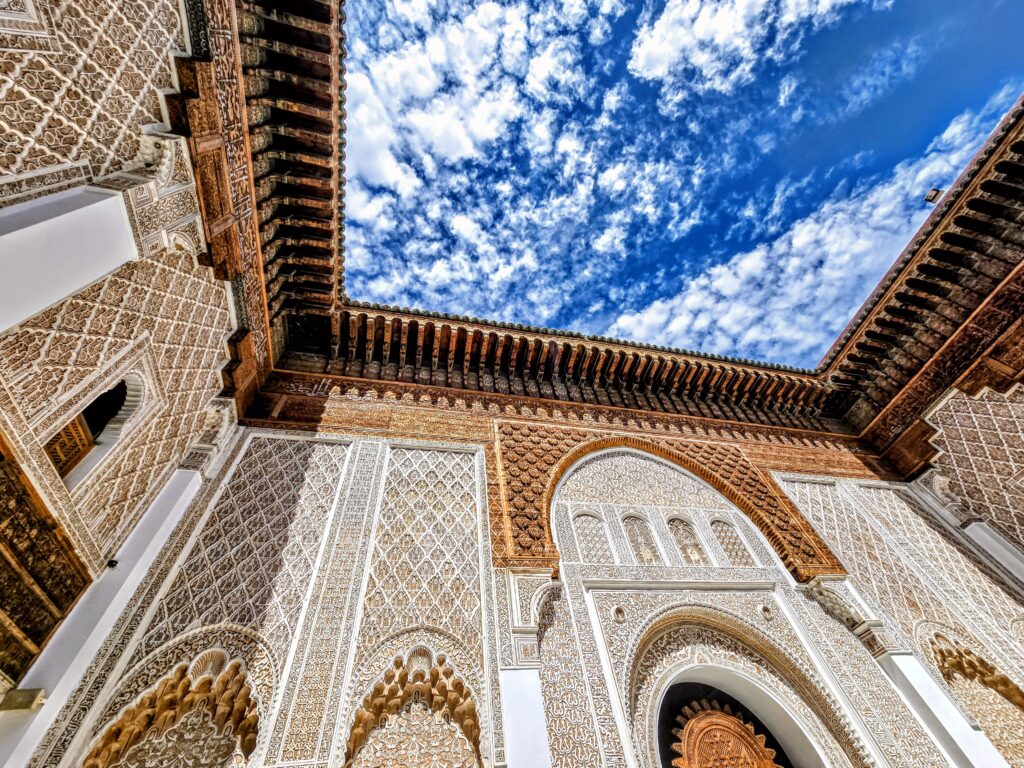
Eventually we left the commercial maze behind and stepped into the calm of Madrasa Ben Youssef. Its courtyard, framed by reflecting pool and palm trees, felt like an exhale after the intensity of the souks. There were colorful art displays and gardens, but it was the craftsmanship that truly stopped us in our tracks: the carved cedar, the impossibly detailed stucco, the geometric tilework marching across every surface. We found ourselves staring up, down, and sideways, constantly discovering new patterns in what at first had seemed like simple decoration. It was one of those places where you think you’ll take a quick look and then realize, half an hour later, that you’re still standing in the same spot, tracing motifs with your eyes.
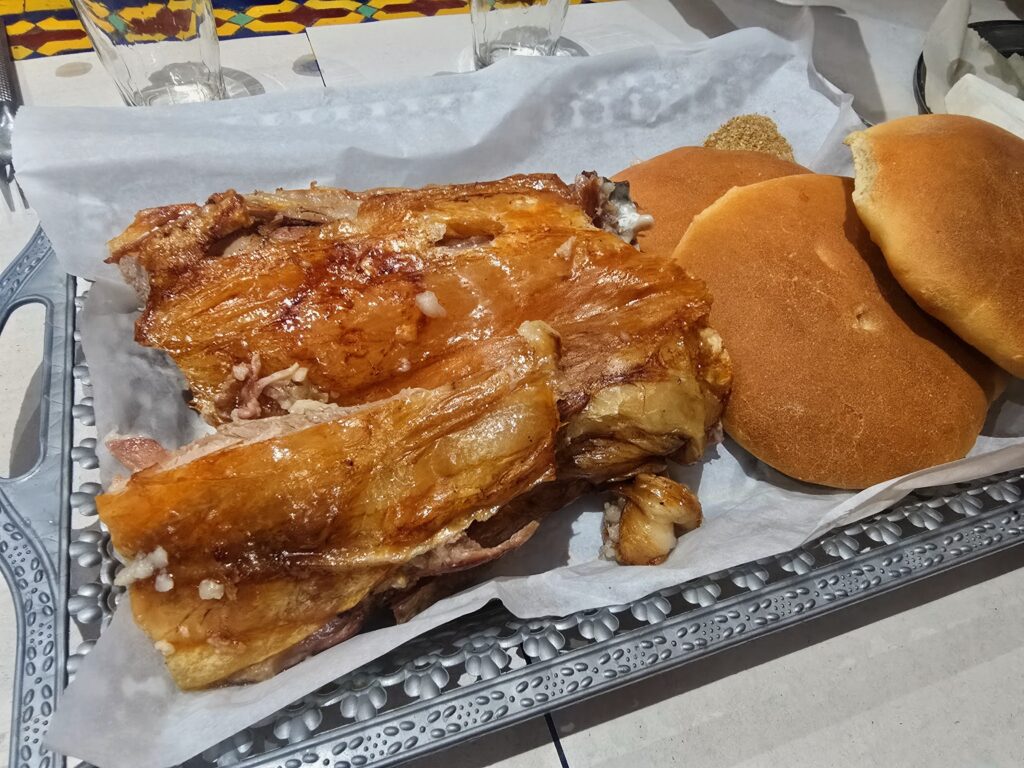
By early afternoon, hunger nudged us back into the maze. Our guide led us through another series of twists and turns to a small, unassuming restaurant renowned for one thing: lamb. Here, the meat is cooked slowly in underground pits, then hauled up, chopped by weight, and served with nothing more complicated than fries, bread, salt with cumin (try it!), and the acceptance that your fingers will be thoroughly greasy by the end. It was simple, primal, and absolutely delicious.
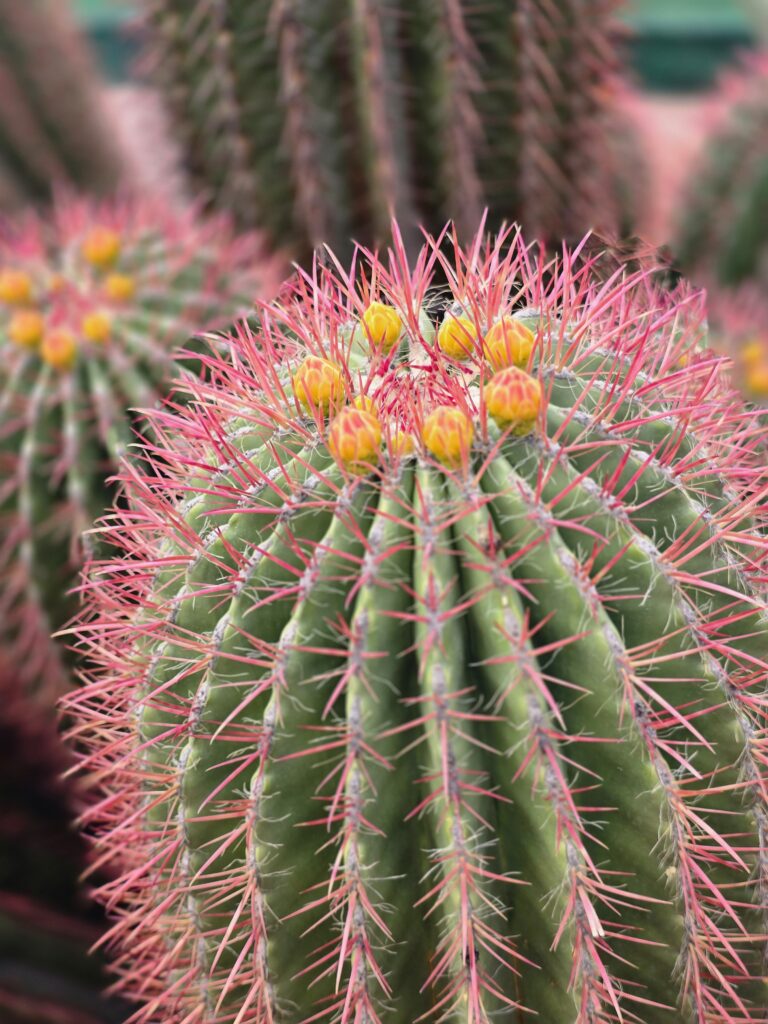
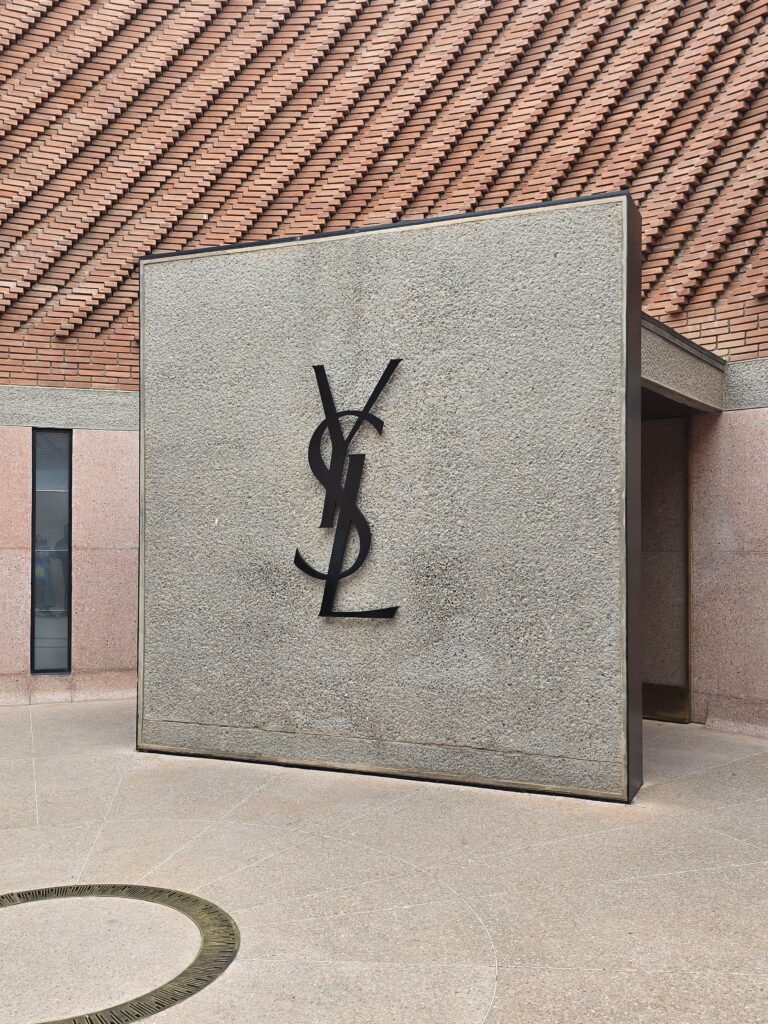
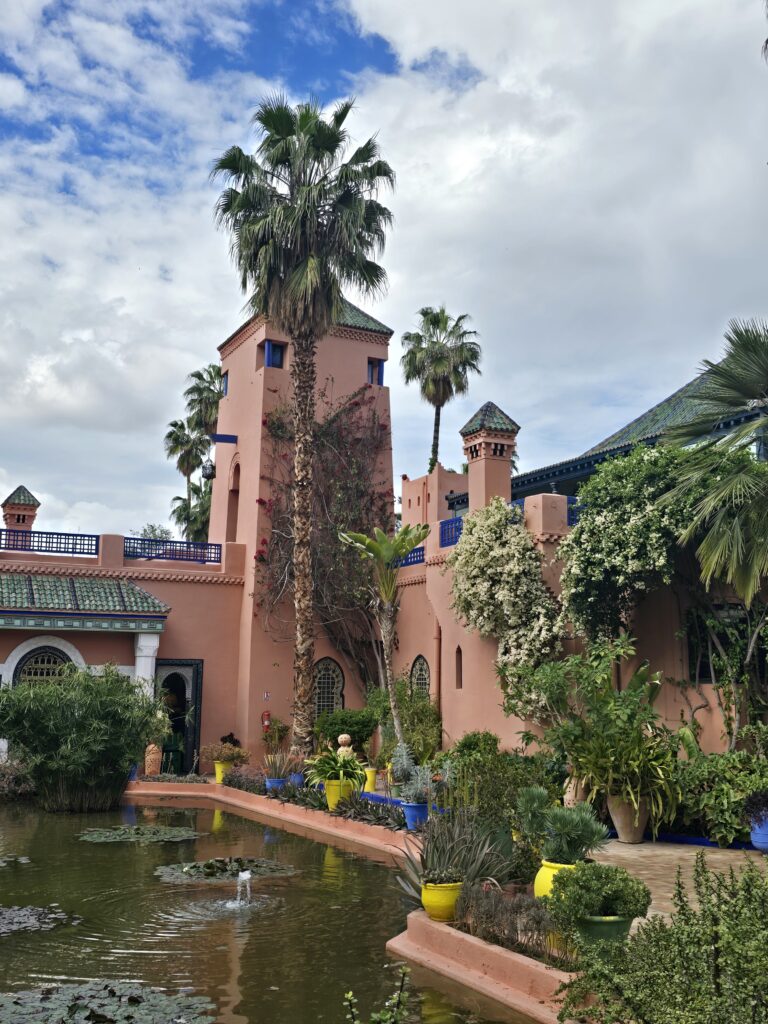
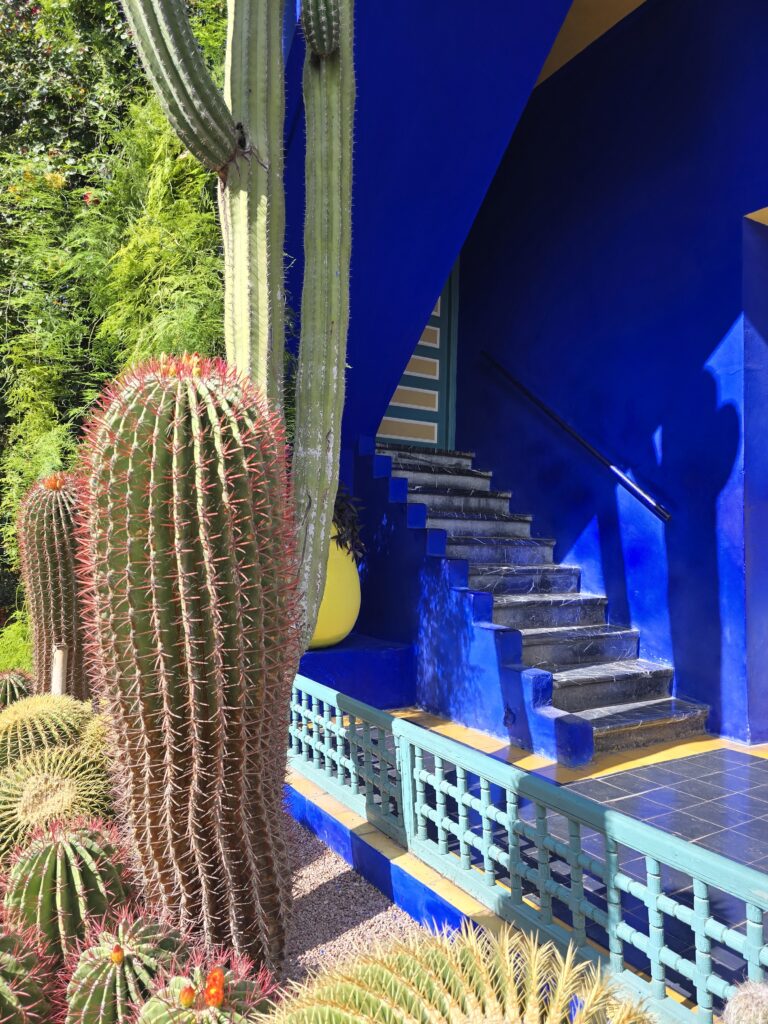
Our final stop of the day with him was the Majorelle Garden and the YSL Museum. If Yves Saint Laurent famously fell in love with Morocco, I’ve long been a fan of him, so this felt like a pilgrimage of sorts. The moment we stepped into the garden, the city noise dropped away, replaced by rustling palms, bamboo groves, and that shock of Majorelle blue against green and yellow. The colors were so intense they almost hummed—impossible to capture properly in standard photos, but seared into memory. The YSL Museum next door extended that feeling: clean lines, thoughtful exhibits, and a quiet reverence for the way this place shaped his work.
By the time we made our way back to Riad Nashira that evening, the Red City had already lived up to its reputation: vibrant, layered, overwhelming, and beautiful, with our tucked‑away riad waiting to fold us back into its calm at the end of it all.
Marrakech Day 2: Vintage Sidecar Tour, Moroccan Cooking Class, and Chez Ali Show
Breakfast at Riad Nashira quickly became a ritual: strong coffee, fresh juice, breads and pastries, eggs made to order—all taken in the calm of the courtyard before stepping back into the hum of Marrakech. On our second morning, we ate with a bit more anticipation than usual; Soufiane was waiting, and our plan for the day involved trading four wheels for two (and a half).
Our first adventure was a sidecar tour of the city. We climbed into our respective sidecars while our motorcycle guides—each from different walks of life, religions, and backgrounds, but united by their love of two wheels and their city—kicked their bikes into gear. From there, Marrakech unfolded in a whole new way. We cruised through the palmeraie, palms punctuating the sky in even rows, then along the so‑called Vegas‑style strip with its hotels and more modern flash. We glided past affluent neighborhoods with manicured hedges and high walls, skimmed the edges of local markets, and even dipped briefly into the narrow medina streets.
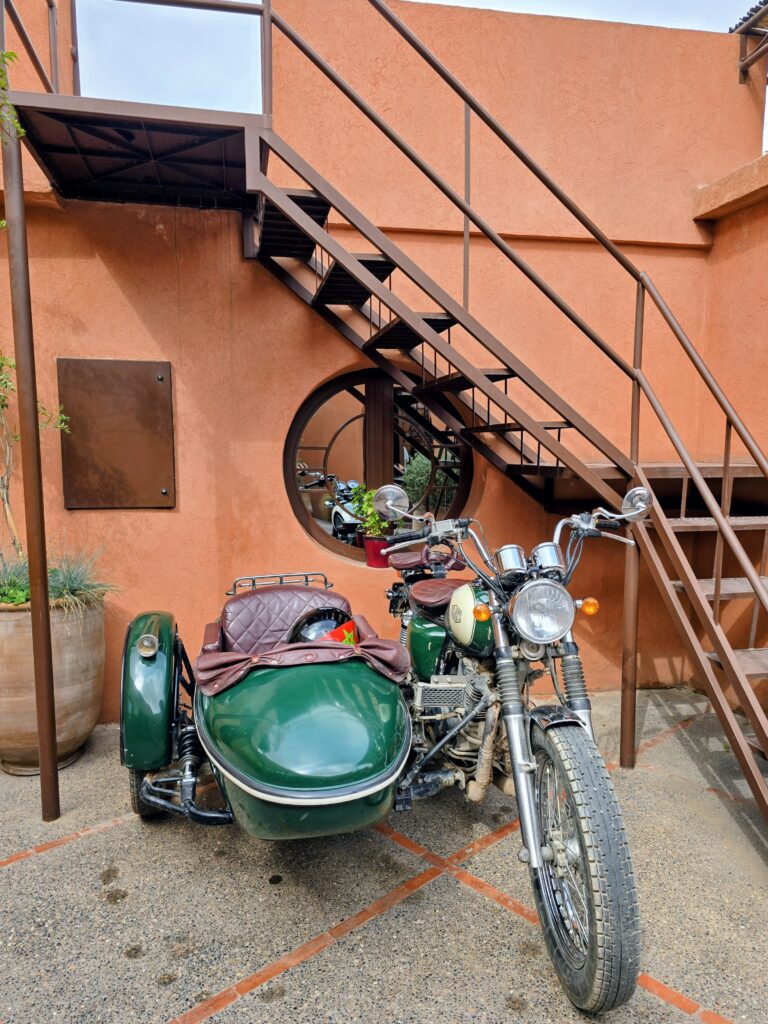
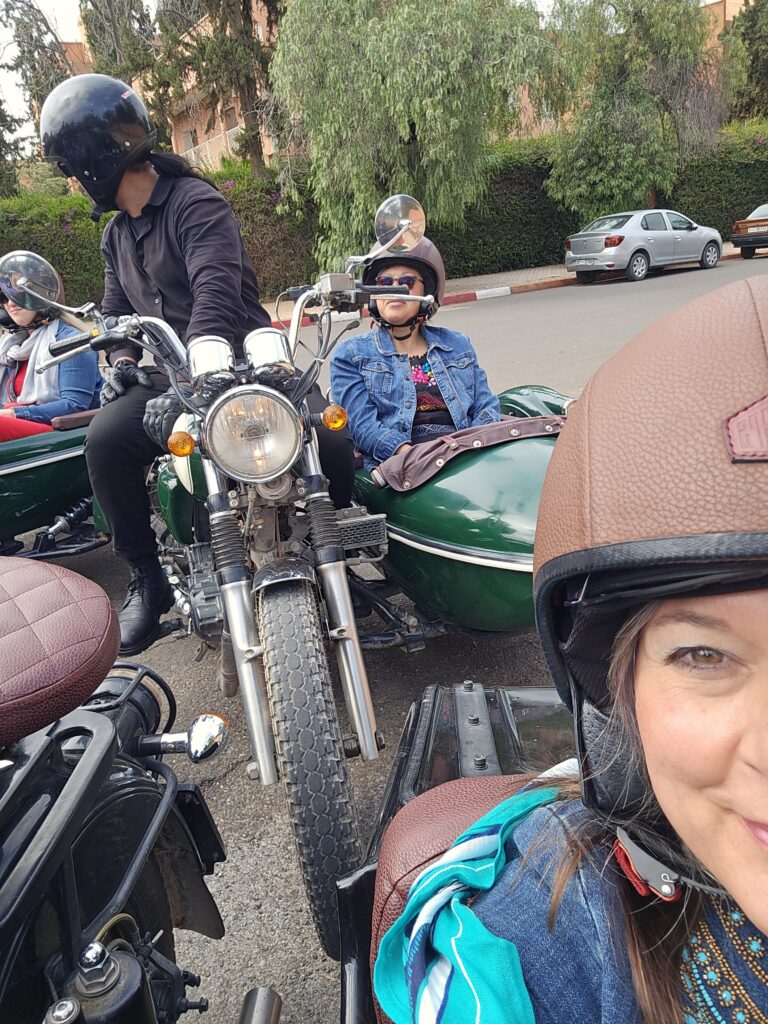
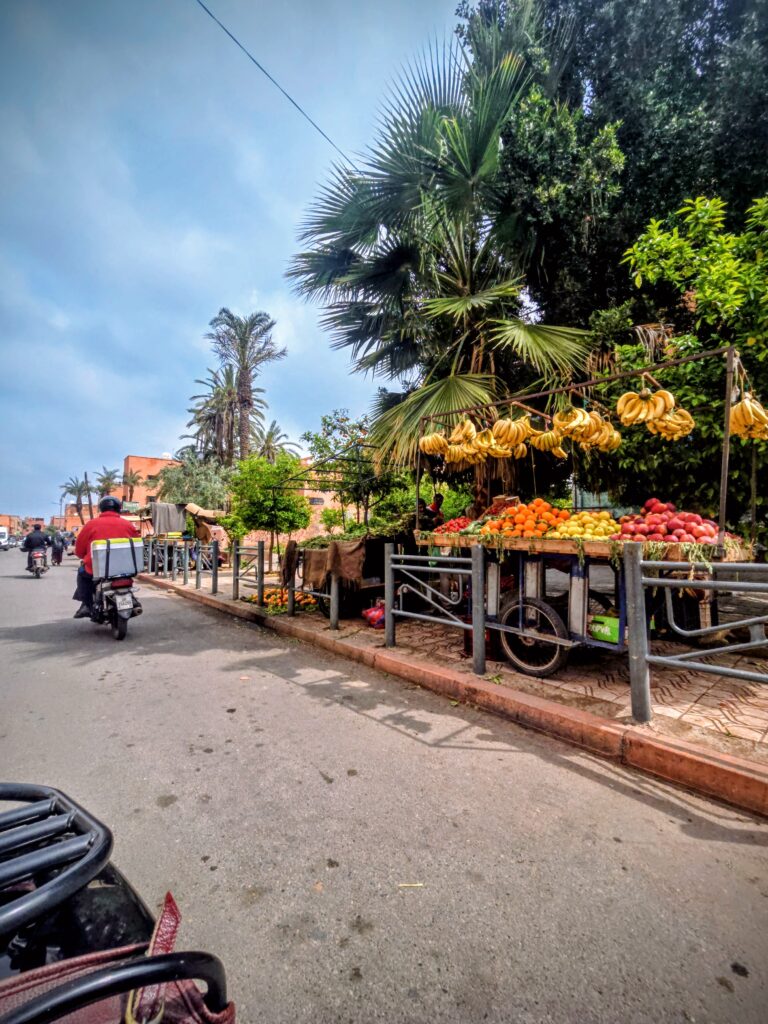
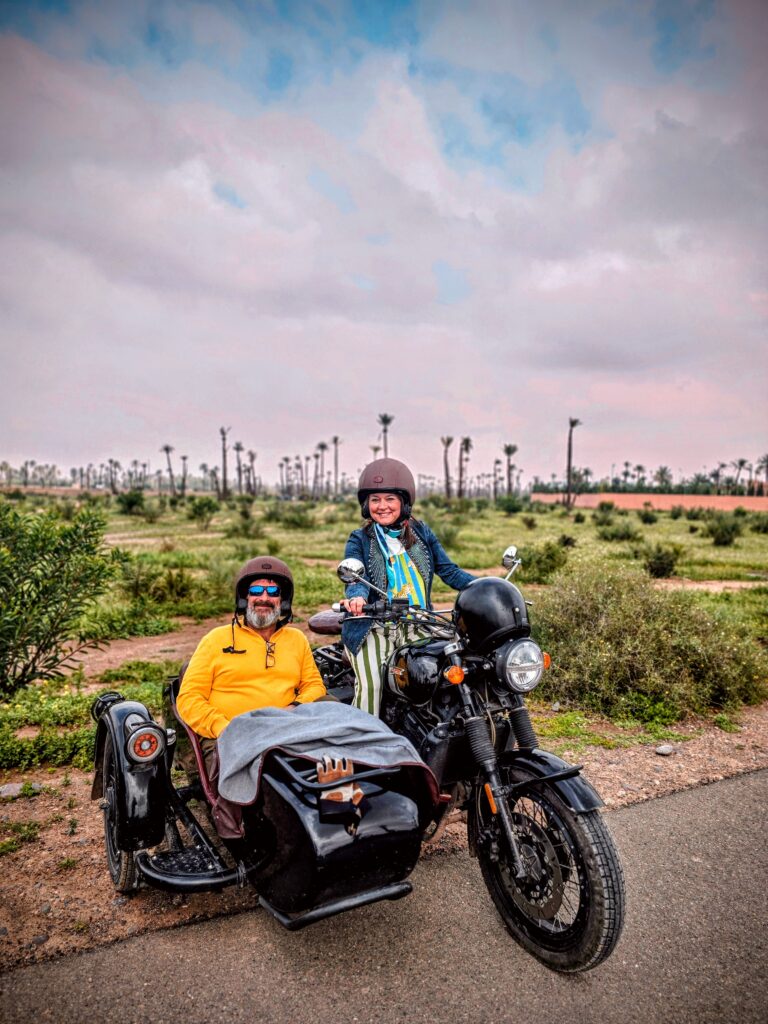
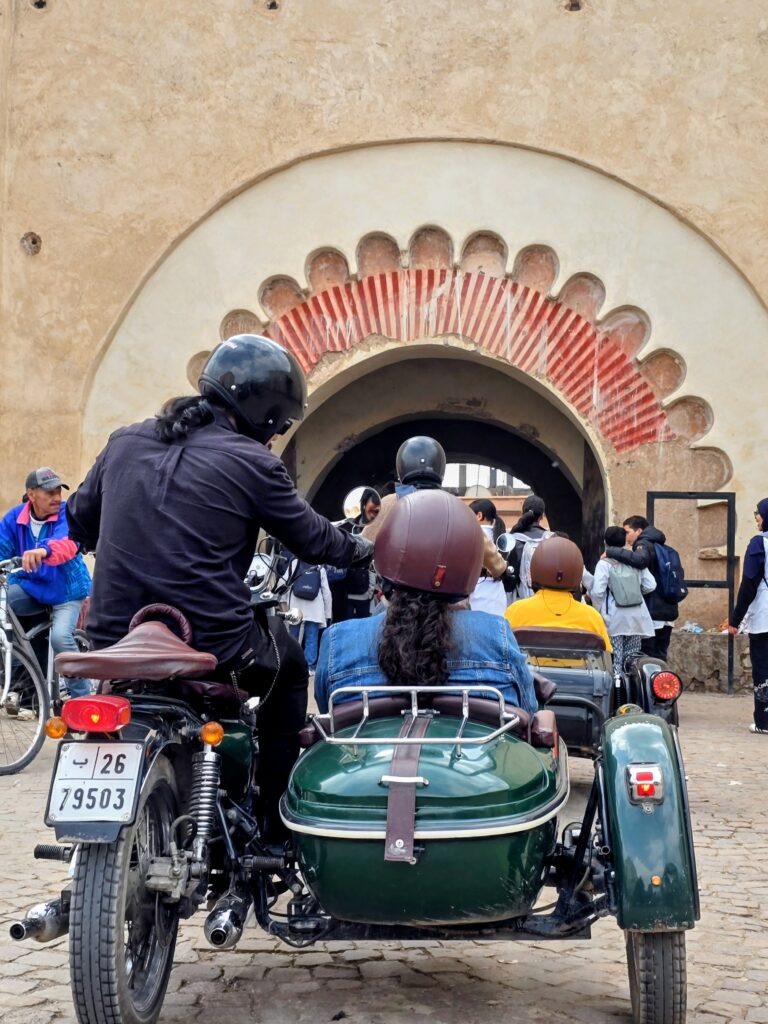
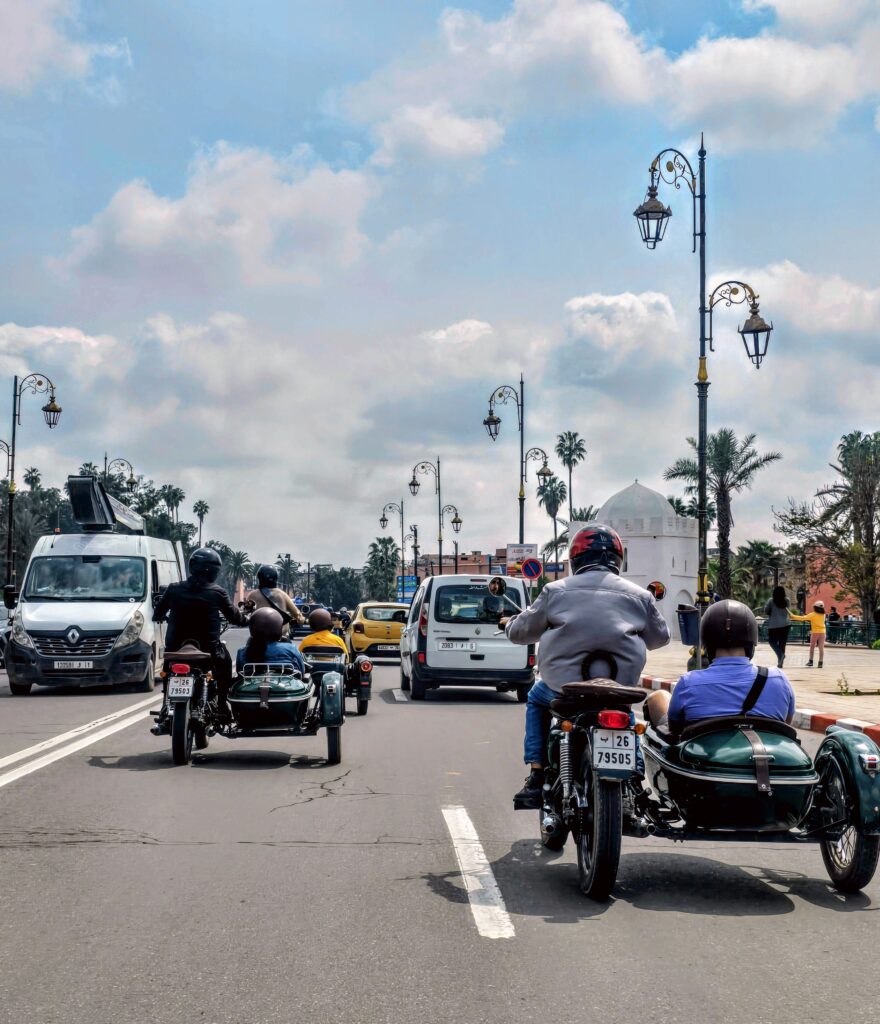
From the low vantage point of the sidecar, everything felt amplified: the wave of schoolchildren leaving class, donkeys and carts stubbornly holding their own against traffic, scooters and motorbikes zipping past in a blur. It was chaotic and thrilling, but never felt unsafe; our guides knew every bump and shortcut, clearly in their element.
After we reluctantly climbed out of the sidecars, Soufiane steered us out of the city and into the countryside, where the urban sprawl gave way to rolling fields of green. Our destination was Chef Tarik’s cooperative for a Moroccan cooking class—more than just a lesson, really, but a gentle immersion into the rhythms of a traditional kitchen.
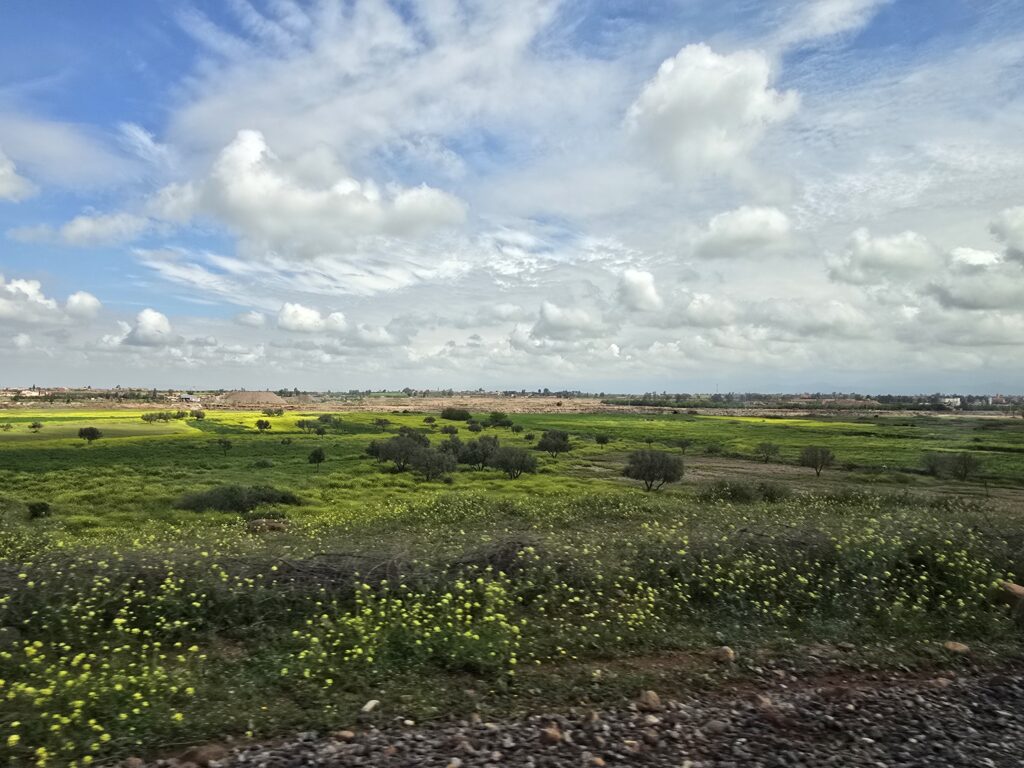
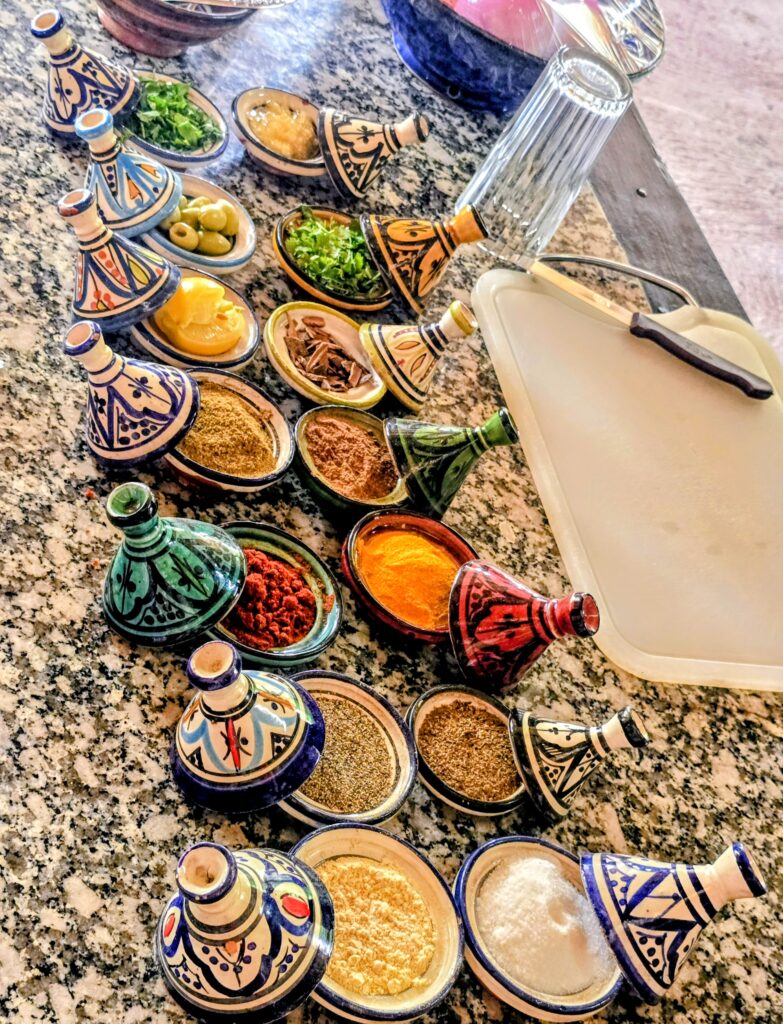
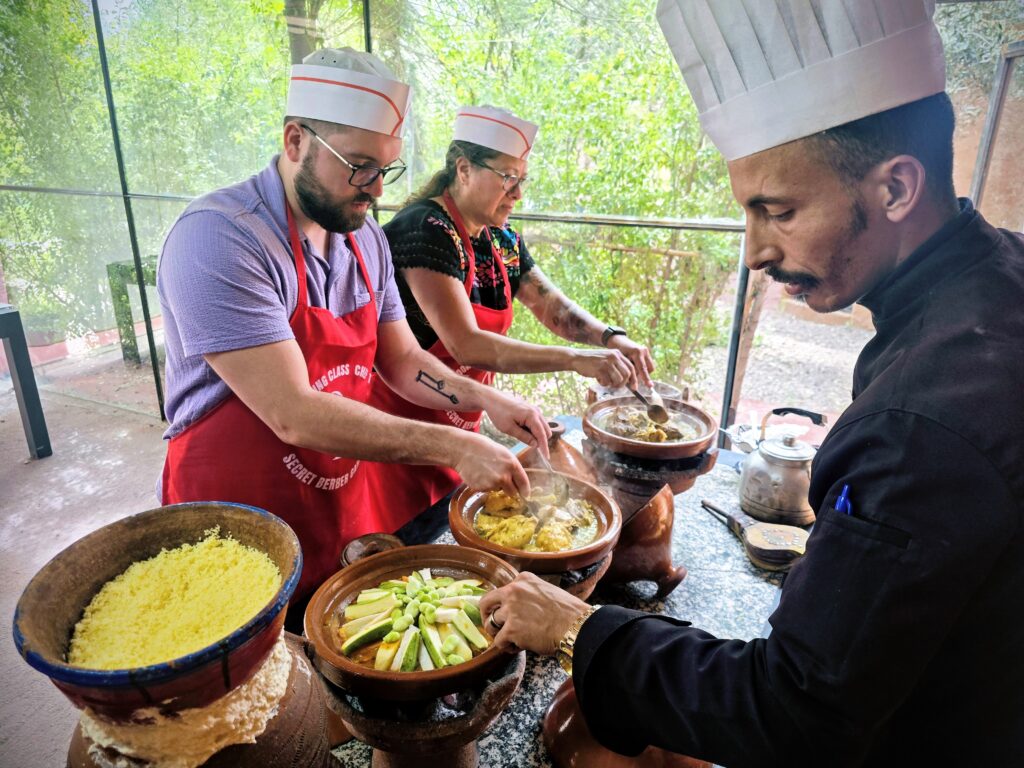
We started with the basics: the spices that form the backbone of Moroccan cooking, the difference between paprika and smoked paprika, the role of cumin, ginger, saffron, ras el hanout. From there we moved into technique—how to build flavors in a tagine, how to prepare (from semolina) and properly steam couscous so it’s light and fluffy rather than dense, how to prepare and plate the side dishes that round out the table. Working together and around the prep table, we each took responsibility for different tagines: chicken, lamb, and vegetables, layering ingredients and spices into the conical pots and leaving them to work their slow magic over the coals.
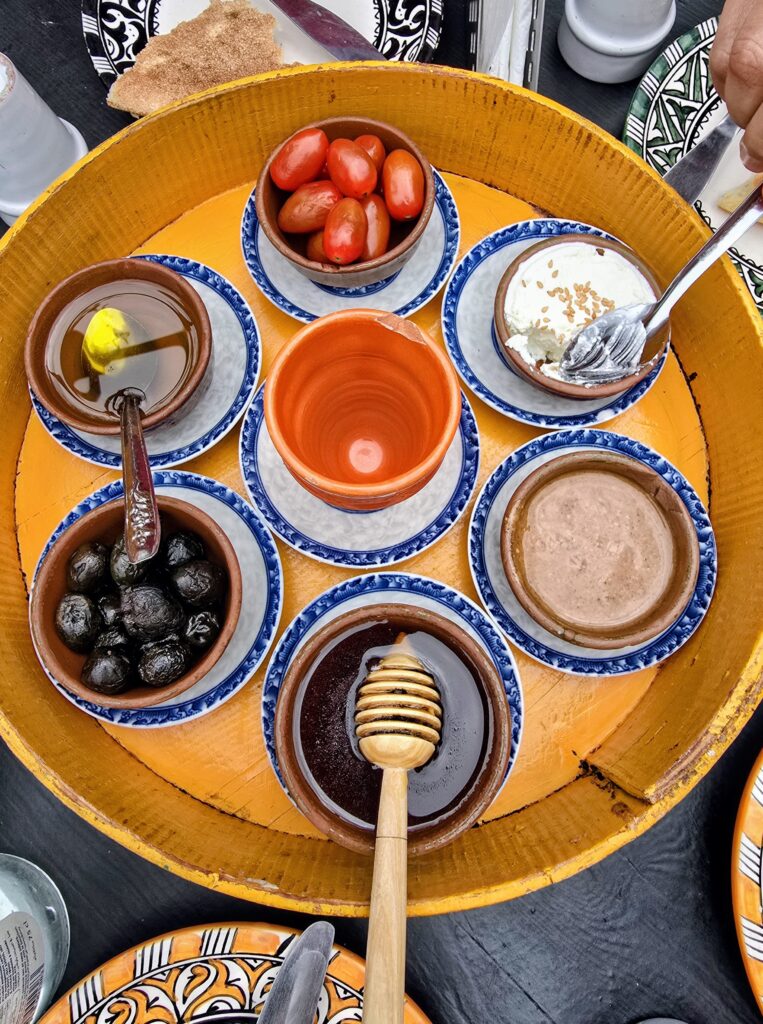
While everything simmered, we were invited into a garden area for what felt like a very civilized interlude: tea served with hummus, olives, fresh vegetables, almond paste, honey, and bread, all laid out under the shade of trees. It was the kind of spread that could have easily passed for a full meal, but we knew the main event was still waiting. After a short walk around the grounds and a quick look at the fields that help supply the kitchen, we returned to find our tagines ready.
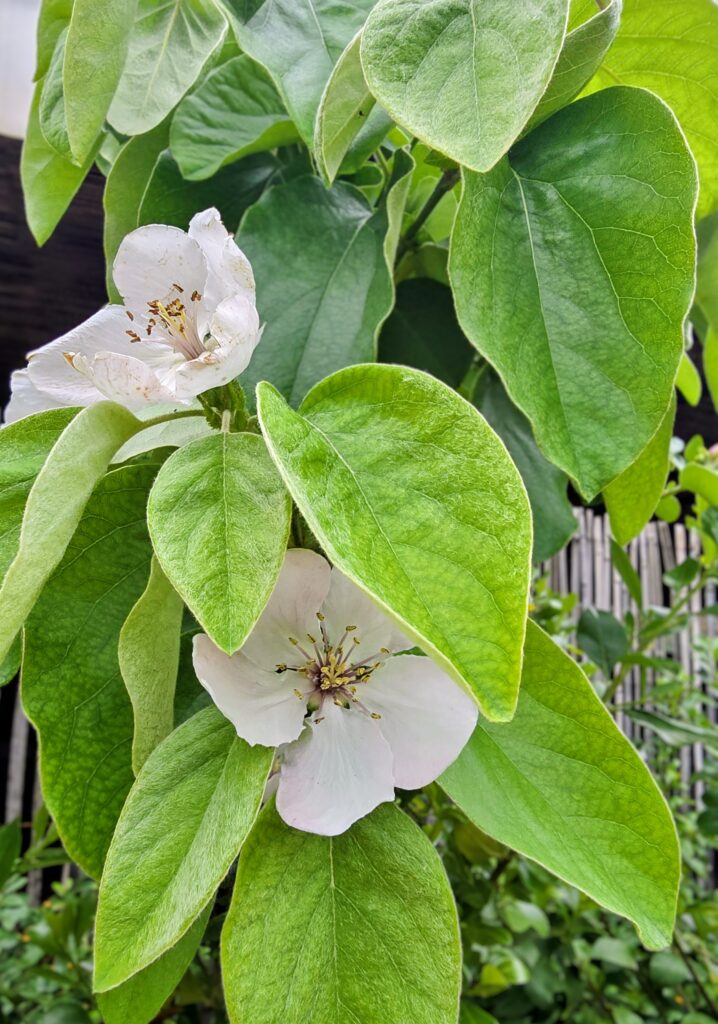
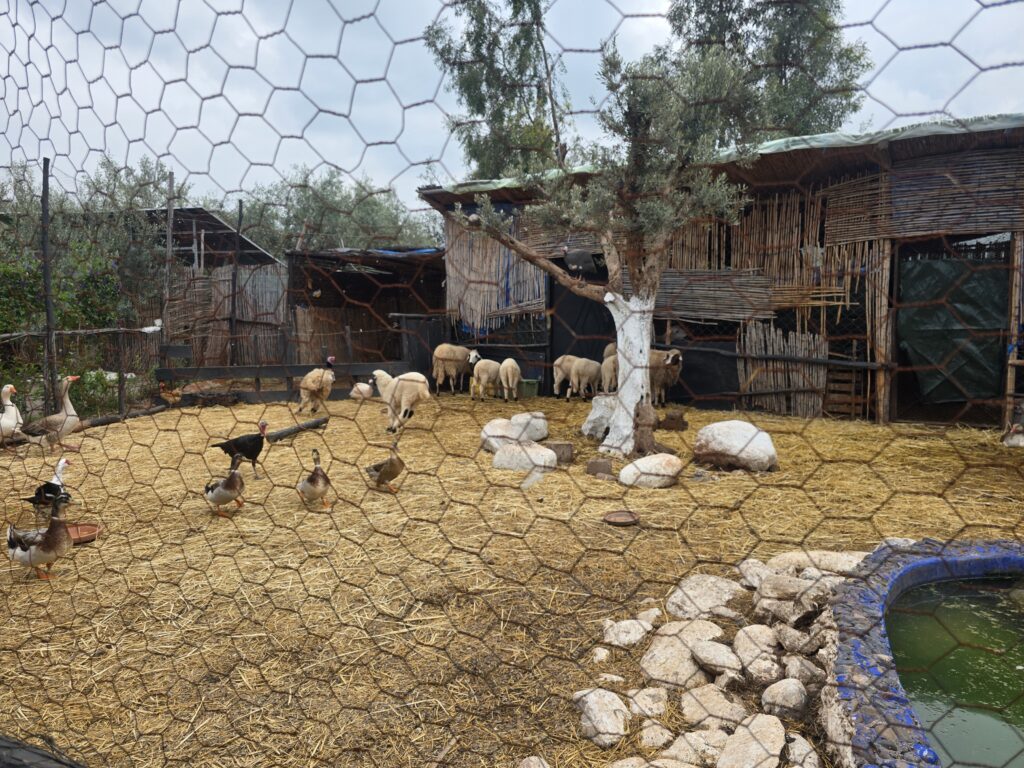
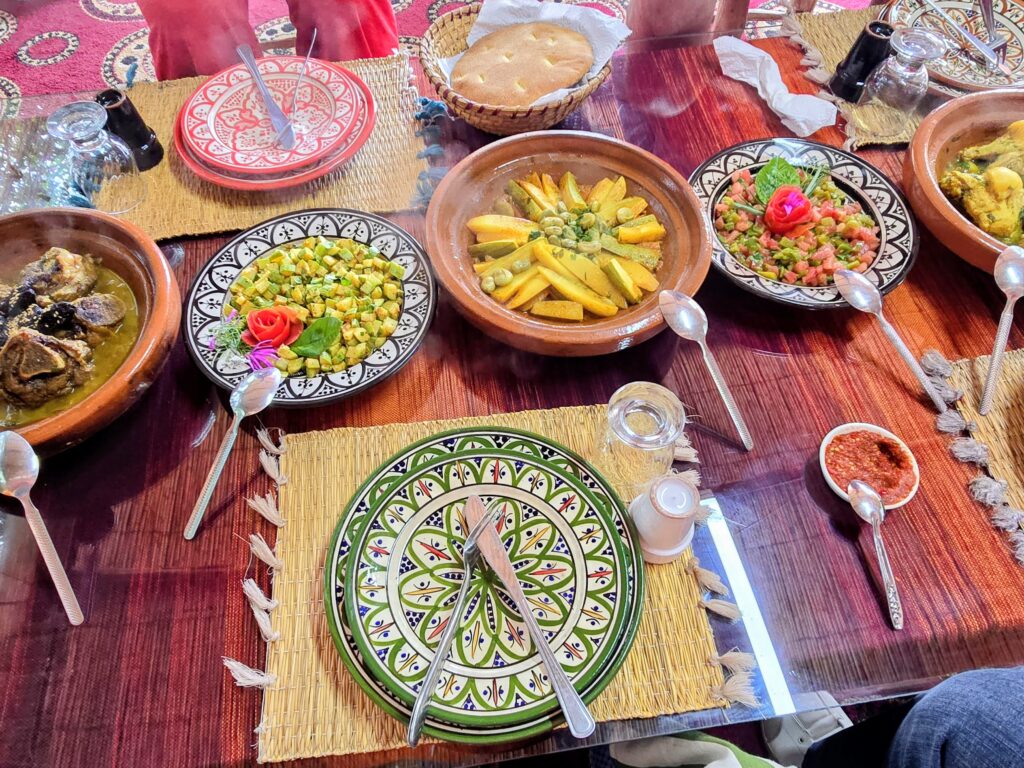
Lunch was a feast built entirely by our own slightly clumsy hands. There’s something deeply satisfying about lifting the lid of a tagine you’ve prepared yourself and being met with a cloud of fragrant steam, then realizing—almost with relief—that it tastes as good as it smells. We lingered over the dishes, comparing notes, stealing bites from one another’s plates, and trying to memorize flavors we’d inevitably attempt to recreate at home.
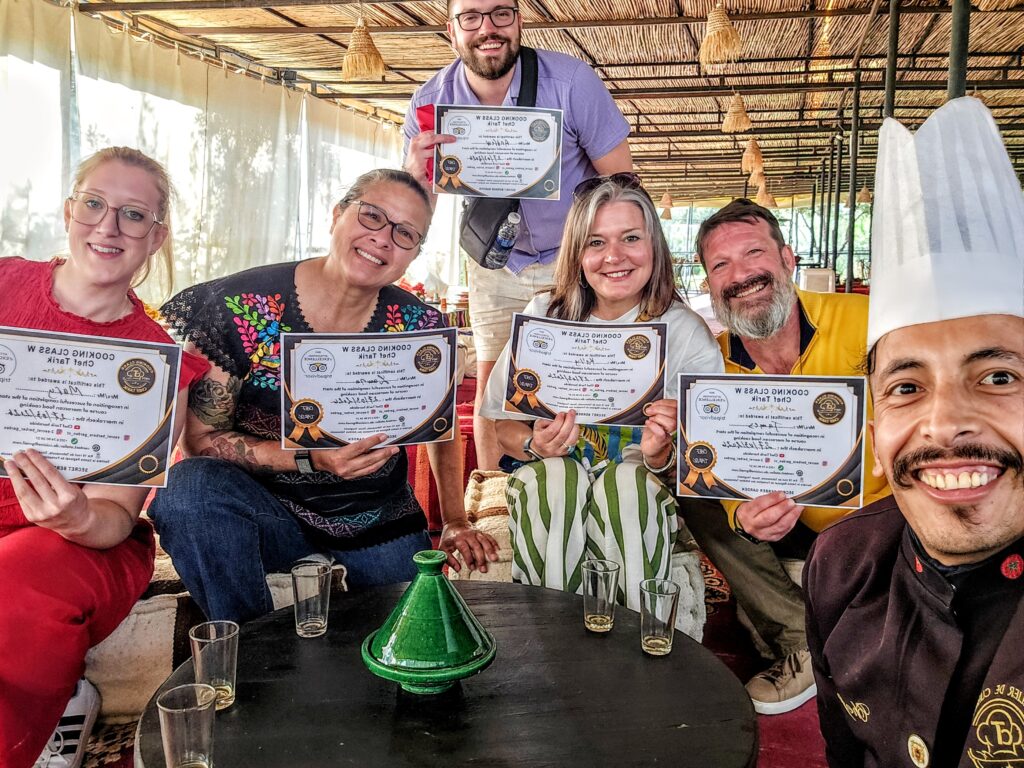
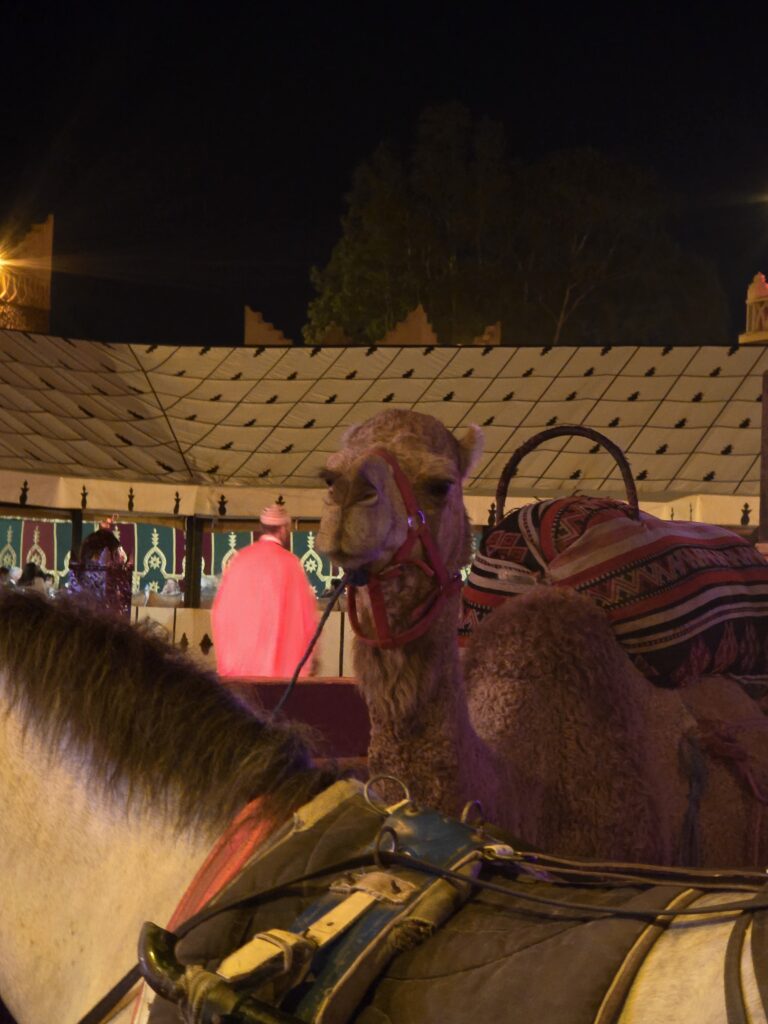
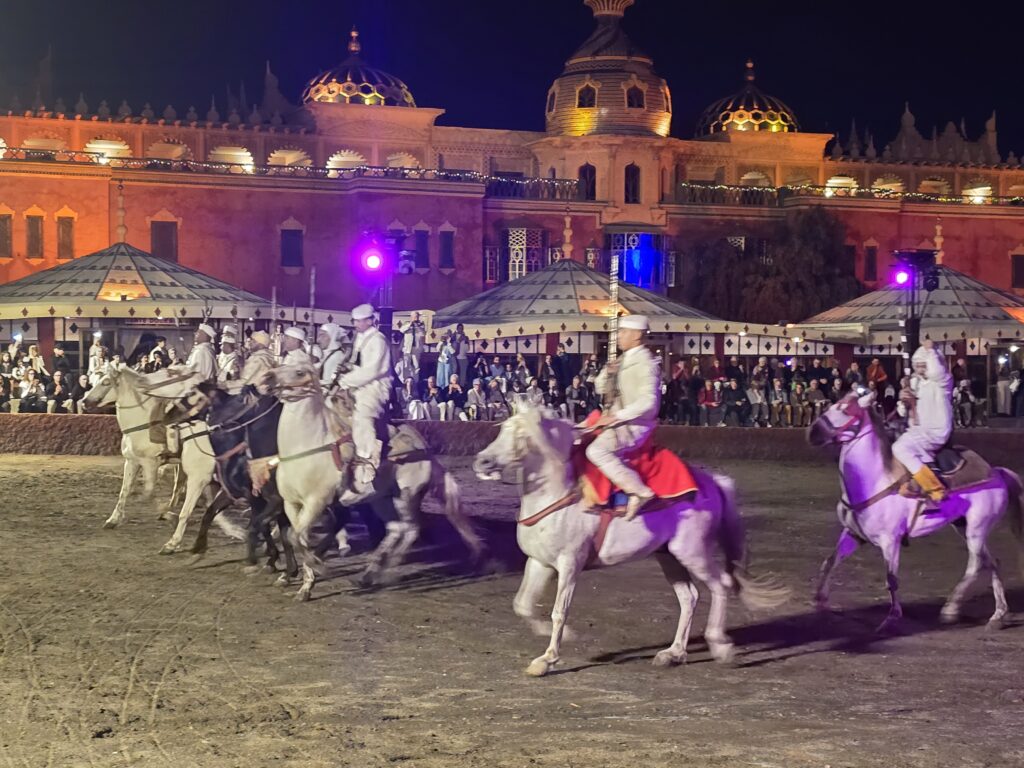
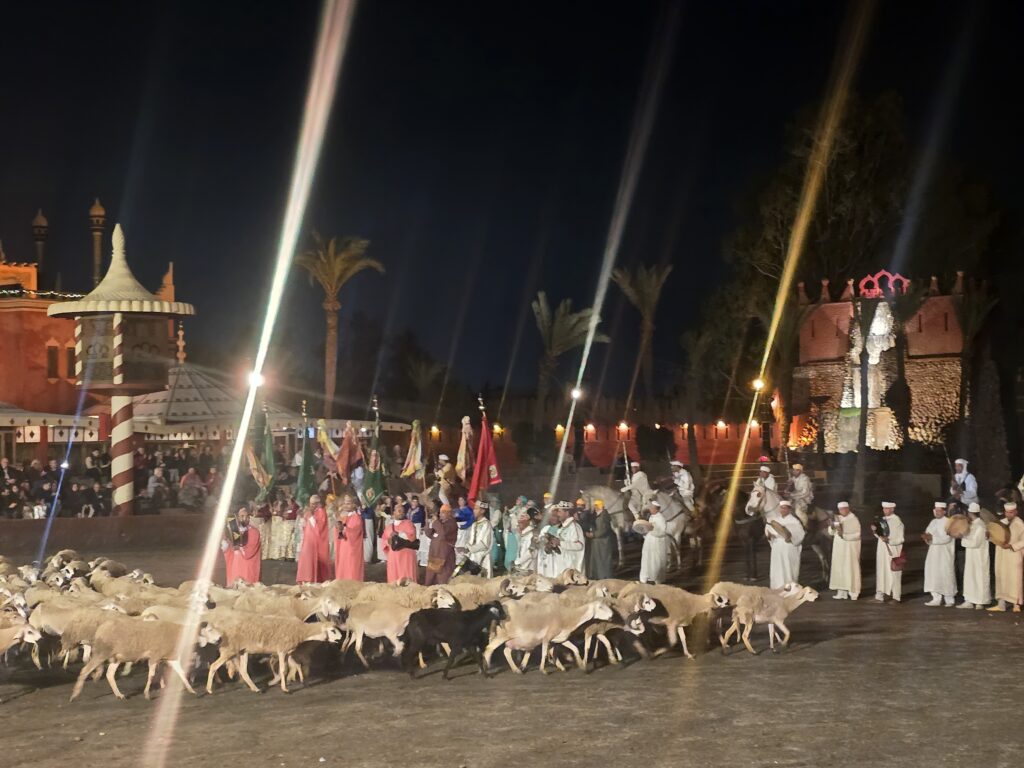
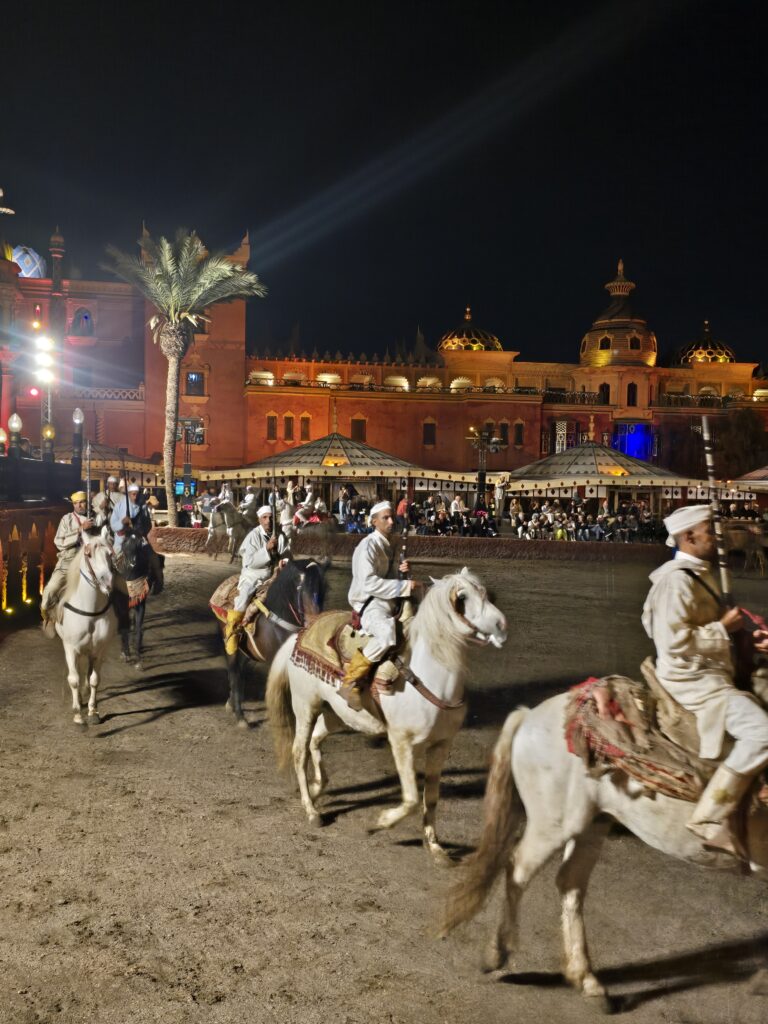
Back in Marrakech, we returned to the riad for a brief rest and refresh—showers, a change of clothes, a moment to let the day sink in—before heading out again, this time for a late‑night rendezvous at Chez Ali. Dinner and a show awaited us there: a riot of horses, costumes, music, and choreography that felt like stepping into a particularly exuberant legend. It was a far cry from the quiet of Riad Nashira or the focused calm of the cooking class, but that was becoming the pattern of our time in Marrakech—a pendulum swing between serenity and spectacle, both of which felt entirely at home in the Red City.
Argan Trees to Atlantic Seas: Our Marrakech to Essaouira Road Trip
By Day 3, we’d settled into a comfortable rhythm at Riad Nashira—breakfast, a quick scan of the day’s plan, then out into whatever Morocco had in store for us next. This time, it meant heading west, trading the terracotta walls of Marrakech for coastal air and a landscape stitched together with argan trees.
We left the city behind and watched as the suburbs thinned out, the color palette shifting from reds and ochres to softer browns and dusty greens. Before long, we were deep in argan country. Even if you didn’t know the name, you’d recognize the trees: low, wide‑armed, slightly scruffy, dotting the hillsides in clusters. This is the only place in the world they grow naturally, which makes argan oil feel a little less like a trendy ingredient and a little more like a quiet miracle of geography.
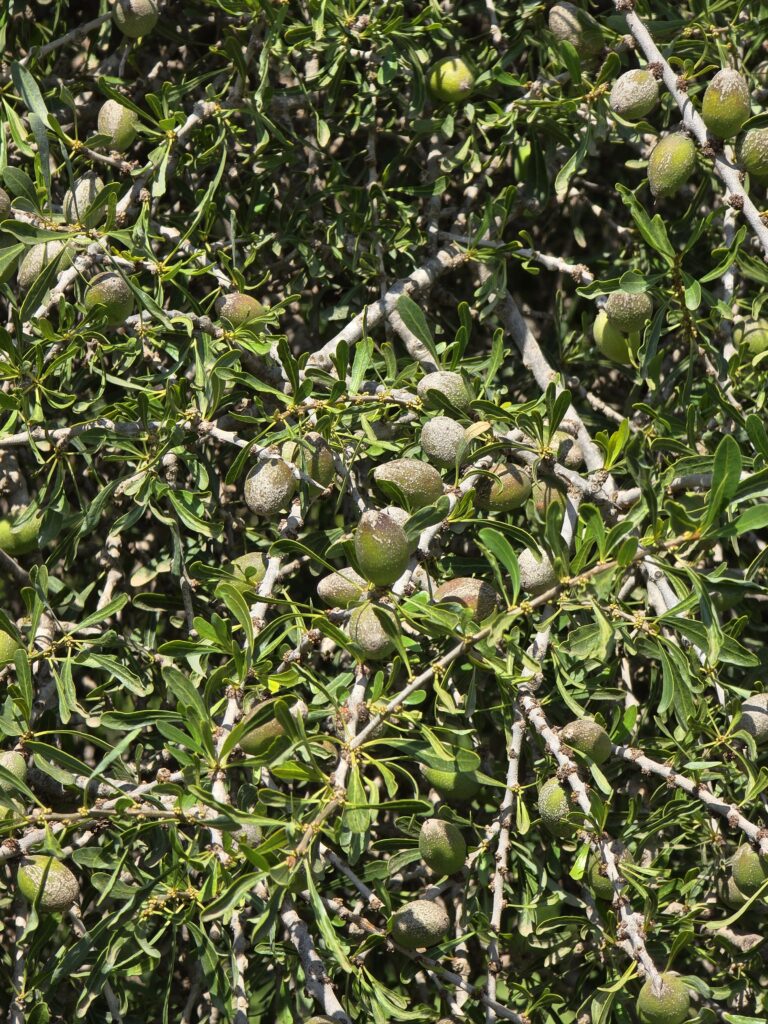
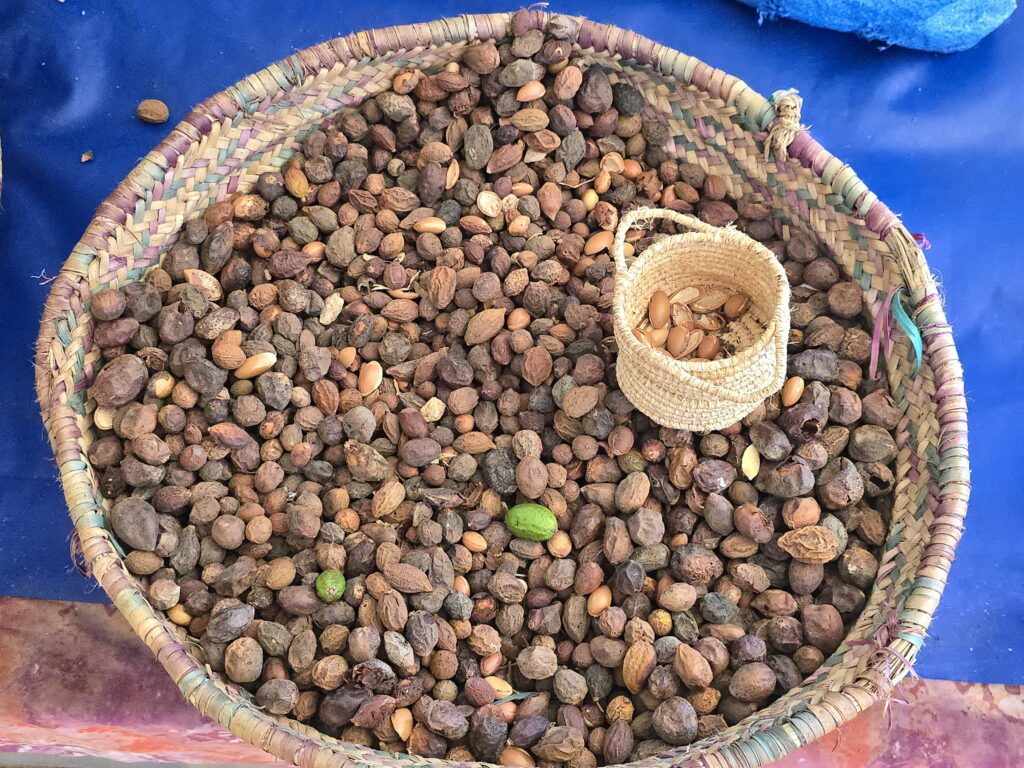
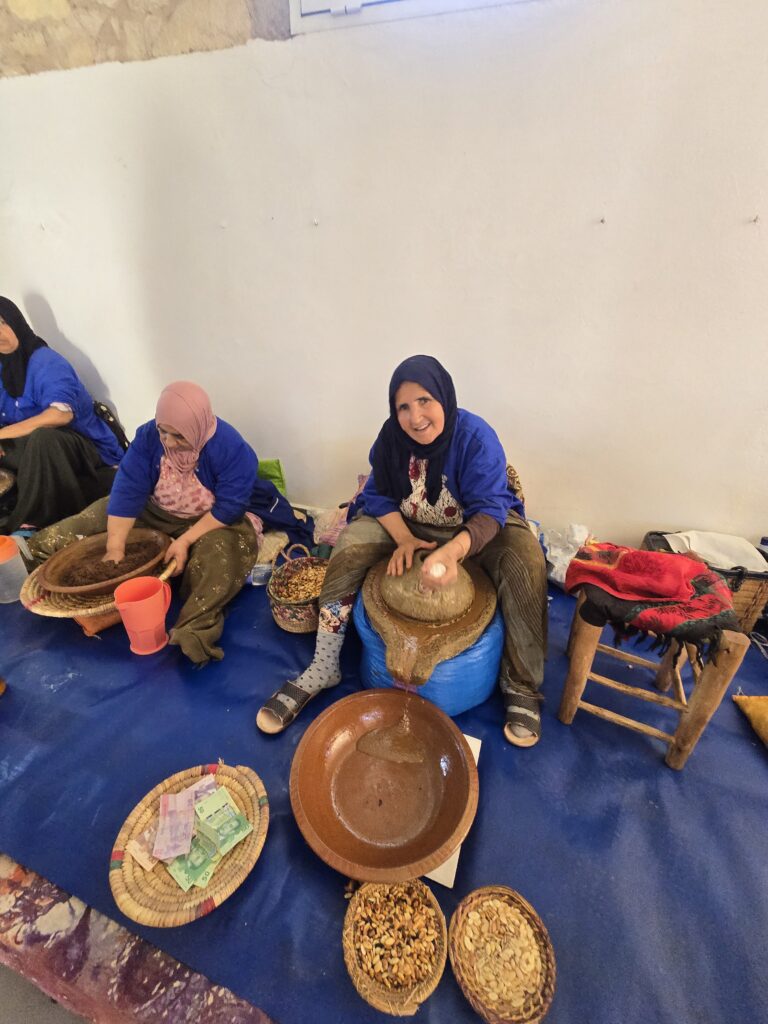
On the way, we stopped at a women’s cooperative to see how that miracle becomes something you can drizzle on bread or massage into your skin. Inside, the process was both simple and mesmerizing: nuts cracked by hand between stones, kernels roasted or left raw, then ground into a paste that’s slowly pressed to extract the oil. There was quiet pride among the women as they worked, the rhythm of their movements clearly well‑practiced. We tasted both culinary and cosmetic versions, dipped fresh bread into nutty, almost smoky argan oil, and learned how important these cooperatives are in giving local women both income and independence. It turned something we’d seen on countless labels into a story attached to real faces.
Back on the road, the air seemed to change almost imperceptibly—lighter, cooler, carrying the faintest hint of salt. The landscape opened up, the sky seemed to grow larger, and somewhere ahead, though we couldn’t see it yet, we knew the Atlantic was waiting. Essaouira lay at the end of this stretch, a white‑and‑blue exhale of a city after the intensity of Marrakech, and the drive there through argan country felt like the perfect bridge between the two.
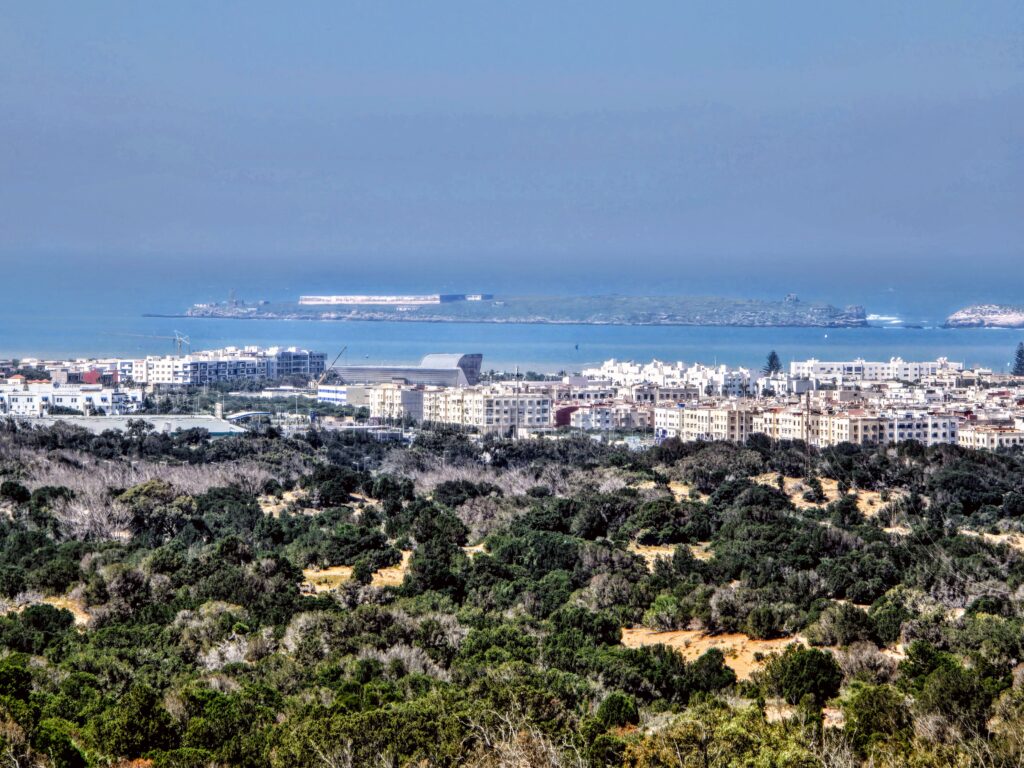
In Essaouira, we met yet another excellent private guide, this time with the Atlantic wind at our backs instead of desert dust. He began our tour on the commerce side of the city, steering us straight toward the fishing port—the working heart of Essaouira.
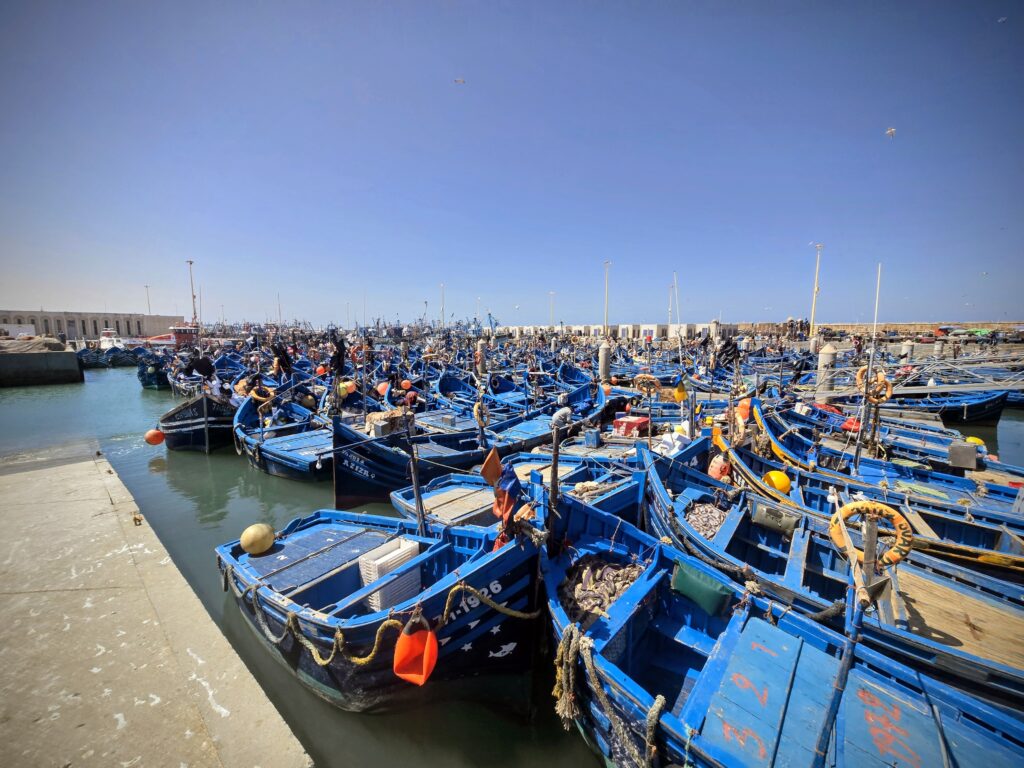
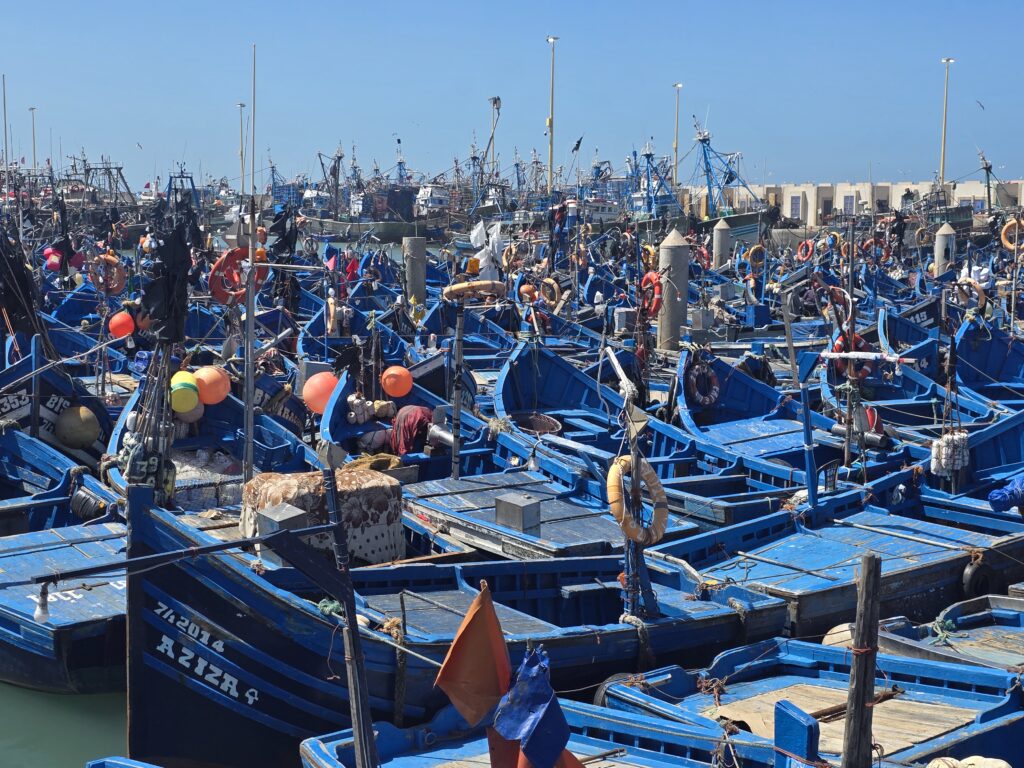
Out on the docks, everything felt in motion: boats gently swaying, nets being hauled and mended, gulls circling overhead, fishermen calling to one another over the din. Our guide explained the two main types of fishing vessels we were seeing—smaller boats built for day trips close to shore and the larger trawlers that head farther out and stay longer at sea. Hearing the distinctions while watching both bob side by side in the harbor made the whole system feel tangible instead of abstract.
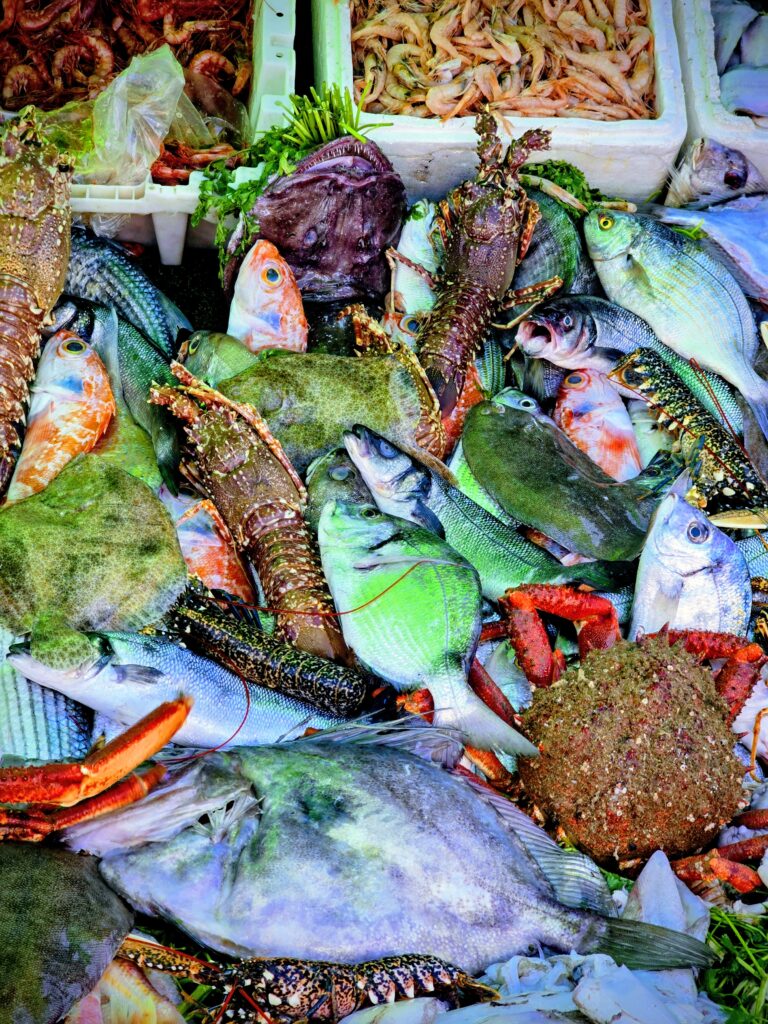
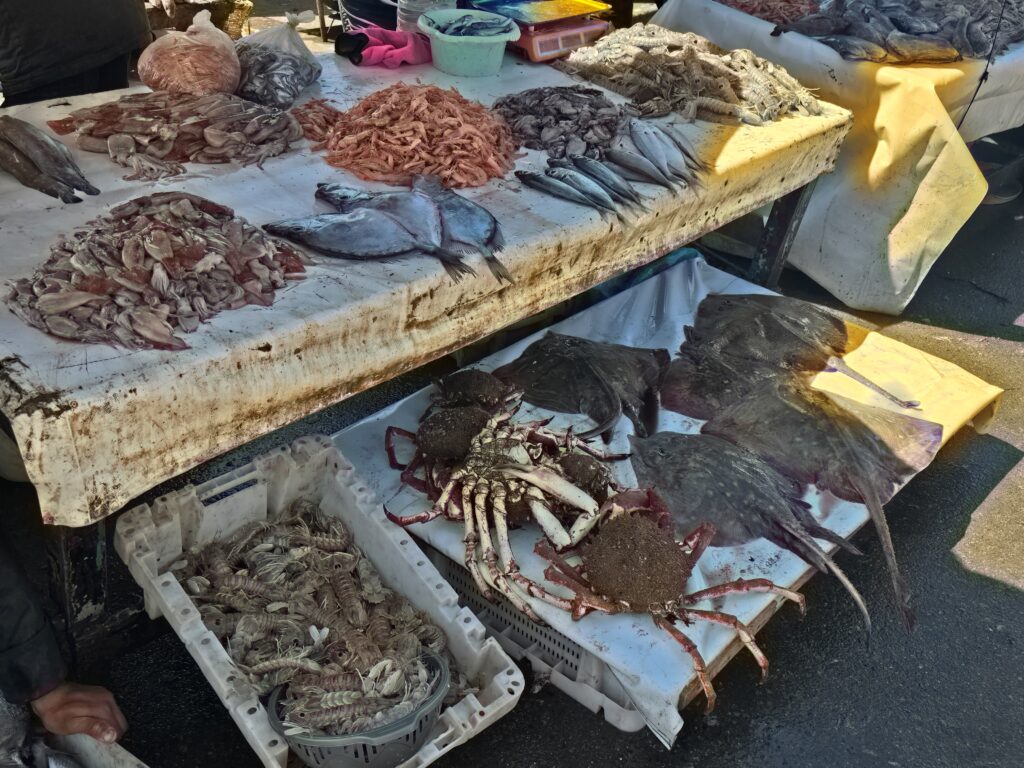
We walked through the seafood stands where the day’s catch was spread out like an edible atlas of the Atlantic: gleaming fish in every size and shape, octopus and squid laid out in tidy rows, langoustines stacked like coral, oysters nestled on ice. It was both overwhelming and oddly beautiful, a reminder of just how much life is teeming below the surface of that restless water.
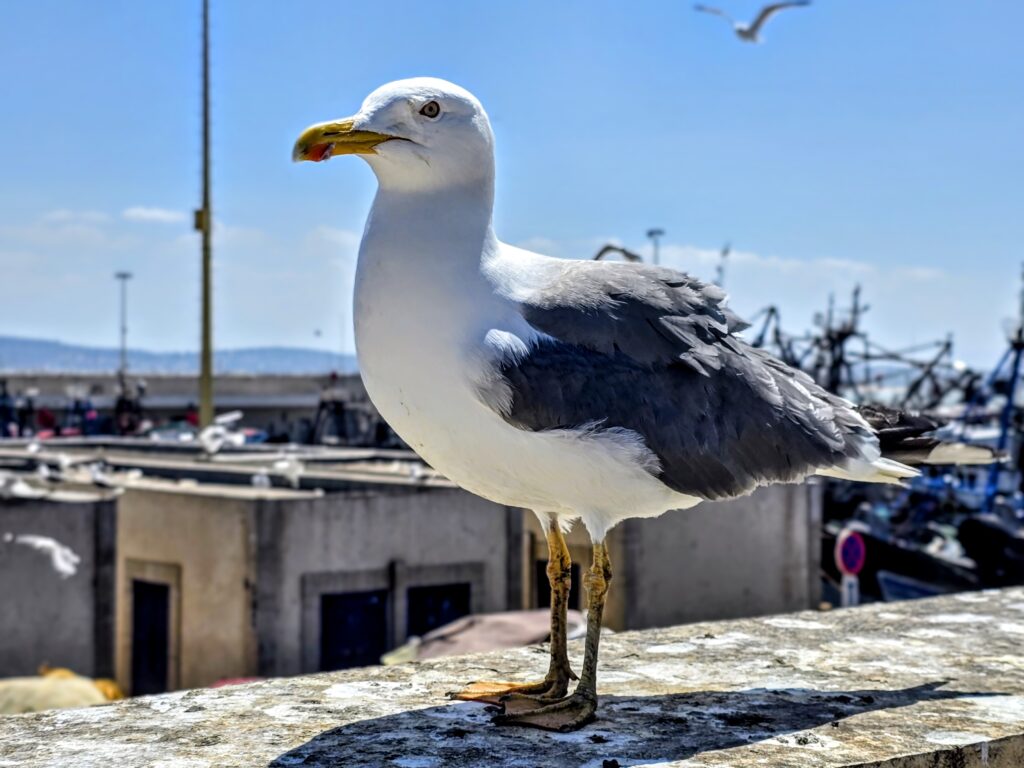
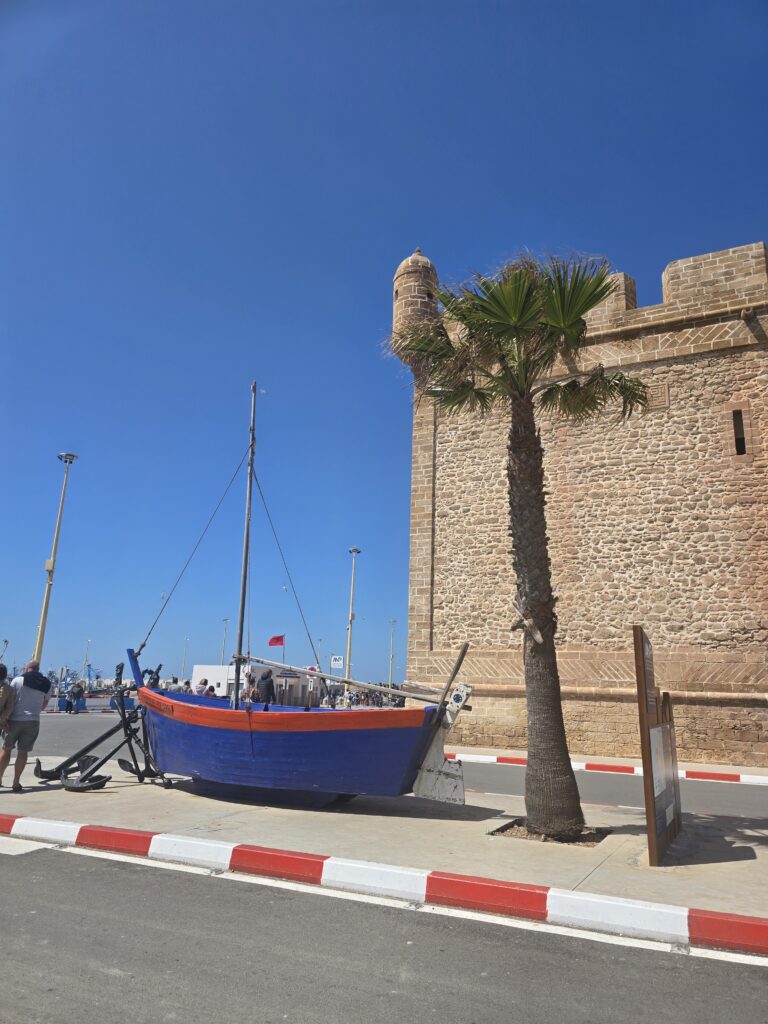
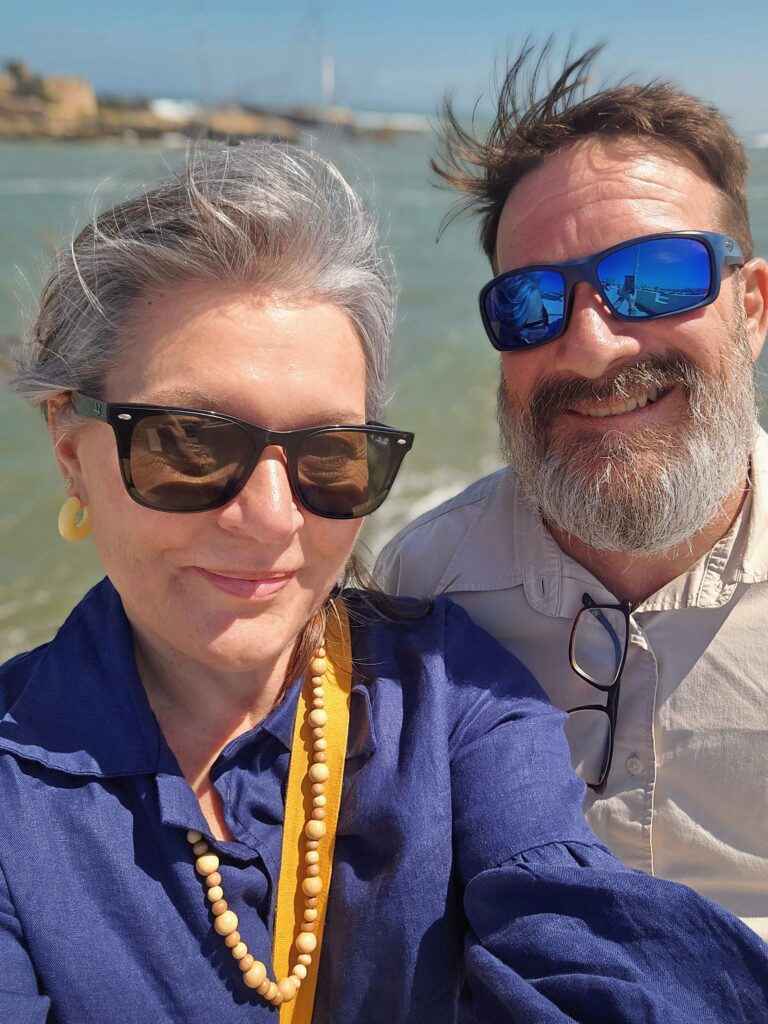
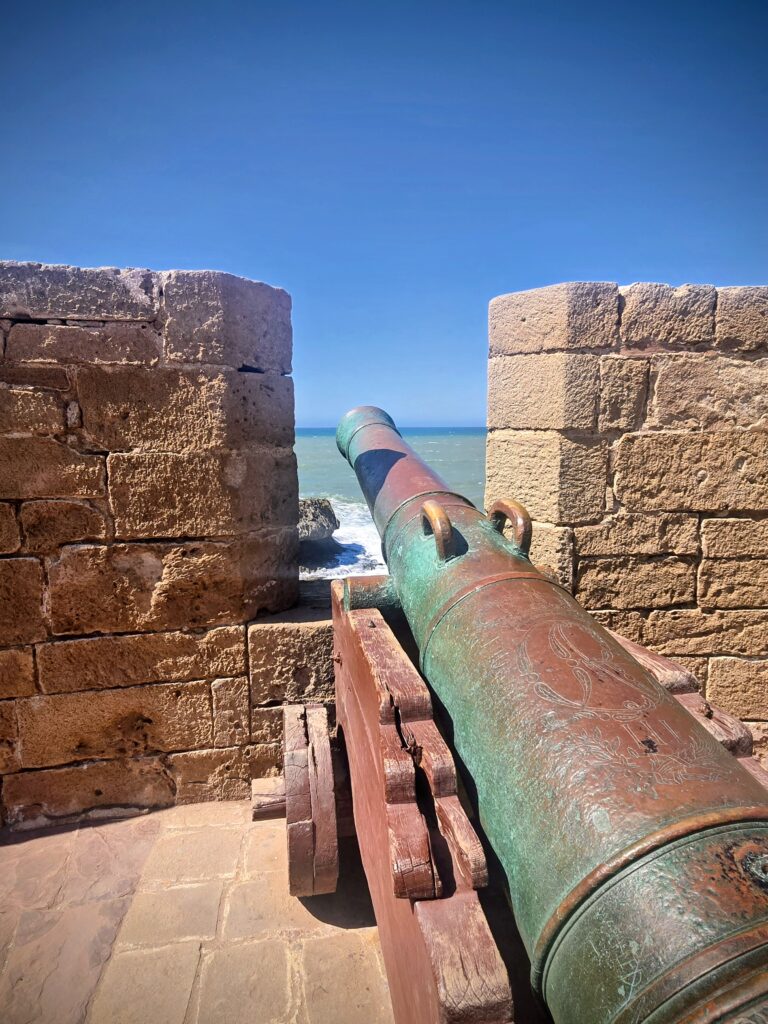
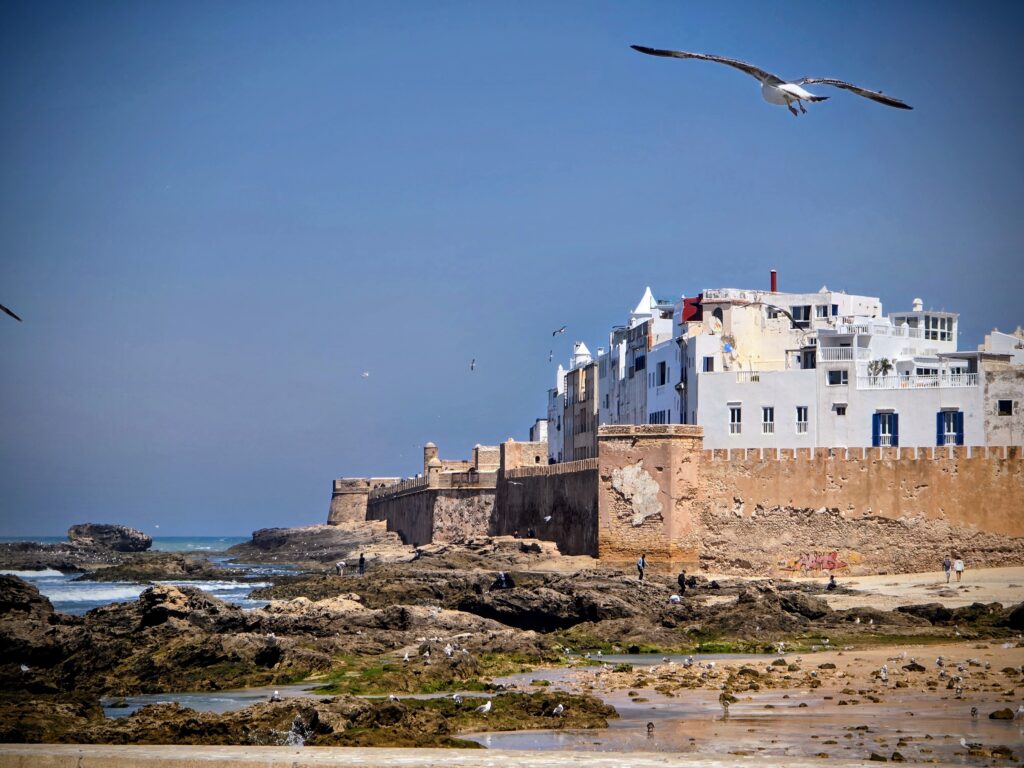
From there, we left the bustle of the port and climbed up onto the ramparts. The wind picked up, the sound of the ocean grew louder, and Essaouira’s layered history came into focus. Our guide told us that the city was once known as Mogador, a name that still lingers in local memory, and pointed out the traces of Portuguese influence in the fortifications and layout. He gestured toward an island just offshore, once home to a prison that served as a kind of Alcatraz of the Atlantic—isolated, inescapable, and a dark counterpoint to the bright white‑and‑blue façades of the town.
As we moved along the walls, he also shared a more modern claim to fame: several scenes from Game of Thrones were filmed here, the stone ramparts and crashing waves providing a ready‑made fantasy backdrop. Standing there with the wind in our faces, looking out over the cannons, sea spray, and clustered white buildings, it wasn’t hard to see why.
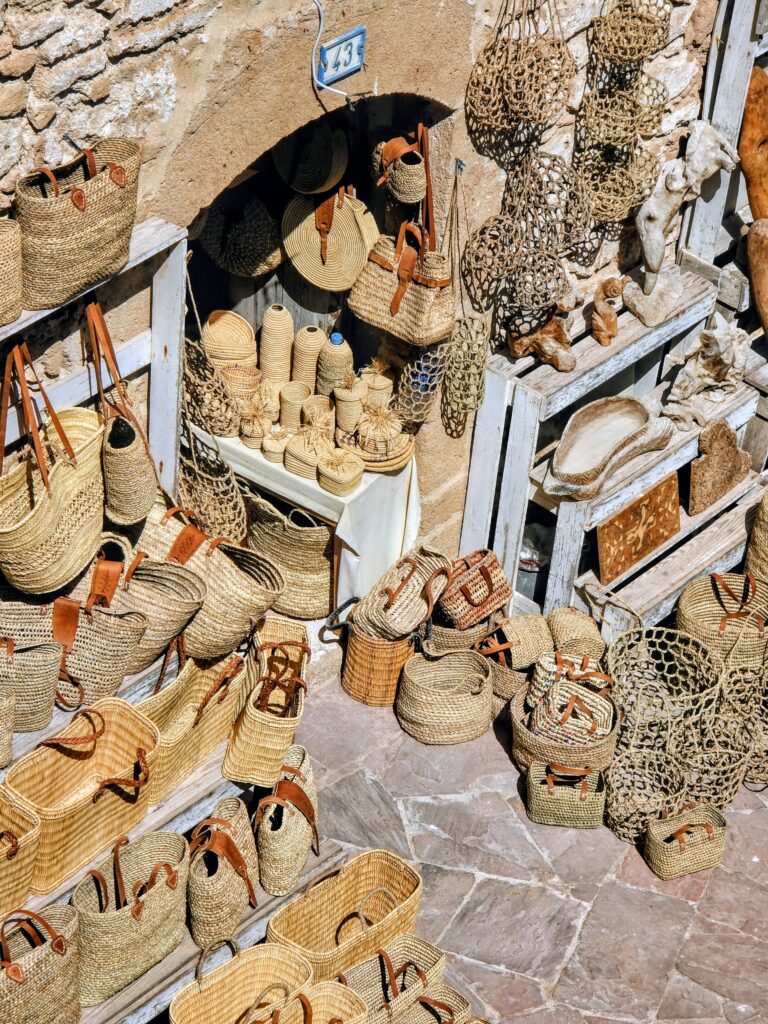
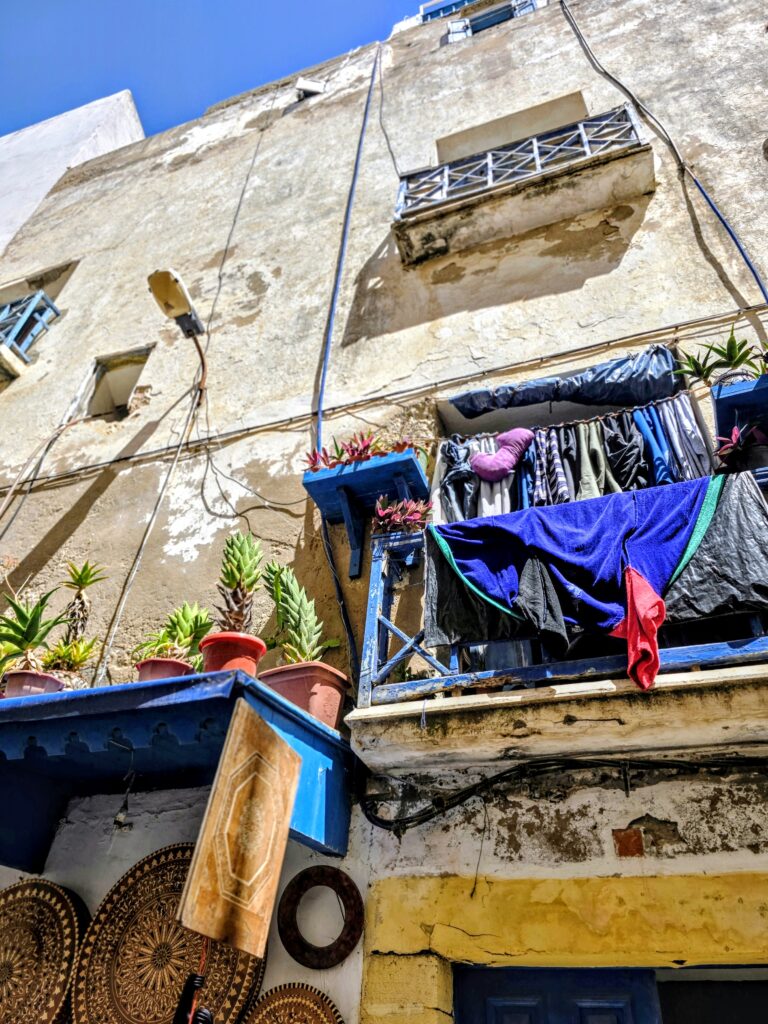
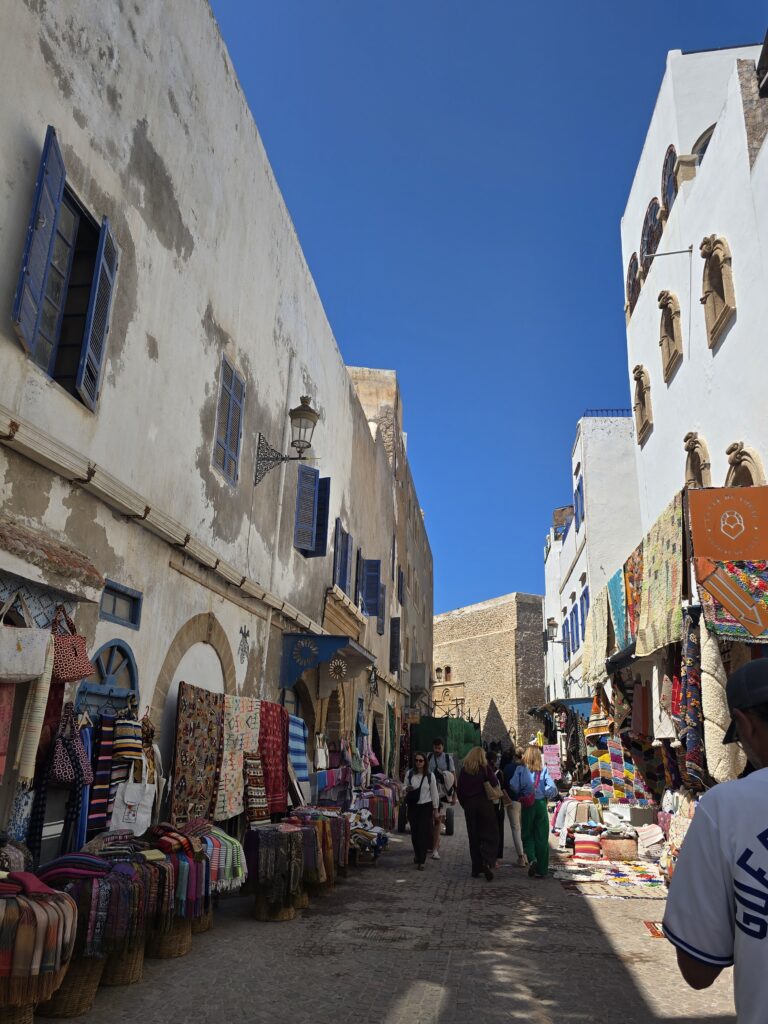
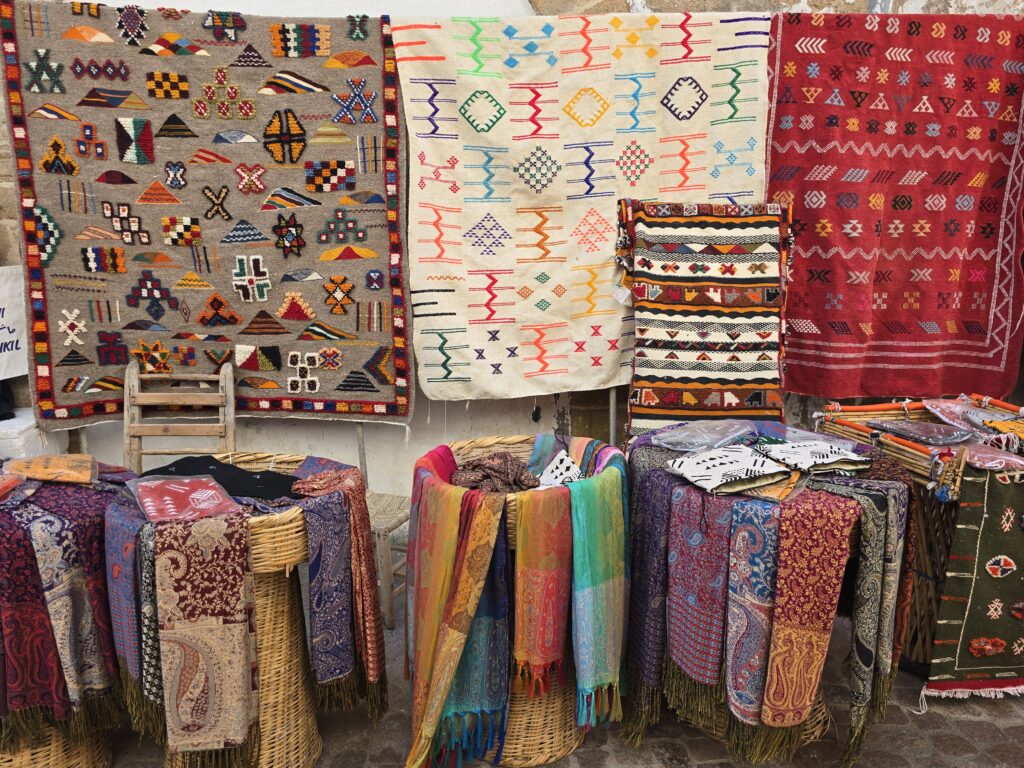
From the ramparts, we dropped back into the medina and began to weave our way through its calmer, salt‑tinged streets. Essaouira’s old town felt different from Marrakech—lower buildings, wider lanes, a softer color palette of white and blue instead of terracotta and jewel tones. Our guide steered us toward select artisans he knew well, pausing to show us workshops where the pace was slower and the work more personal: inlaid wood, textiles, jewelry, each piece shaped by a particular pair of hands rather than a production line.
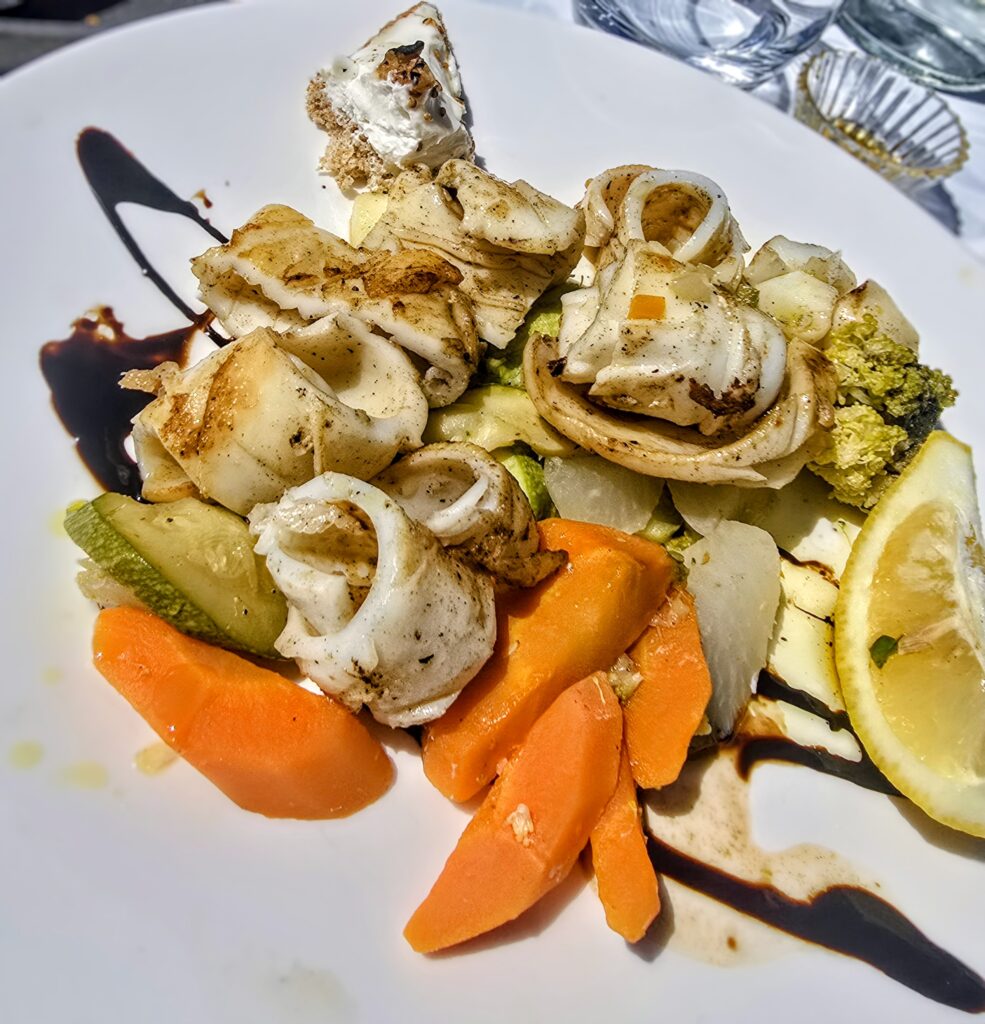
Eventually we wound our way inward to a small restaurant with a rooftop terrace overlooking the coast. Up there, with the Atlantic spread out in front of us and the gulls wheeling overhead, seafood felt like the only appropriate choice. We lingered over a leisurely lunch—grilled calamari for me—while watching the waves slam into the rocks below and the rhythm of the port continue in miniature.
After lunch, I asked our guide if we could circle back to a spot where I’d spotted palmiers, my favorite cookie. He smiled and did one better, leading us instead to a bustling local bakery tucked down an unassuming street. A line spilled out the door—always a good sign—and he slipped inside with the easy confidence of a regular, emerging a few minutes later with a bag full of palmiers and a selection of classic Moroccan pastries we selected from the window display.
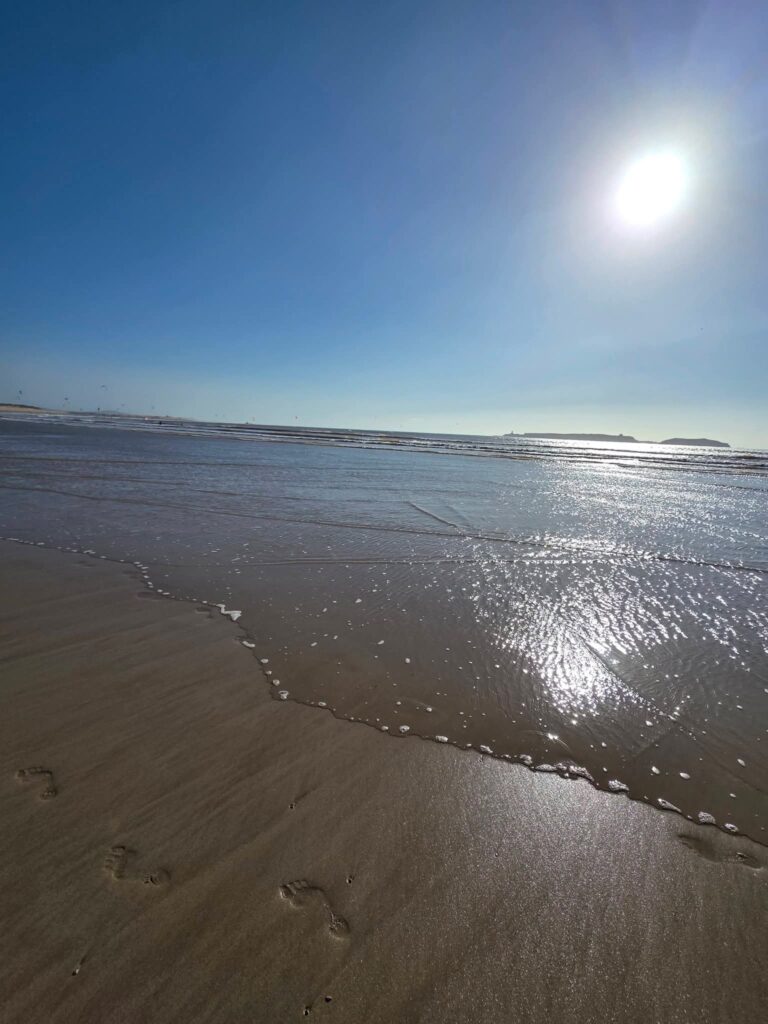
We carried our spoils to a nearby sunlit courtyard just outside a silversmith’s shop, where we sat for a few minutes, letting the warmth soak in while we sampled everything. The palmiers were exactly what I’d hoped for—crisp, buttery, caramelized at the edges—and the pastries around them were sweet, nutty, fragrant with honey. When we’d had our fill, we stepped into the silversmith’s world, learning how delicate filigree, bold Berber motifs, and everyday jewelry are all coaxed into being from plain metal. Our guide then returned us to Soufiane, who made one more stop before we headed back to Marrakech to allow us to spill out onto the beach and feel the sand between our toes.
Luxurious Final Day in Marrakech: La Sultana Hammam, Rooftop Lunch, Shopping & Sunset at Our Riad
Our last full day in Marrakech felt like a love letter to Morocco—slow, indulgent, and sun-drenched from start to finish.
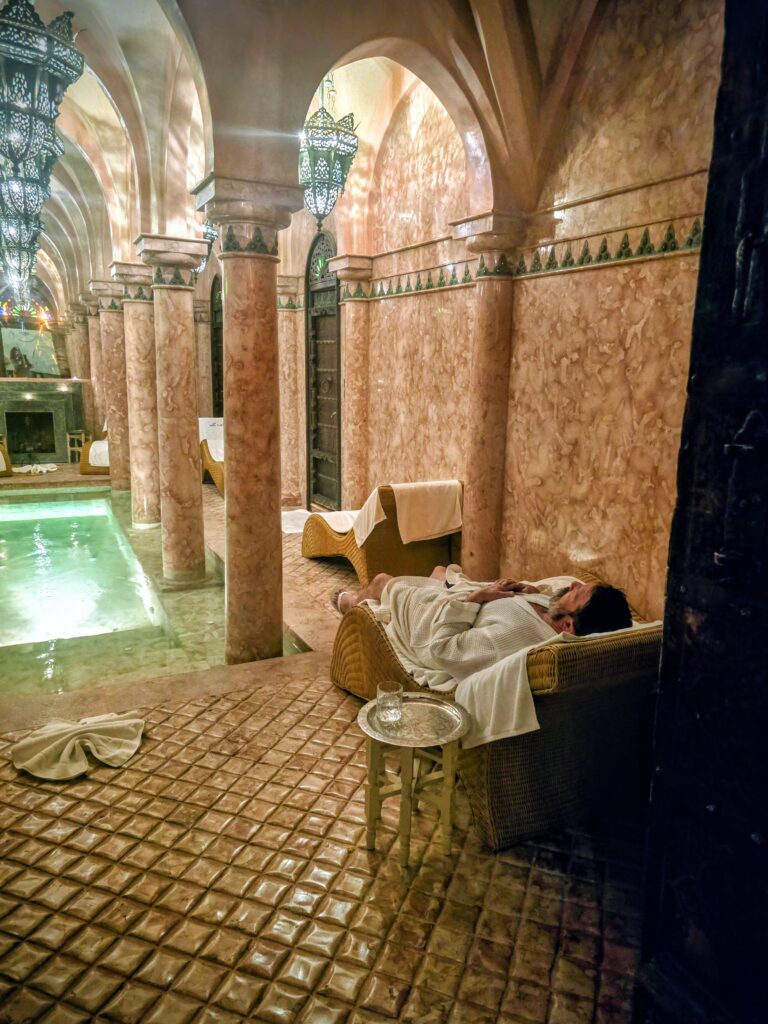
We began the morning at La Sultana for a traditional hammam and massage, the most luxurious way to close out the trip. The hammam was a full sensory reset: steam, black soap, warm water, and that feeling of being completely scrubbed back to new skin. Afterwards, we floated straight into the spa lounge for a massage that melted away every last bit of travel tension.
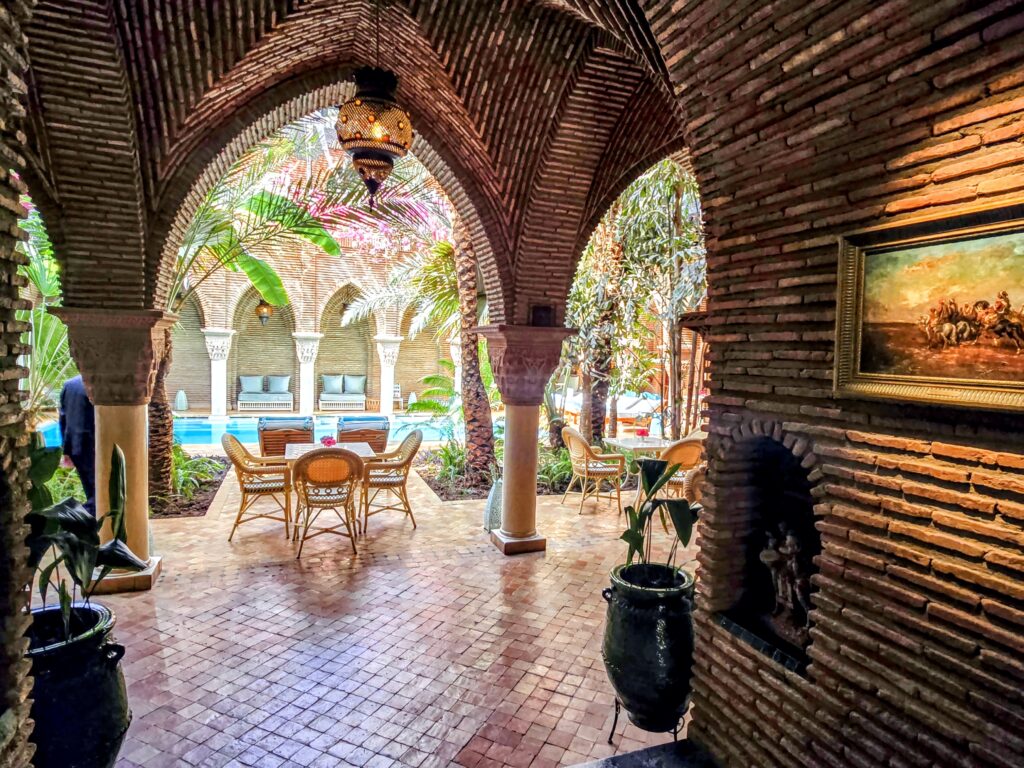
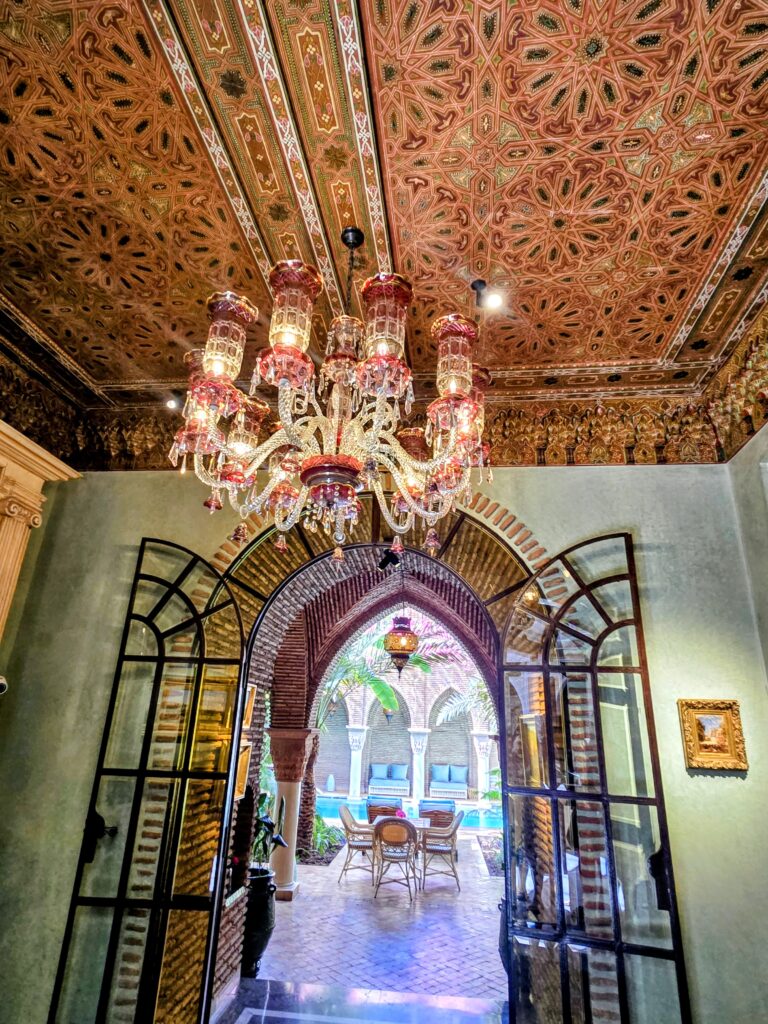
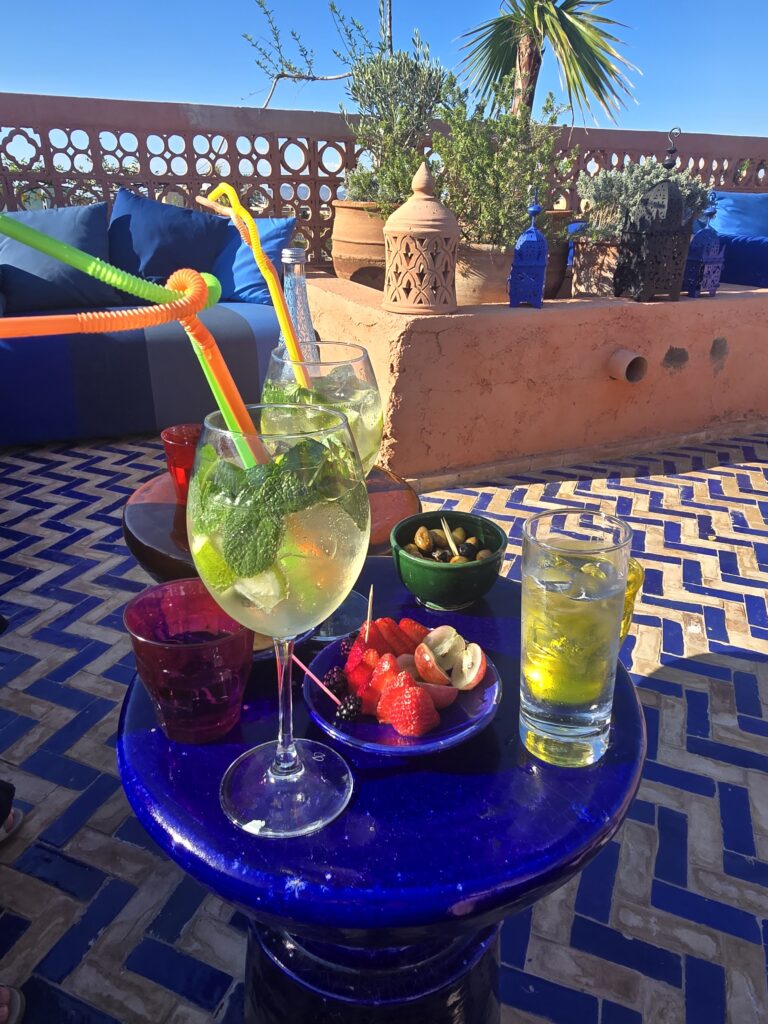
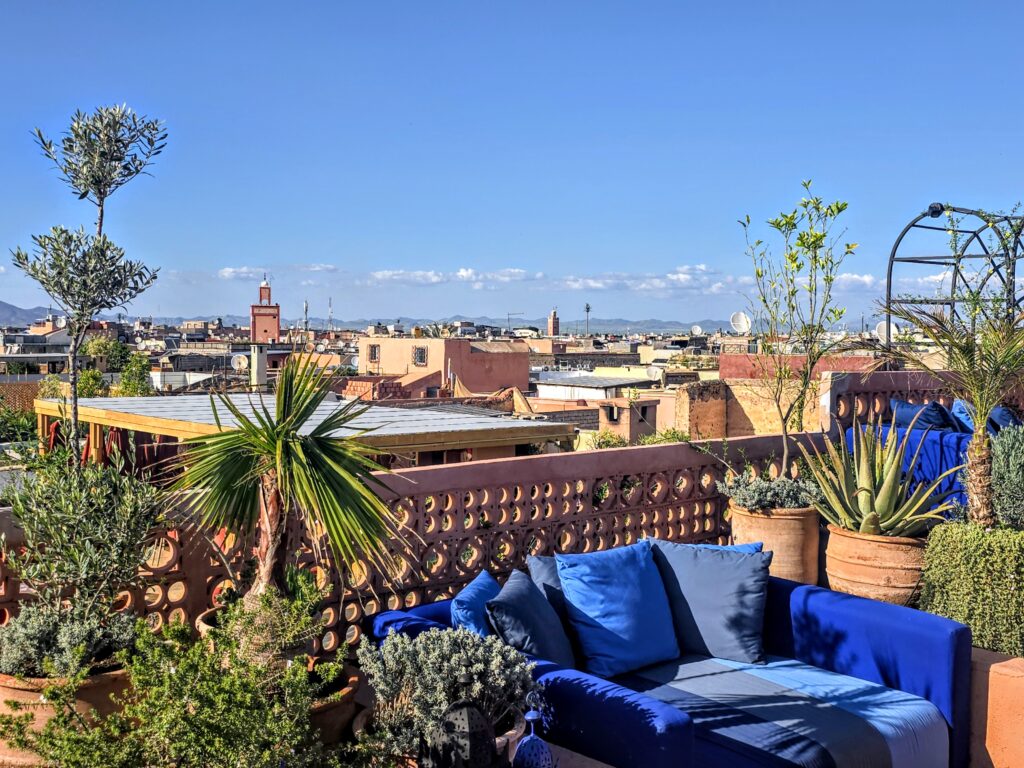
Soft and serene, we headed up to La Sultana’s rooftop for lunch. The moment we arrived, we were handed straw hats to shade our faces from the midday sun—a small touch that made everything feel even more cinematic. The rooftop was lush and decadent, with views stretching across Marrakech, and we settled into a long, lazy 5-star lunch.
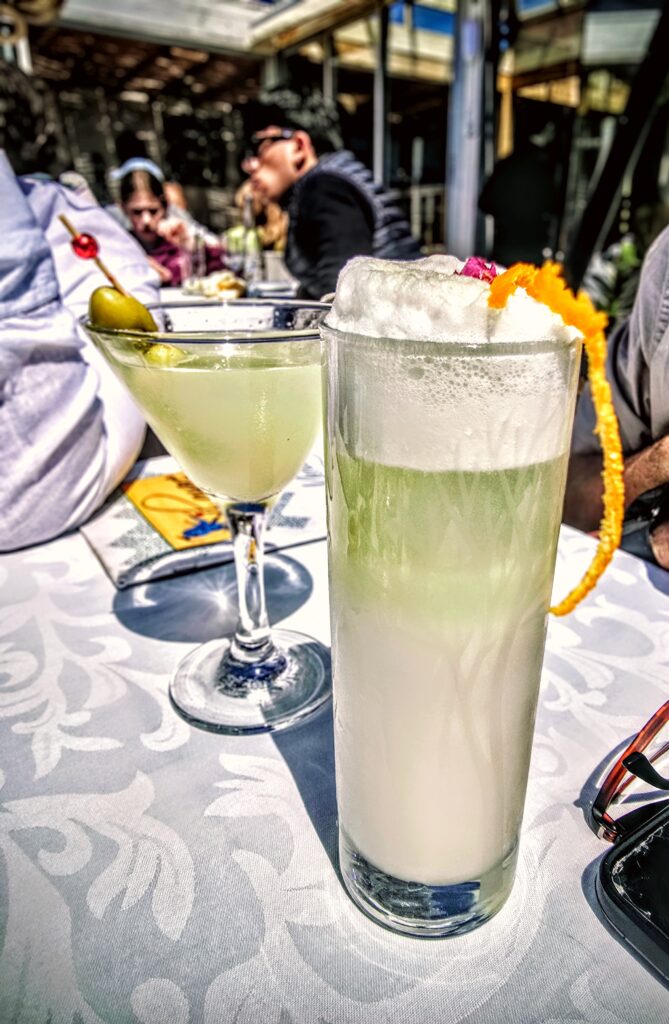
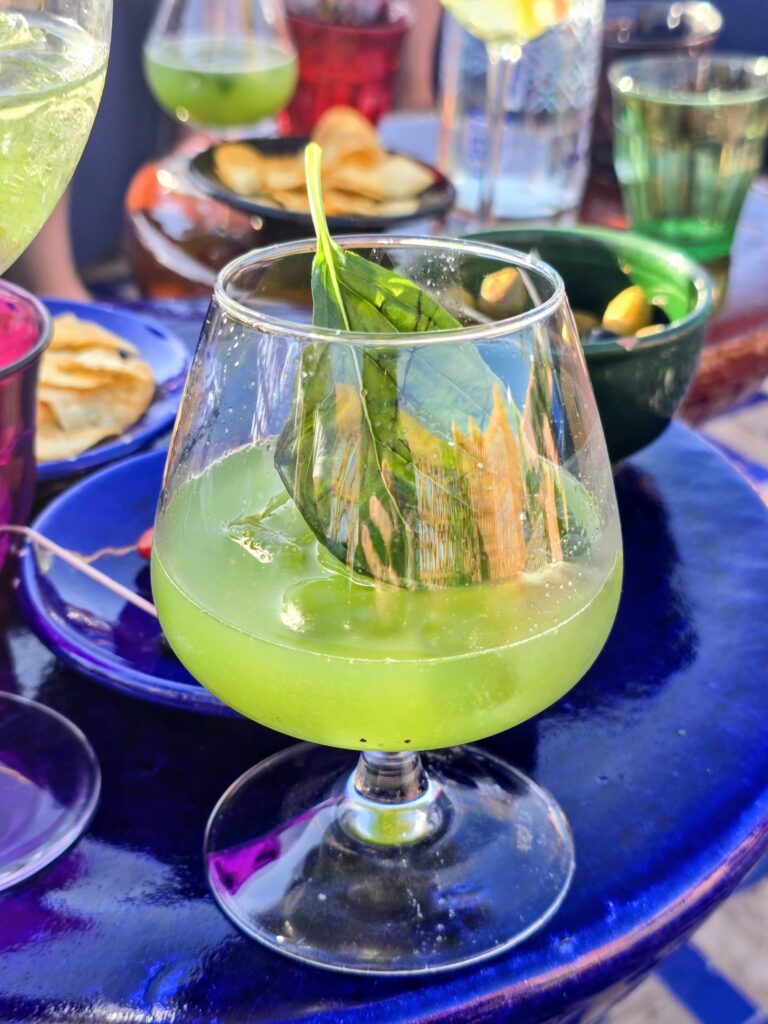
We started with cocktails, each one as beautiful as the view:
Cocktail Highlights
- Atlas Spritz – Local sparkling wine, elderflower, tonic, and orange slice
- Desert Rose – Gin, rose water, lemon, sugar, and a rose petal garnish
- Mint Medina Mojito – White rum, fresh mint, lime, sugar, and soda
- Saffron Sunset – Vodka, saffron-infused syrup, orange, and passion fruit
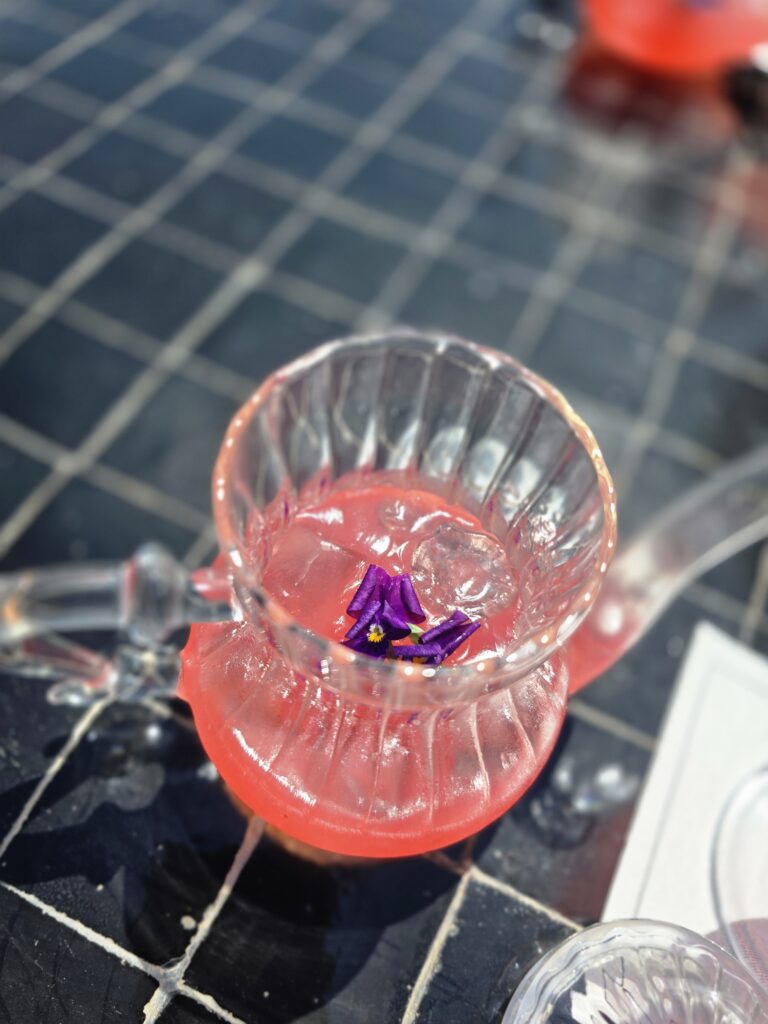
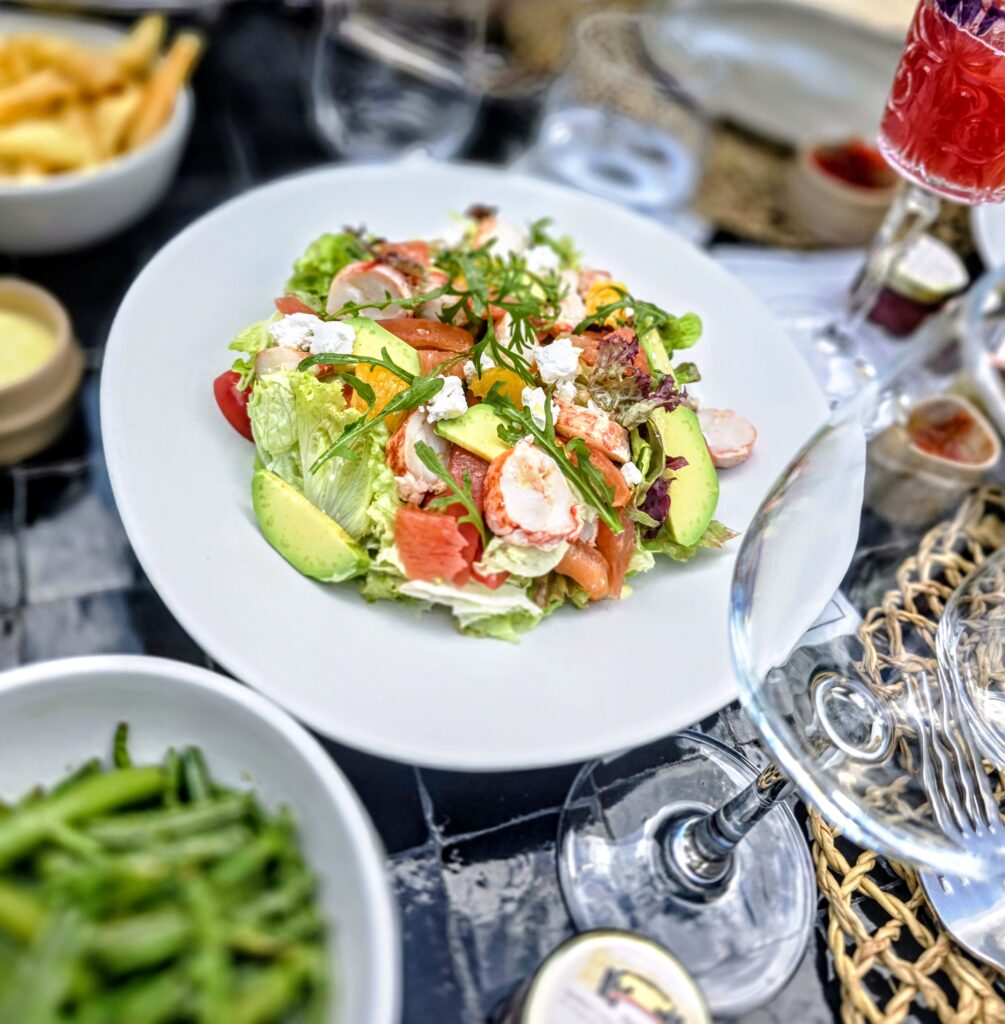
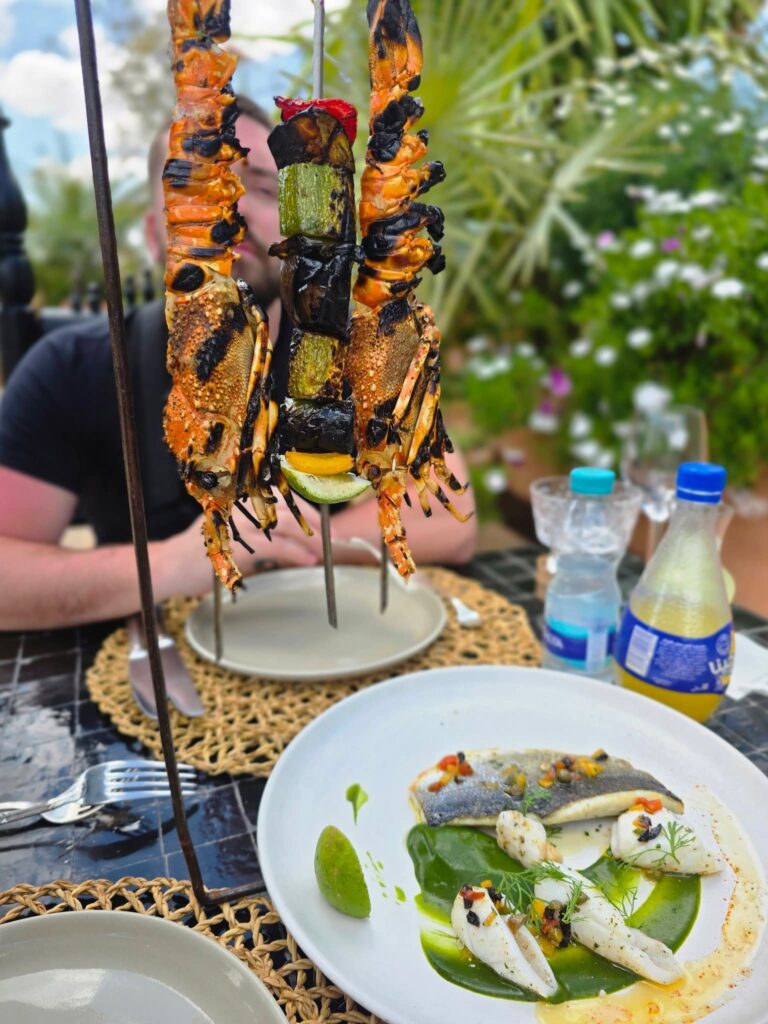
Glasses clinked under the straw hats as we lingered in the shade, and then the food began to arrive: decadent lobster, perfectly grilled fish, and tender squid, all brightened with citrus, herbs, and that unmistakable Mediterranean-meets-Moroccan flair. It was the kind of lunch you try to stretch out as long as possible, knowing it’s one of the last.
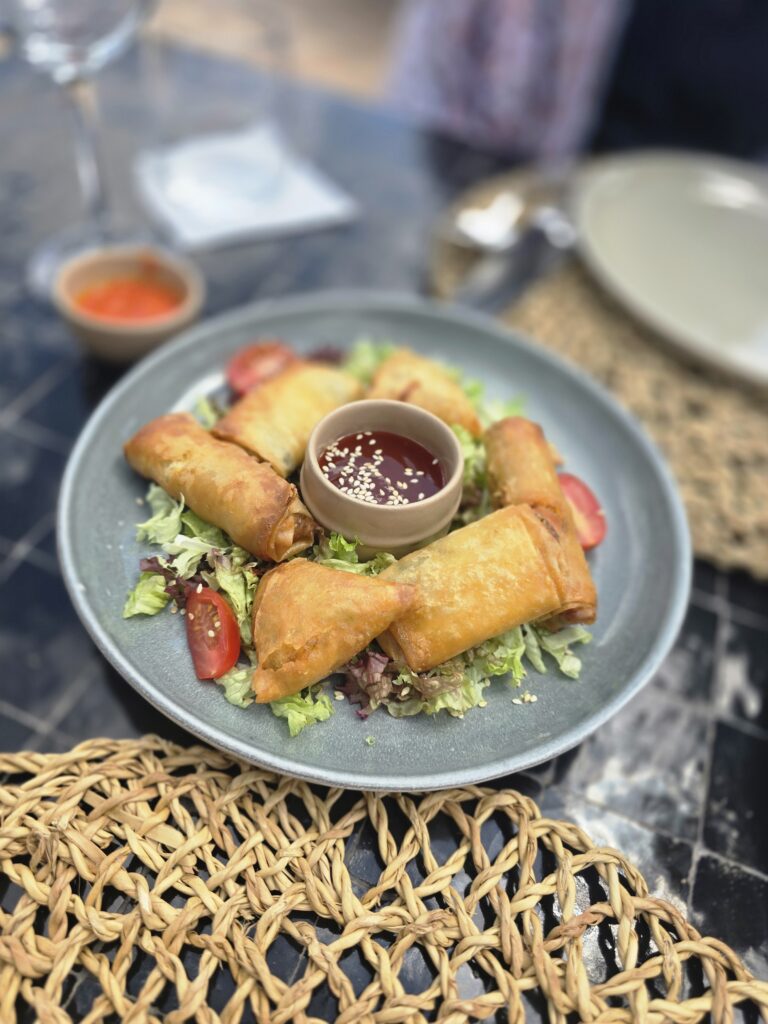
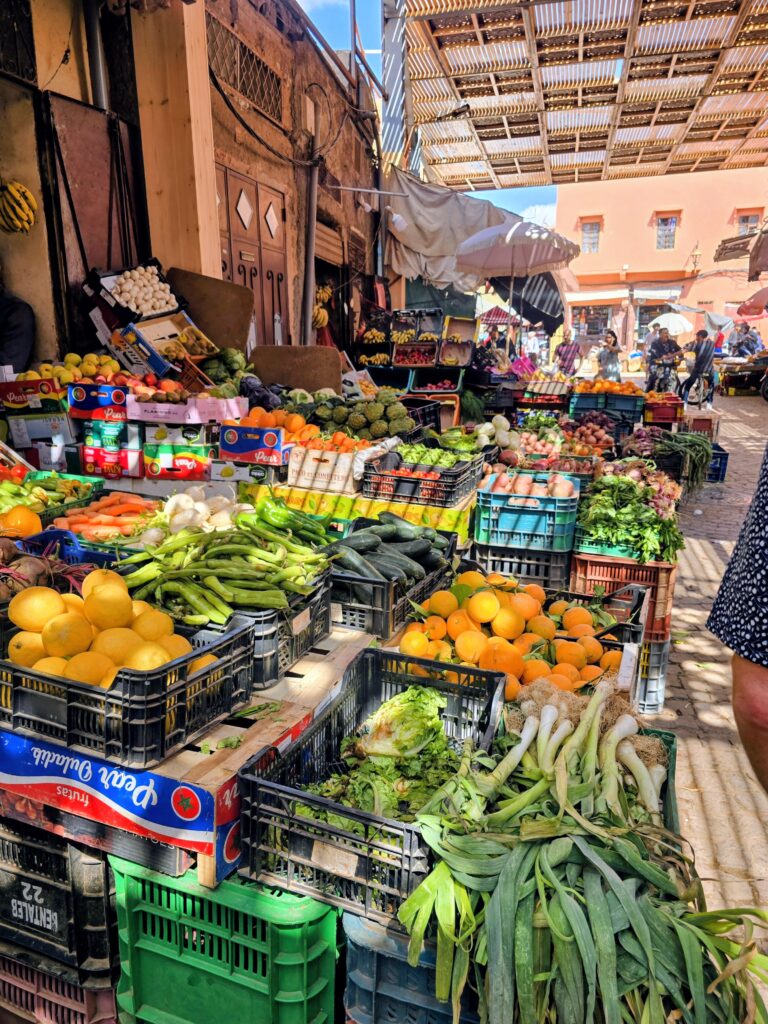
Afterwards, we wandered slowly through the nearby streets and alleys for a final round of shopping. This time we were on a mission for edible souvenirs: jars of fiery harissa, and food-grade rose and lavender to carry a bit of Morocco’s fragrance back home with us. The afternoon slipped by in a haze of color, spice, and that familiar medina buzz.
When the bags were full and our feet were ready for a break, we called Soufiane, who had become our trusted driver and unofficial Marrakech guide. He whisked us back to our riad, where we headed straight for the rooftop one last time. We ordered more drinks, turned our faces to the sky, and tried to soak in every last Moroccan sunbeam, committing the warmth and light to memory.
Our final evening was spent exactly where it all began: in the courtyard of our riad, dining al fresco. The bartender and server, who by now felt more like friends than staff, joined us in easy conversation between courses. There was laughter, shared stories, and that bittersweet feeling of knowing a trip is coming to an end just as it feels most familiar.
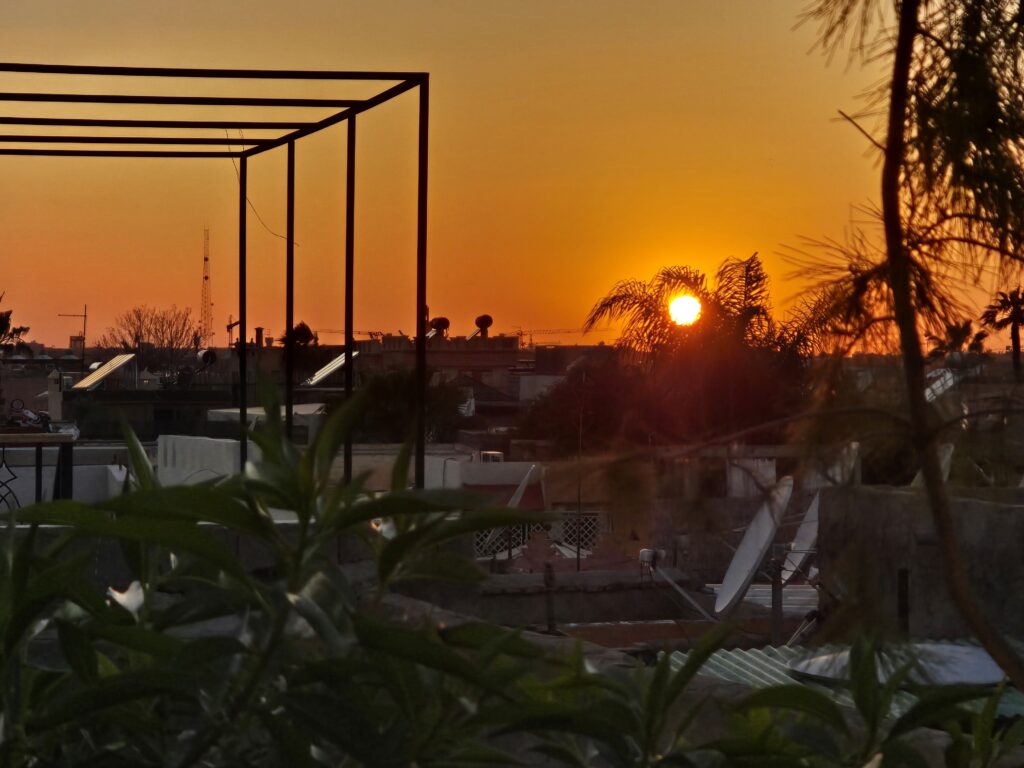
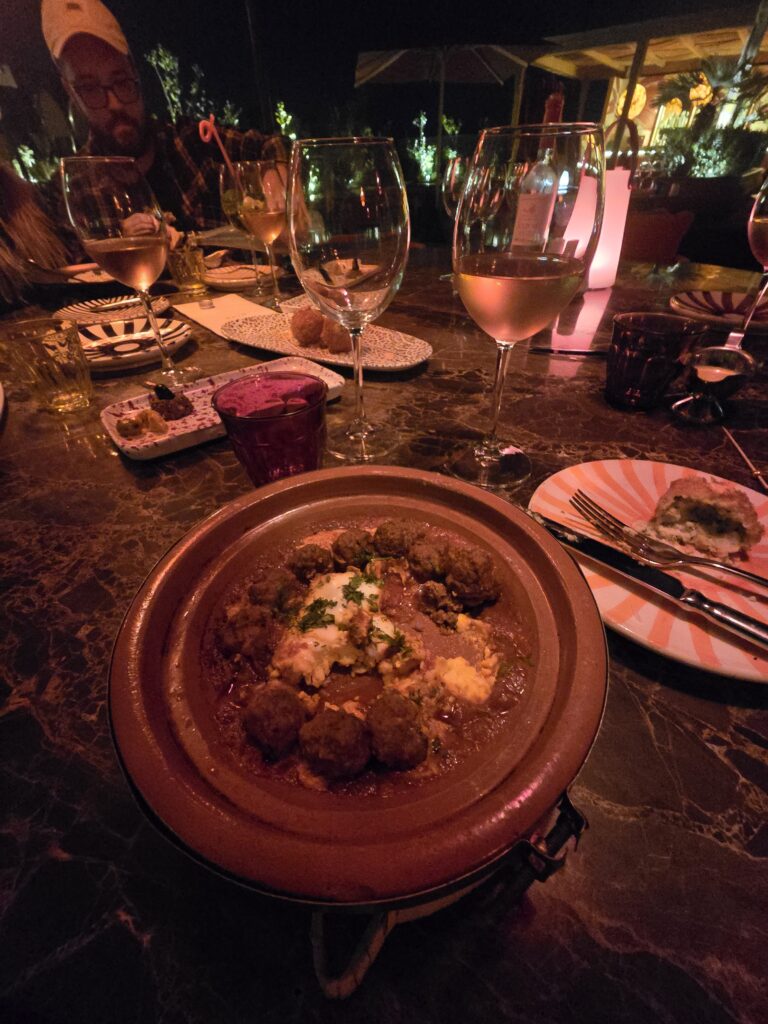
We toasted to Marrakech one last time—its hammams and rooftops, its spices and sunsets, and the people who made it feel like home, if only for a few days.
Goodbye, Morocco: A Deeper Kind of Connection
The next morning, we packed our bags one last time and began the journey back to Casablanca for our flight home. The drive felt quieter than when we’d first arrived—less about anticipation and more about reflection. The landscapes that had once felt so new now seemed almost familiar, like pages in a book we’d just finished but weren’t quite ready to close.
As I watched Morocco roll by outside the window, I realized that what I felt leaving this country was different from so many places I’ve visited before. Travel often gives me a sense of connection—a fondness for a city, an appreciation for its food, its architecture, its rhythm. But Morocco stirred something deeper.
Here, I found myself appreciating humanity in a new way: in the warmth of every “welcome,” the patience of every explanation, the quiet pride in every pot of mint tea poured and every dish served. Beauty took on a different meaning too. It wasn’t just in the grand mosques, intricate tiles, and golden sunsets, but in everyday moments—the laughter echoing through a riad courtyard, the gentle chaos of the medina, the calm of the desert sky.
As our plane lifted off from Casablanca, I knew I was leaving more than just a destination behind. Somewhere between the alleys of Marrakech, the calm of the hammam, and the shared meals under the stars, I left a small piece of my heart in this wonderful Kingdom. My hope is that I’ll return one day to find it again—to revisit the places that felt like instant memories, to discover new corners of Morocco, and to reconnect with the quiet, grounding magic that makes this country unlike anywhere else I’ve been.