Minarets rising from ancient medinas, snow-dusted peaks watching over the desert, and the scent of spice and orange blossom drifting through sun-warmed streets—Morocco always felt to me like a doMy Moroccan Magic Carpet Ride: Riads, Road Trips, and an Arabian Nights Dreamorway into the tales of the Arabian Nights. I chose this kingdom not just for its bright colorful cities, bustling souks, and endless dunes, but because it promised exactly what my imagination had been chasing for years: a place where history and myth still seem to walk side by side. This is the Morocco I went searching for—and the one I’m excited to share with you.
Perched at the crossroads of Africa, Europe, and the Arab world, the Kingdom of Morocco has been shaped by ancient Amazigh (Berber) civilizations, one of the oldest Jewish communities in the diaspora—rooted here long before the Arab conquerors arrived—and centuries of trade across the Sahara and the Mediterranean. From the imperial cities of Fes and Marrakech to the Atlantic ports that once lured merchants and pirates alike, Morocco has long looked outward, blending cultures while fiercely guarding its own identity.
That spirit of openness is woven into one of my favorite historical tidbits: in 1777, Sultan Mohammed III made Morocco the first country to officially recognize the newly independent United States. Long before my plane touched down in Casablanca, these old diplomatic ties gave my Arabian Nights daydreams a surprising twist—reminding me that this “exotic” kingdom from my imagination has quietly been part of my own country’s story for nearly 250 years.
Arrival in the White City: Casablanca
We flew with Royal Air Maroc on a direct flight from Dulles to Casablanca, where we were met by a Fast Track agent who whisked us through airport protocols. Passports stamped and luggage collected, we were swiftly delivered to our “chauffeur,” who would stay with us throughout our 11 days in Morocco.
In the almost eight-month lead-up to this adventure, I had worked closely with a boutique travel curator, Morocco Riads and Beyond, to shape an itinerary that felt less like a tour and more like a thread through the culture, terrain, and people of Morocco. All that behind-the-scenes curation is what made what followed feel so seamless—a detail that will come full circle later in this story.
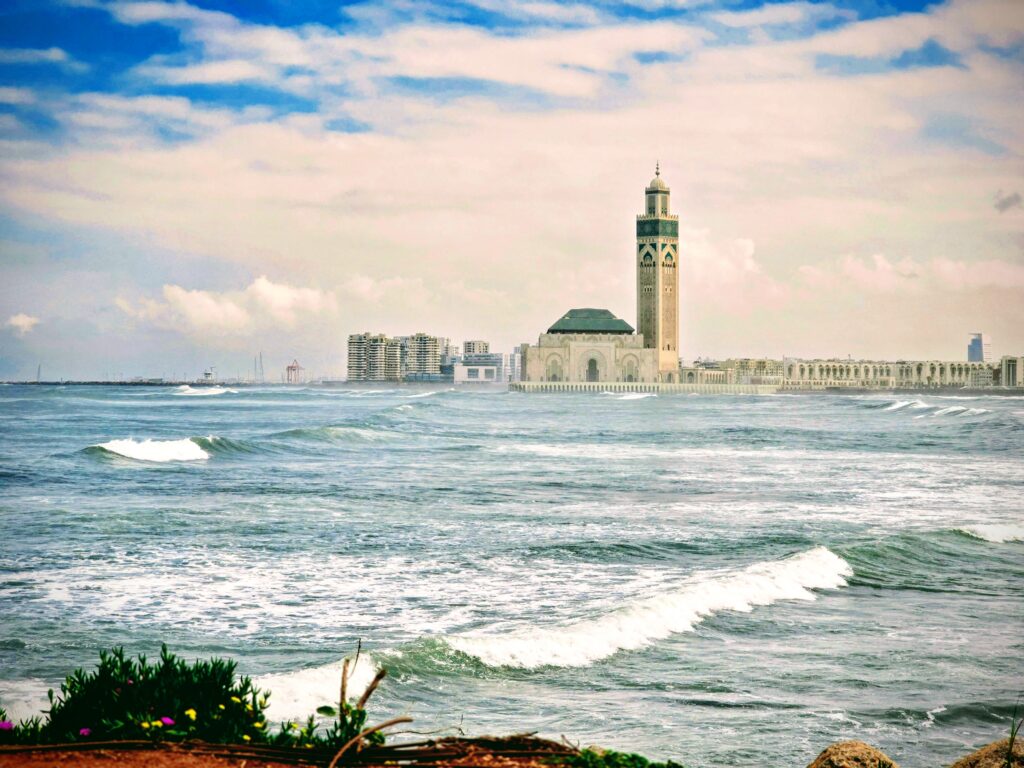
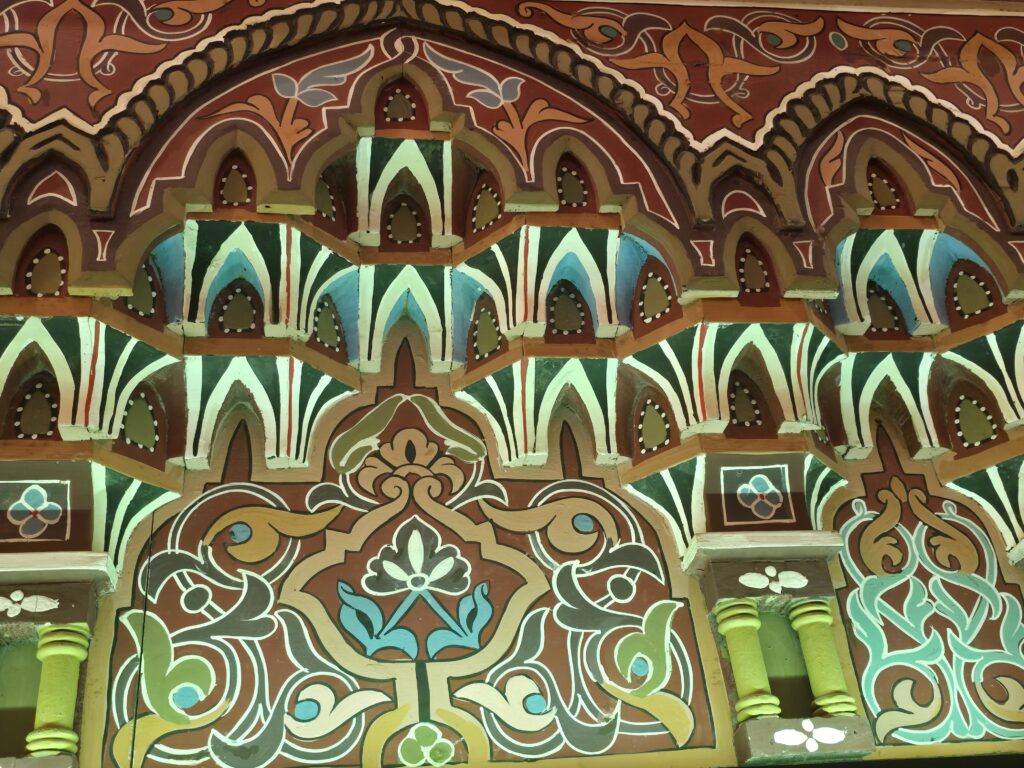
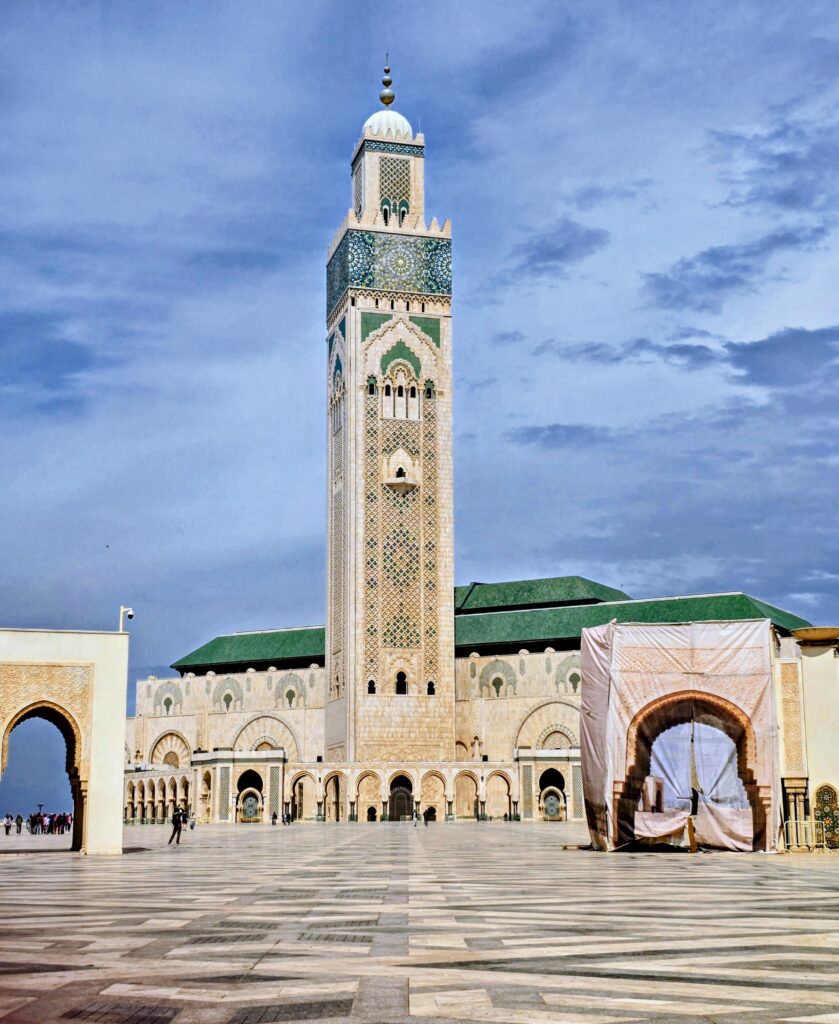
Our driver, Soufiane, introduced himself and we were off on a brief vehicle tour of Casablanca with three stops: the luminous modernist Catholic church of Notre Dame de Lourdes, famed for its sweeping stained-glass walls; the grand Place Mohammed V, Casablanca’s central square framed by French colonial architecture and a busy fountain; and finally the showstopper, the Hassan II Mosque—one of the largest mosques in the world, its 210-meter minaret towering over the Atlantic, its prayer hall able to hold 25,000 worshippers (with space for tens of thousands more outside), and every surface dressed in intricate zellij tilework, marble, and carved cedar that left us in awe on our very first day. Casablanca serves as the major economic hub for Morocco but it was not a planned overnight stop and after glimpsing Rick’s Cafe briefly, we began our road trip to Fez.
Road to Fez: Into Morocco’s Spiritual Heart
From Casablanca we started our road trip inland to Fez, Morocco’s spiritual and intellectual heart. With its UNESCO-listed old medina, the 9th-century University of al-Qarawiyyin, and a maze of car-free alleyways that feel centuries removed from the modern world, Fez promised to be our first real plunge into the Morocco of my imagination.
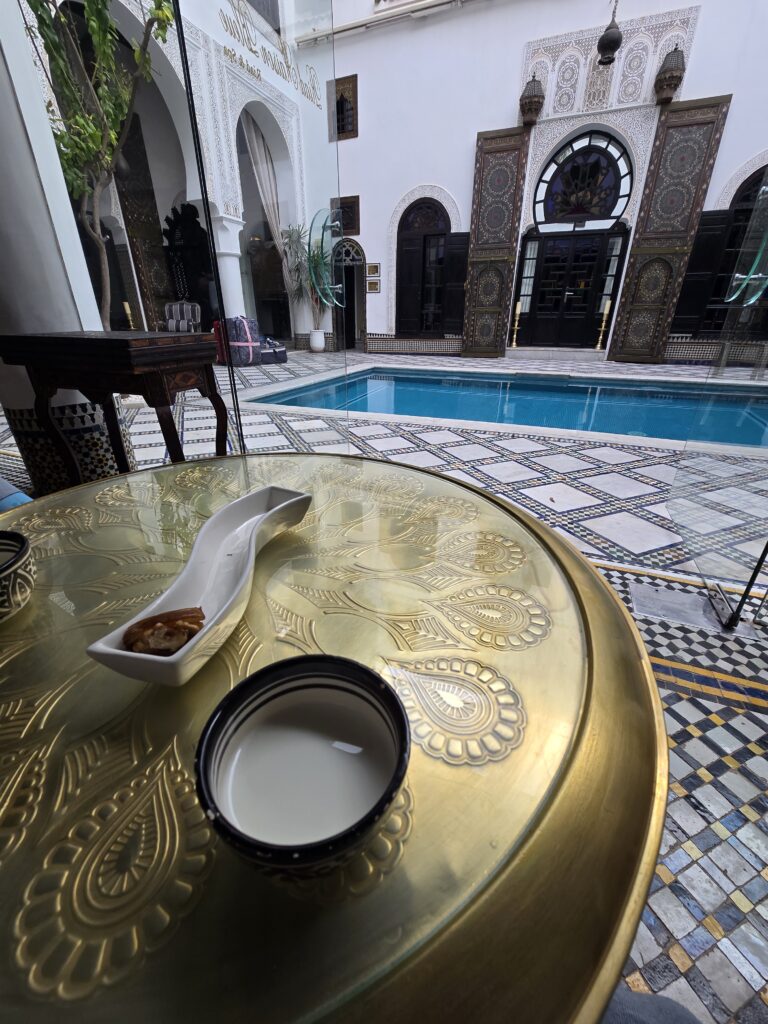
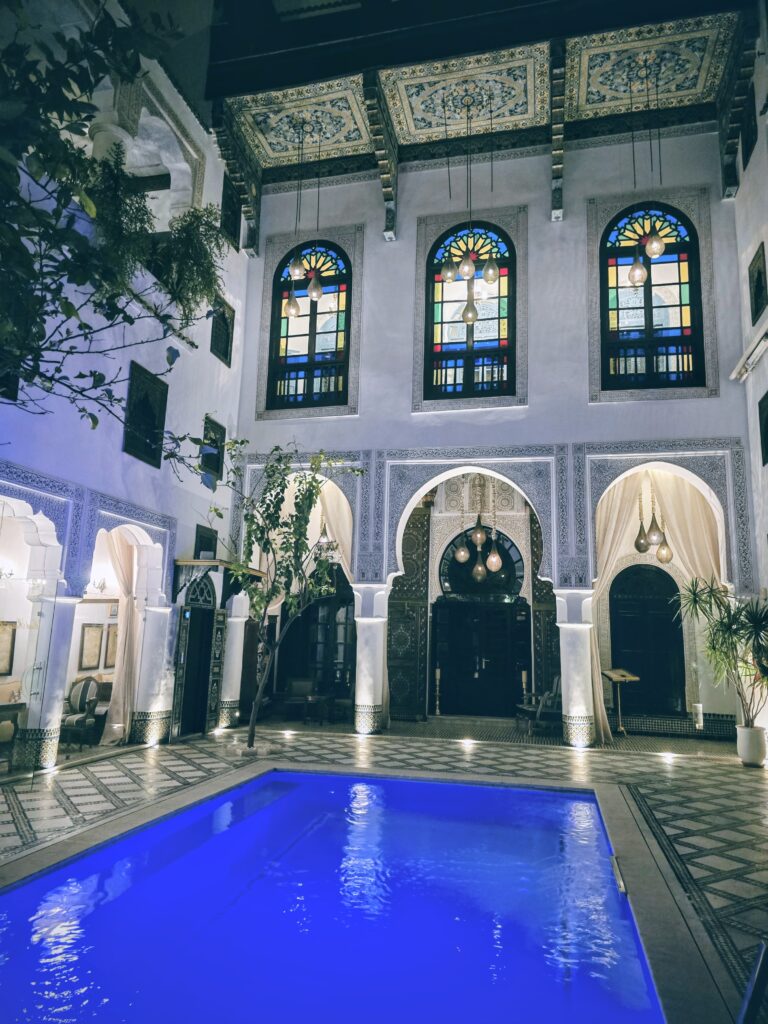
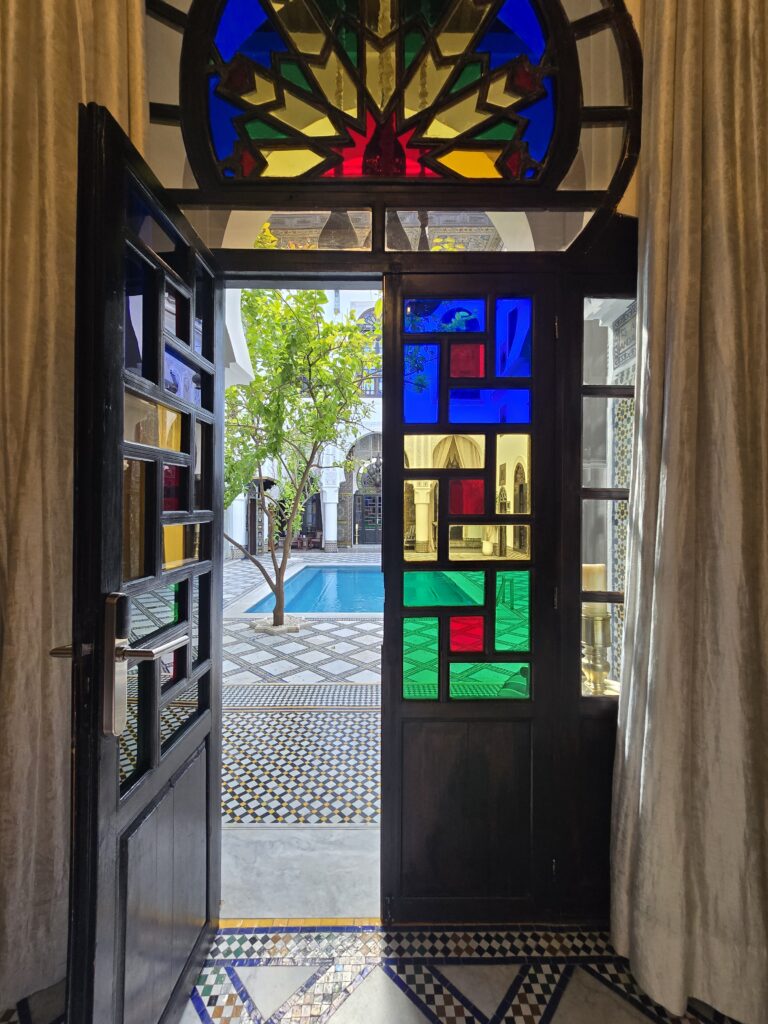
The drive from Casablanca to Fez is roughly 4–4.5 hours, so Soufiane took us straight to our accommodations for our two-night stay in Fez: Riad La Maison Bleue, where we received our first taste of Moroccan hospitality with trays of rose milk, pastries, and nuts. A riad, I learned, is more than just a boutique hotel—it’s a traditional Moroccan house built inward around a central courtyard or garden, usually hidden behind a plain exterior door in the medina. Step inside, though, and you’re suddenly in another world of tiled courtyards, carved wood, fountains, and birdsong. La Maison Bleue was our first riad, and the moment we crossed its threshold, Morocco started to feel not like a place we were visiting, but like a home we were being welcomed into.
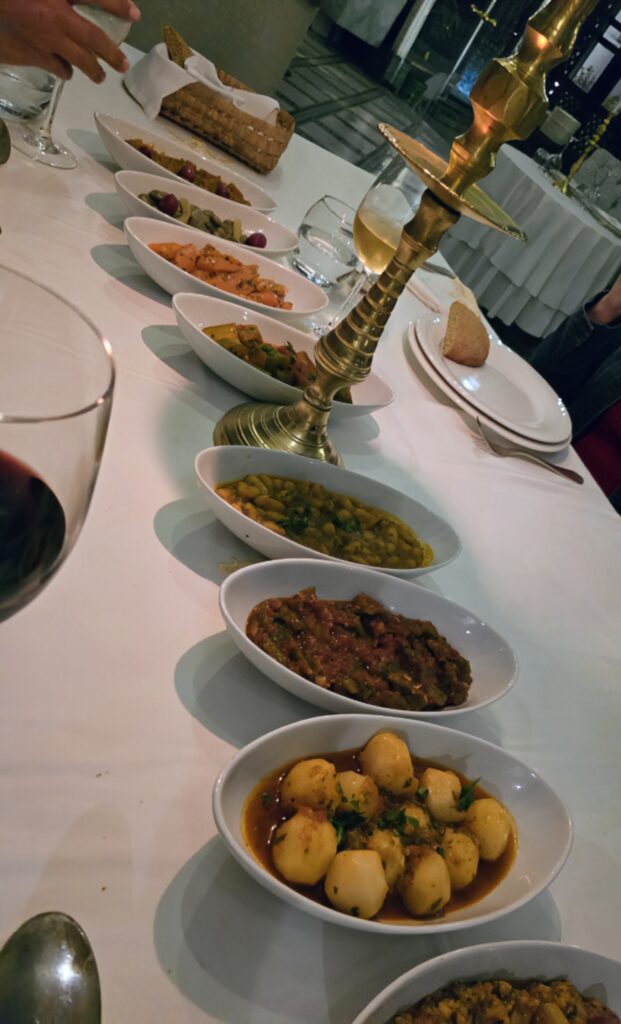
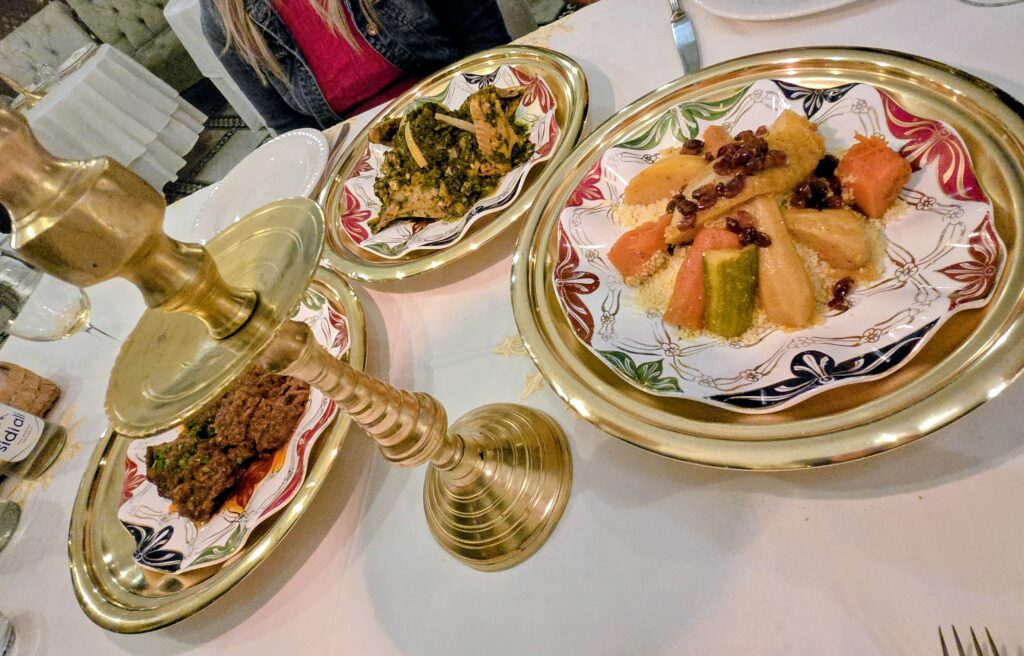
That first evening, we were also introduced to our first traditional Moroccan cuisine: tagine. A tagine is both the name of the dish and the conical clay pot it’s cooked in. Meat, vegetables, dried fruits, and spices are layered inside, then slow‑cooked so the steam circulates under the lid and everything gently braises in its own juices. The result is fall‑apart tender, fragrant with cumin, saffron, ginger, and preserved lemon—a kind of edible welcome to Morocco. We would come to enjoy tagine in many variations over the course of our trip—chicken, lamb, goat, (gasp camel), vegetable, sometimes sweet with figs or apricots—as it’s an integral part of the Moroccan diet and appears on almost every table.
Exploring the Fez Medina: Rug Cooperative, Tanneries, Hidden Doors & City Views
The next morning, fortified by breakfast, we met our local guide for a walking tour of the medina. If arriving in Fez had felt like stepping into a different world, this was our invitation to actually understand it.
Within minutes we were absorbed into the tangle of alleyways—past butchers and bakeries, doorways draped in woven textiles, and glimpses of everyday life unfolding behind half‑open doors. Because it was Ramadan, many of the stalls were closed or quiet, metal shutters pulled down or propped half‑open. The medina felt hushed, almost suspended in time—a stark contrast to the way we’d later see it explode into color and sound once Eid al‑Fitr was announced.
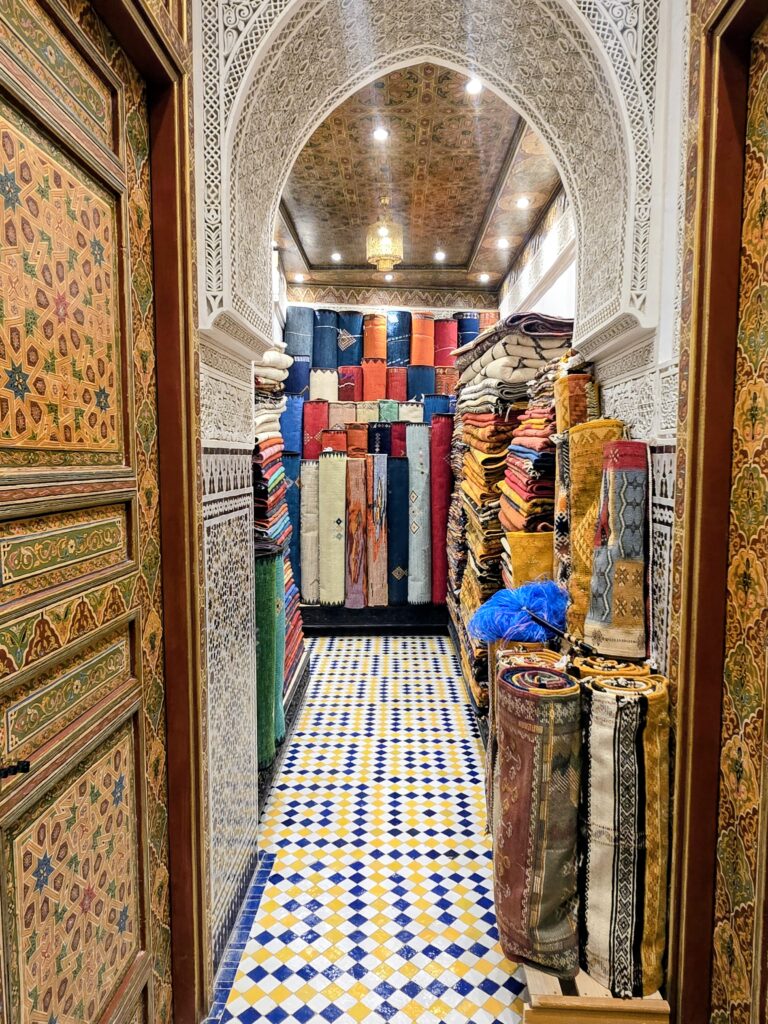
Our first stop set the tone for the day: a beautifully restored, multi‑level fondouk in the medina that once hosted traders and their goods, now dedicated to the art of Moroccan rug making.
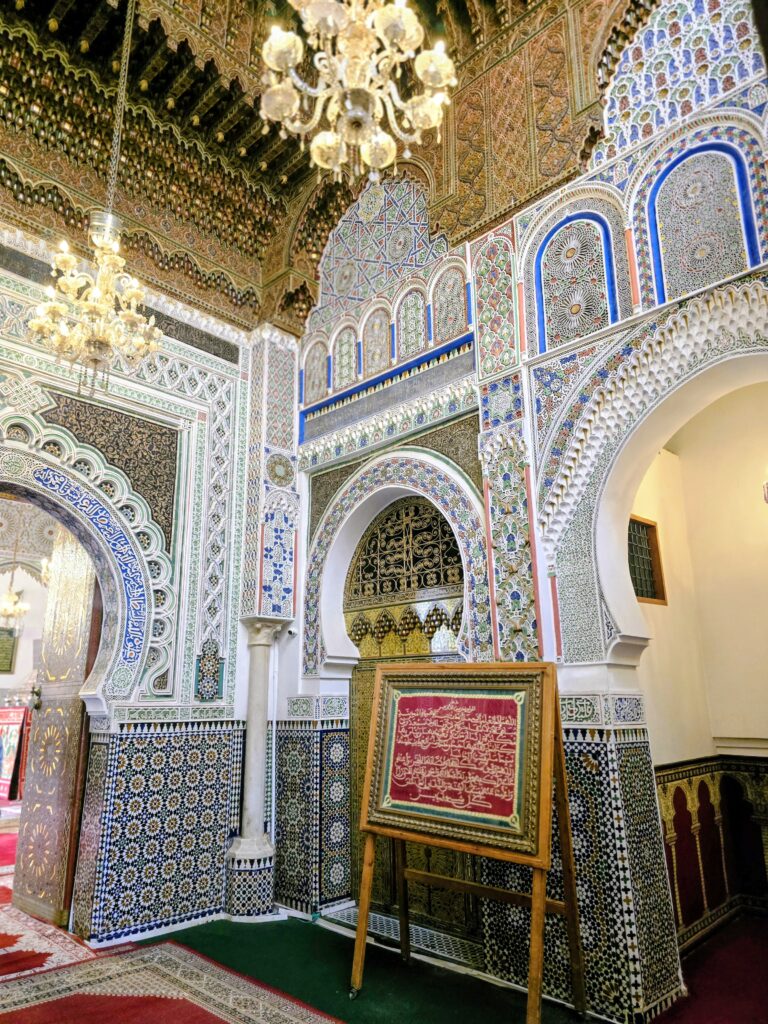
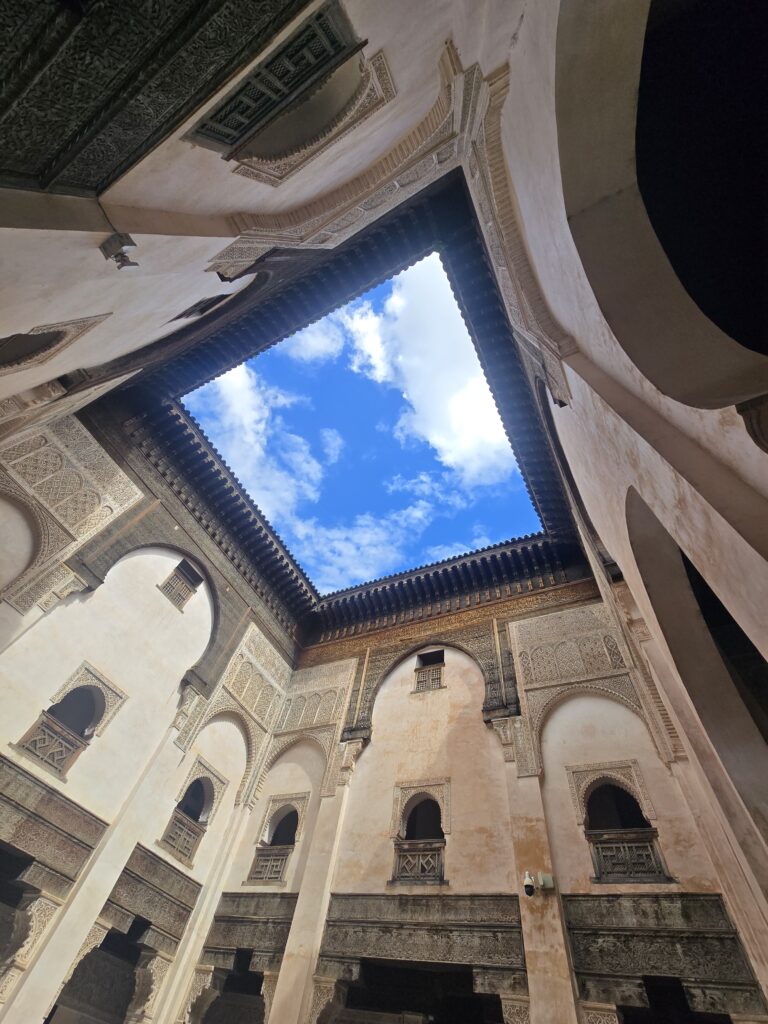
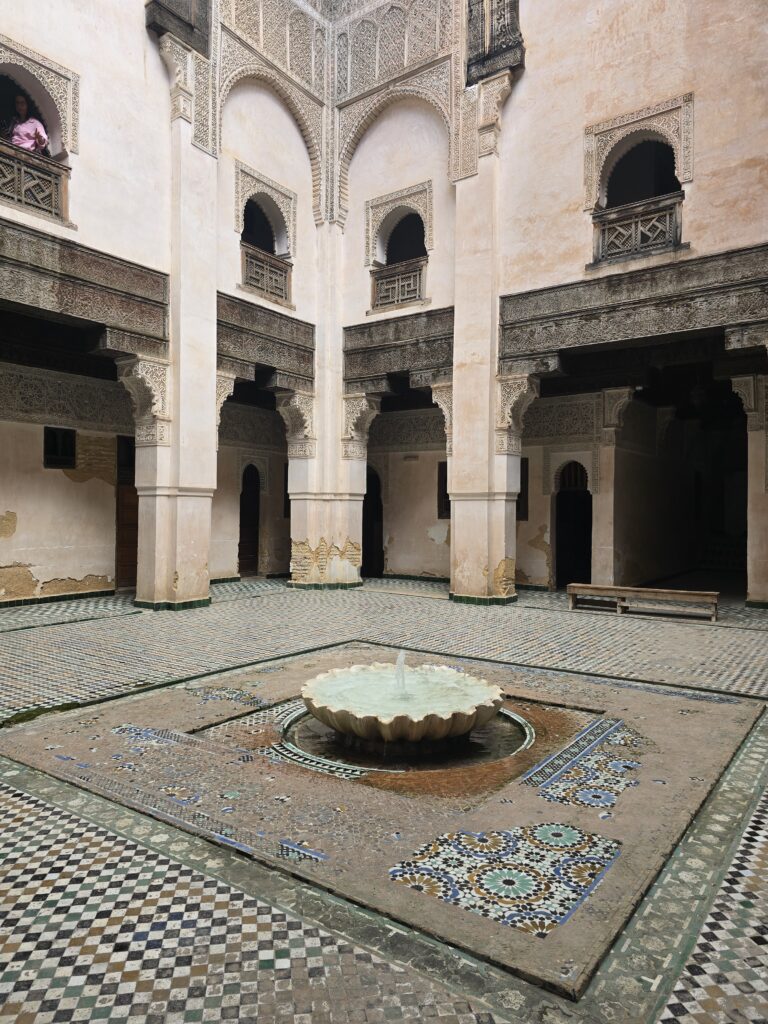
From the outside, the building was almost unremarkable, another sand‑colored façade along a narrow lane. Inside, it opened into a light‑filled atrium wrapped in galleries and archways. The floors and walls were clad in vibrant zellij tilework—geometric patterns in deep cobalt, emerald, and sun‑warmed ochre—framing carved cedar columns and railings that, incredibly, were original. The wood glowed with the patina of centuries.
We were ushered up a short flight of stairs and settled onto low couches while someone appeared with what turned out to be the best cup of Moroccan tea of our entire trip. It arrived in a gleaming silver teapot, poured from high above into small glasses so that a crown of foam formed on top. This version was perfectly balanced: strong green tea, just enough sugar, and a fistful of fresh mint that made the whole glass taste like liquid sunshine.
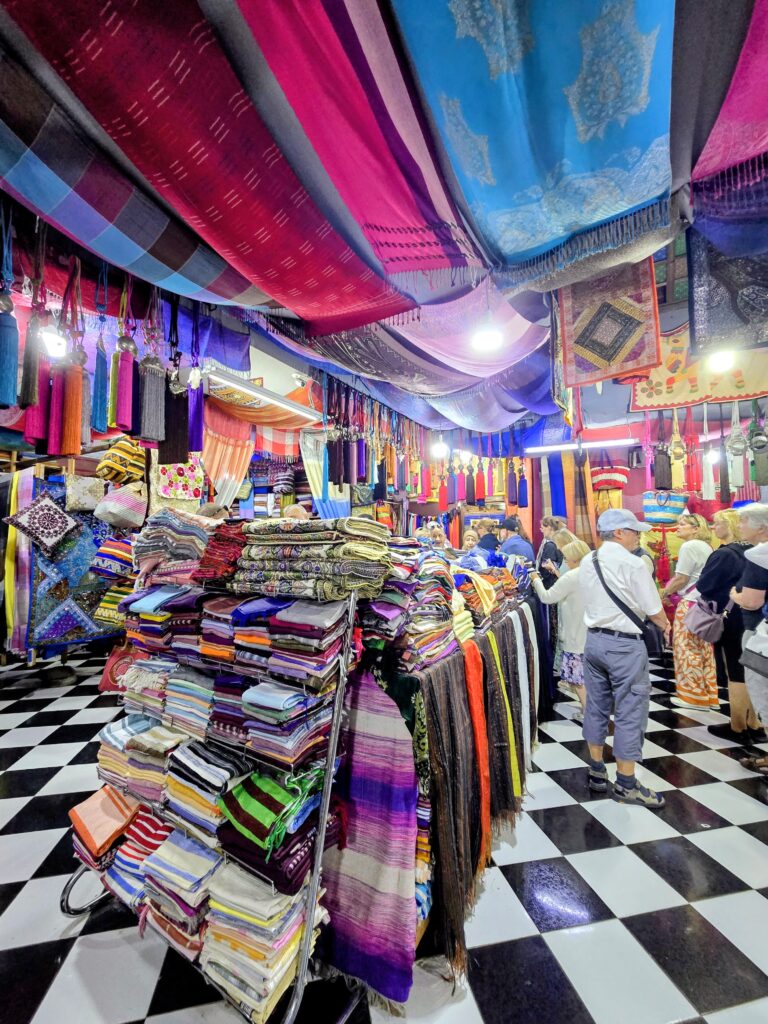
As we sipped, our host began to unfold the story behind the rugs stacked around us. Everything, he explained, is sourced locally: wool from Moroccan sheep, sometimes mixed with camel hair; silk spun from the fibers of cactus plants; natural dyes made from plants, roots, and minerals. Nothing about these pieces is mass‑produced. Each rug is a slow conversation between the weaver, her materials, and her memories.
This particular cooperative, he told us, focuses on supporting some of the most vulnerable members of the community: young girls learning a trade, widows, and divorced women who might otherwise struggle to find stable income. The rugs are beautiful, but knowing who they help support—and how long it takes to create each one—adds a different kind of weight to the decision to buy.
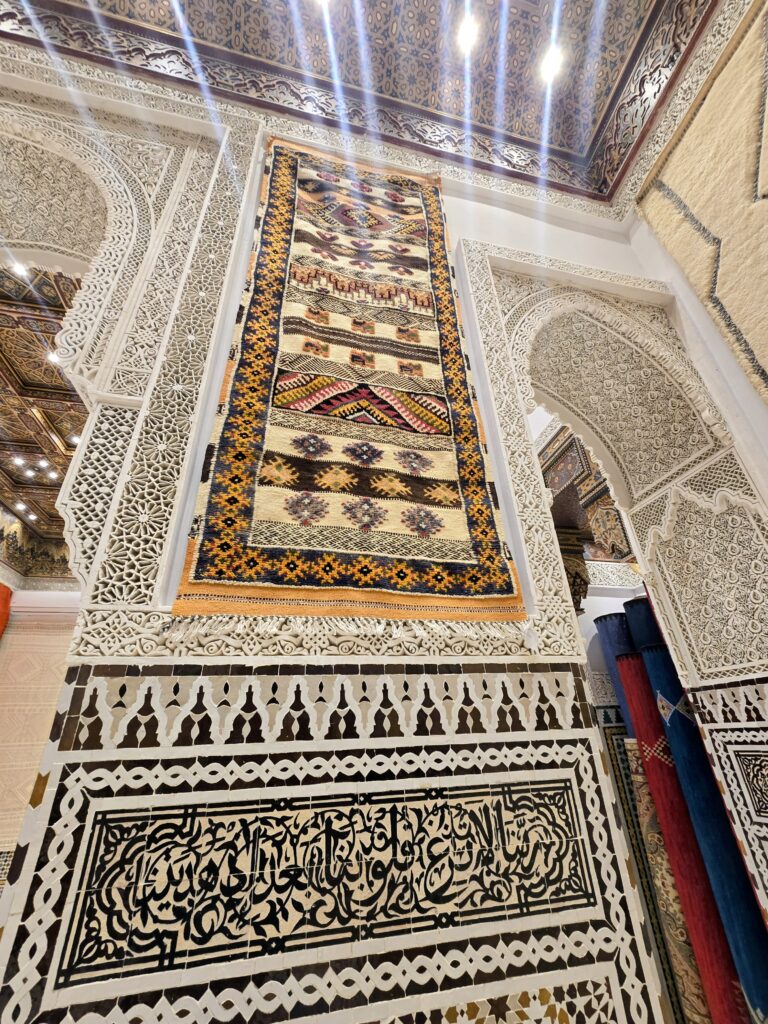
He showed us the differences between Berber and Arab designs. Berber rugs, traditionally woven by Amazigh women in the Atlas Mountains, often feature bold, asymmetrical patterns and symbols—a kind of visual language referencing protection, fertility, nature, and daily life. The colors tend to be earthy and organic, or in the case of the now‑famous Beni Ourain rugs, minimal cream wool with dark, irregular diamonds.
Arab designs, by contrast, lean more towards symmetry and intricate, repeating geometric patterns—starbursts, borders, and medallions that echo the tilework and carvings we’d been admiring all morning. The effect is more formal, almost architectural, whereas Berber pieces often feel more personal and spontaneous.
We didn’t actually see anyone at the loom here—that glimpse would come later in another part of Morocco—but standing in that sunlit courtyard, surrounded by stacks of hand‑knotted work, it was easy to imagine the hours and stories woven into each piece.
That morning was also our first real introduction to something that would become a theme of our trip: trying to buy as thoughtfully as we could. In Morocco, it’s easy to be swept up in the beauty of what’s on offer—rugs, oils, ceramics, textiles—but behind many of those pieces are cooperatives like this one, quietly providing steady, dignified work. The most reputable are certified by the government, so if you’re shopping, it’s worth asking whether a cooperative is officially recognized, who made what you’re buying, how long it took, and who your money supports. We didn’t get it perfectly right every time, but Fez was where we started paying closer attention.
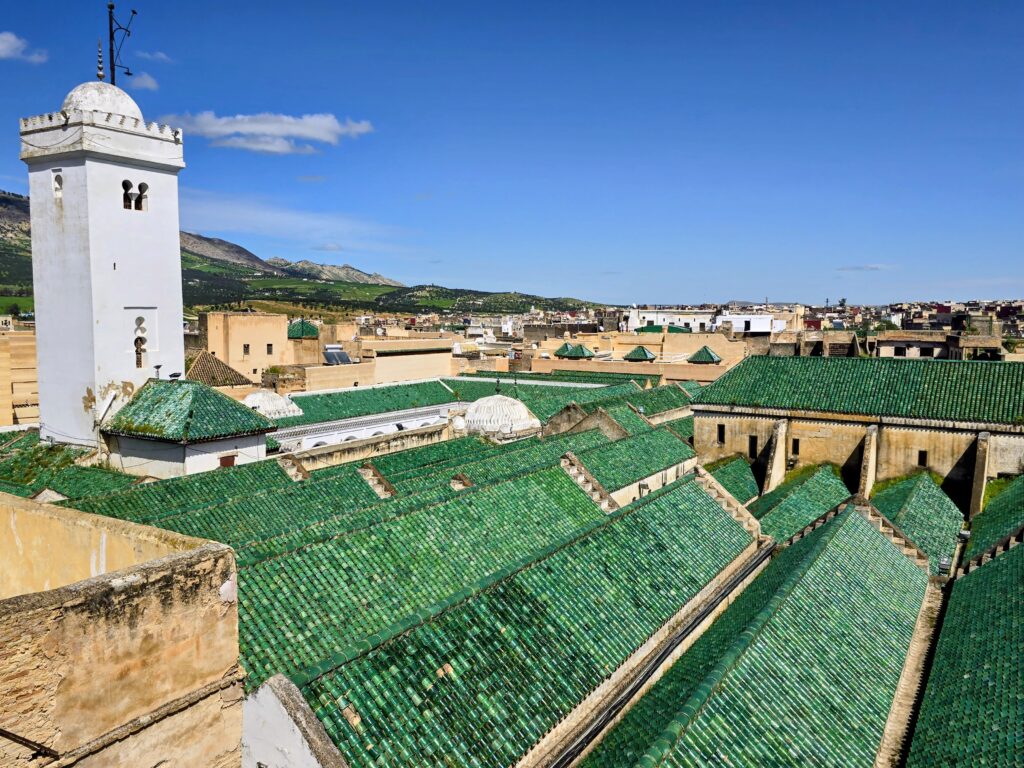
Finally, our guide led us up another set of stairs, then another, until we emerged onto the rooftop. From there the whole medina unfolded in every direction: a dense sea of sand and terracotta rooftops, satellite dishes, laundry lines fluttering in the breeze. Directly below us, the emerald‑green tiles of a mosque roof glowed against the muted tones of the city, a jewel set in stone. The call to prayer drifted up, weaving through the hush of the streets below—quieter than usual, our guide told us, because it was Ramadan and so much of daily life was shifted to the evening.
From there, we continued through the medina toward one of its most storied landmarks: the University of al‑Qarawiyyin. Founded in the 9th century by Fatima al‑Fihri, it’s often cited as the world’s oldest continuously operating university. During Ramadan, the atmosphere around it was especially subdued; we didn’t linger or witness much activity inside, but even from the outside you sense the weight of its history—green‑tiled roofs just visible above the alleys, a carved doorway that has watched over more than a thousand years of students and scholars passing through.
As we walked, the smells began to change before the scenery did—a sharp, unmistakable mix of animal hides, dye, and something almost metallic. We were getting close to the tanneries.
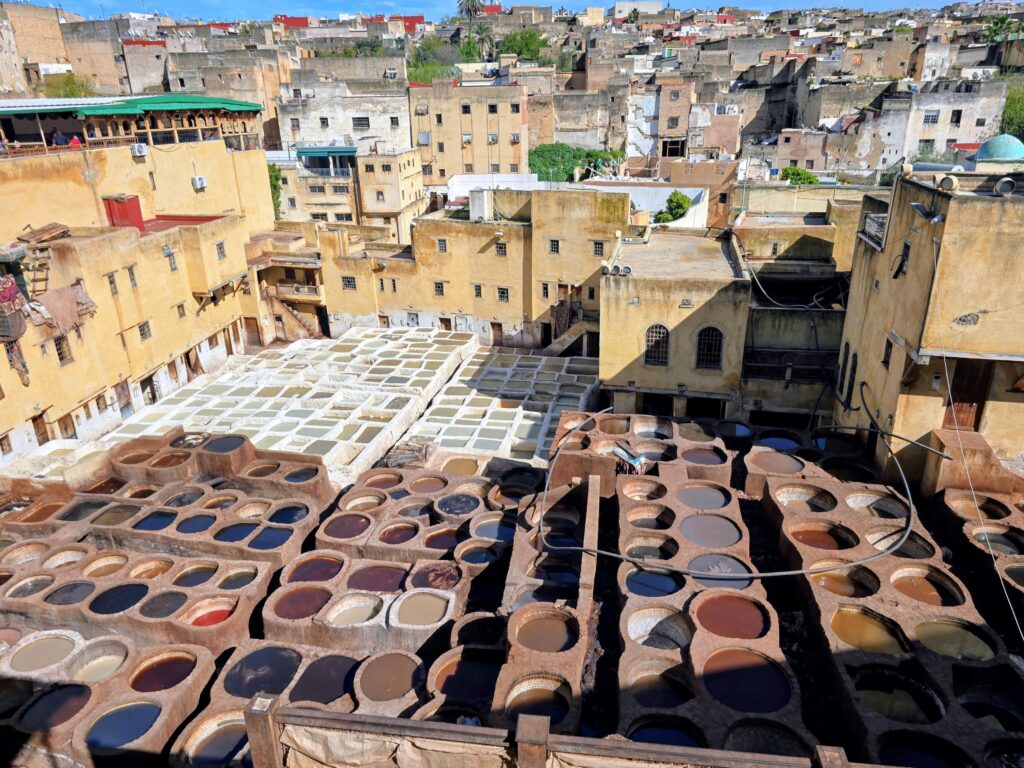
Fez’s Chouara Tannery is one of those places you’ve probably seen in photos long before you arrive: a honeycomb of stone vats filled with opaque, jewel‑toned liquids, hides draped over railings, workers standing waist‑deep as they knead leather with their feet. To reach the famous viewpoint, we wound through a leather shop and up several flights of stairs, past shelves of bags, jackets, poufs, and babouche slippers in every color.
At the top, someone pressed a sprig of fresh mint into our hands—nature’s version of a filter against the smell below. The scene was as surreal as the photos suggest: rows of circular pits, some filled with milky white lime solution used to soften and strip the hides, others brimming with reds, saffrons, indigos, and greens from natural dyes like poppy, saffron, indigo, and henna. Men moved from vat to vat with practiced, almost balletic motions, a rhythm that hasn’t changed much in centuries. It’s beautiful, and also undeniably raw—very much “real life,” not a staged attraction.
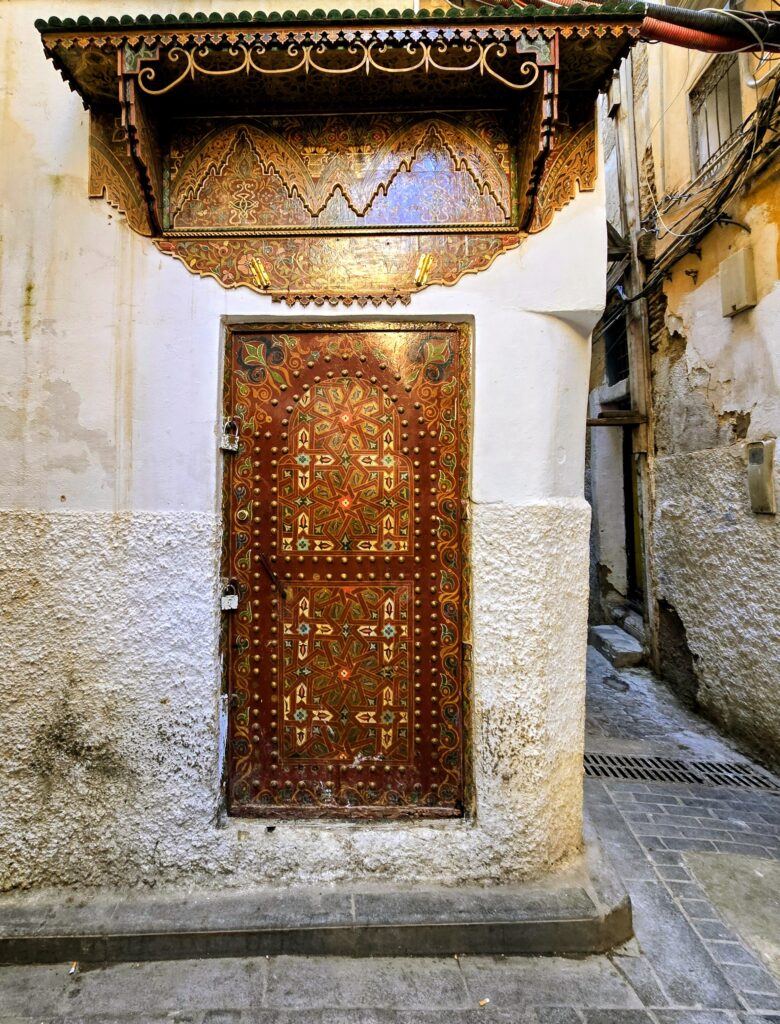
Walking back through the medina afterward, our guide began to point out something I would have otherwise overlooked: the doors.
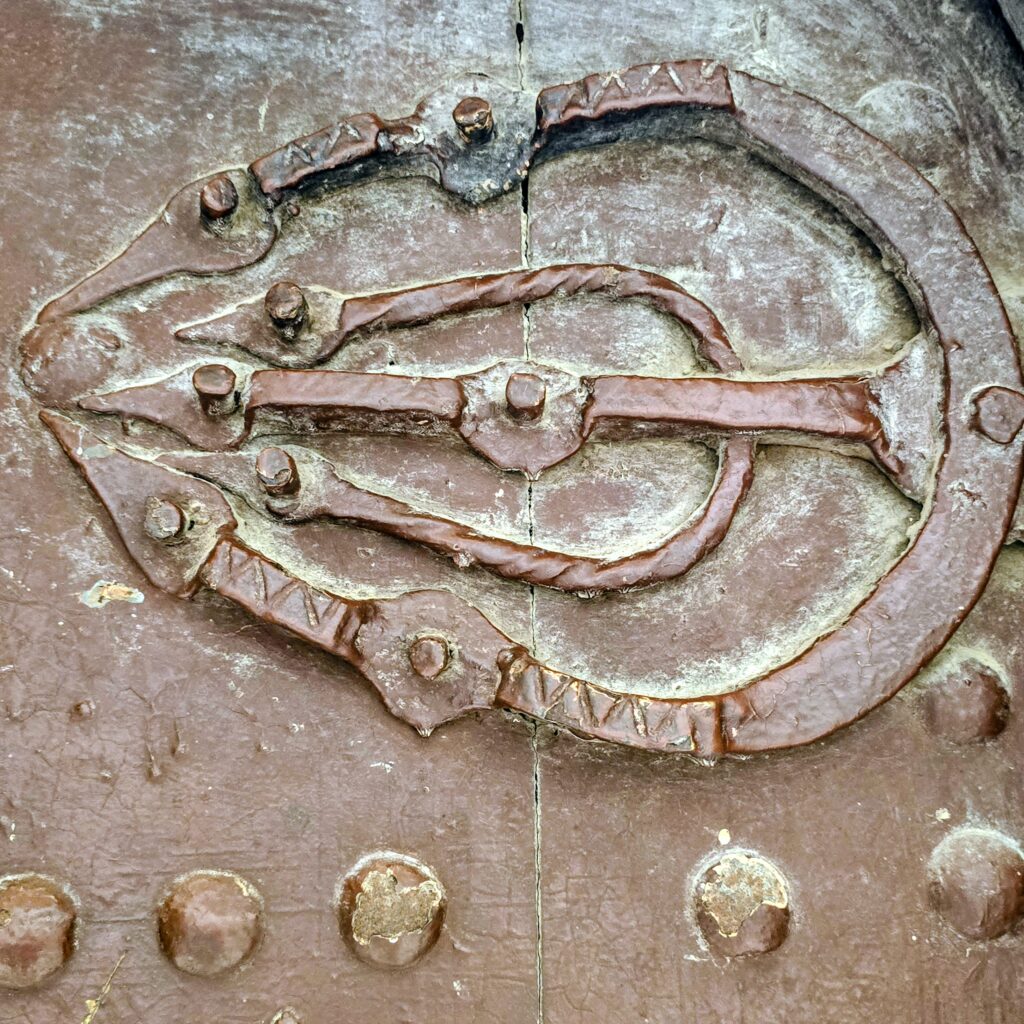
In a place where so much life happens behind walls, doors in Fez are more than just entrances—they’re stories in wood and metal. He stopped us in front of one particularly striking example: a tall, arched door banded with metal studs, painted a deep, weathered blue. Set within it was a second, smaller door, and each had its own knocker.
The large knocker, he explained, was used by men or by guests arriving on horseback or with goods—a deeper, heavier sound that carried through the house. The smaller door and its lighter knocker were for women, children, or close neighbors. Just by the sound alone, the family inside would know who was at the door and how to receive them.
The size and complexity of the door also offered clues about what lay beyond. Larger doors often hinted at a more spacious riad inside—sometimes you could count the decorative panels to guess how many main rooms the house had. The plain outer wall gave nothing away; the door held the secrets.
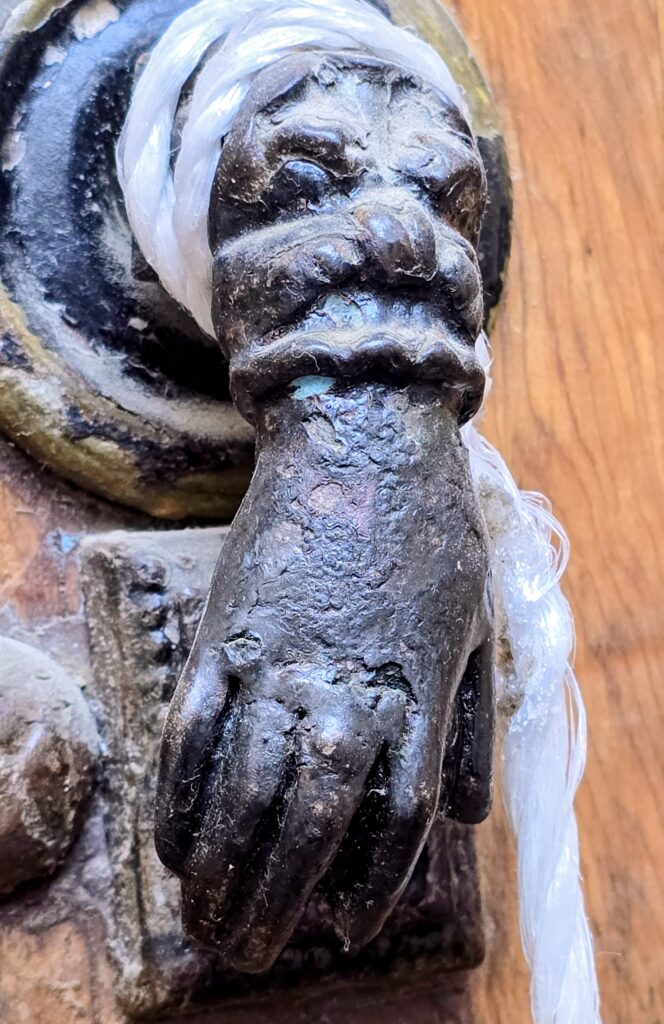
Then there were the symbols layered on top of that function. Many doors were crowned or flanked by the Hand of Fatima, or khamsa—a stylized open hand, usually with an eye in the center of the palm. It’s meant to ward off the evil eye and bring protection and blessing to the home. You start to notice it everywhere once you know what to look for: carved into wood, worked into metal knockers, painted above lintels, and echoed later in jewelry and ceramics.
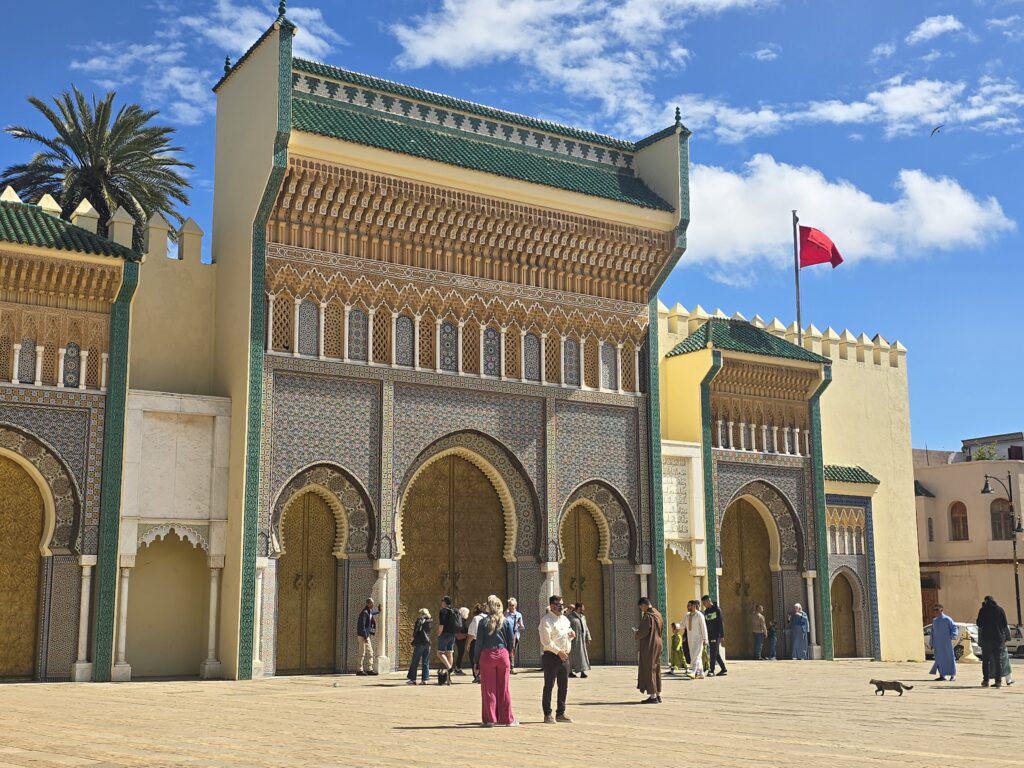
Before we returned to our riad, our driver took us out of the medina and up to one of the old hilltop fortresses overlooking Fez. After a day spent inside the maze, seeing it from above was disorienting in the best way—the entire medina gathered into a single, sand‑colored bowl of rooftops and minarets. In the late‑afternoon light it glowed soft gold, quiet and still in the rhythm of Ramadan, a city holding its breath before the celebrations of Eid.
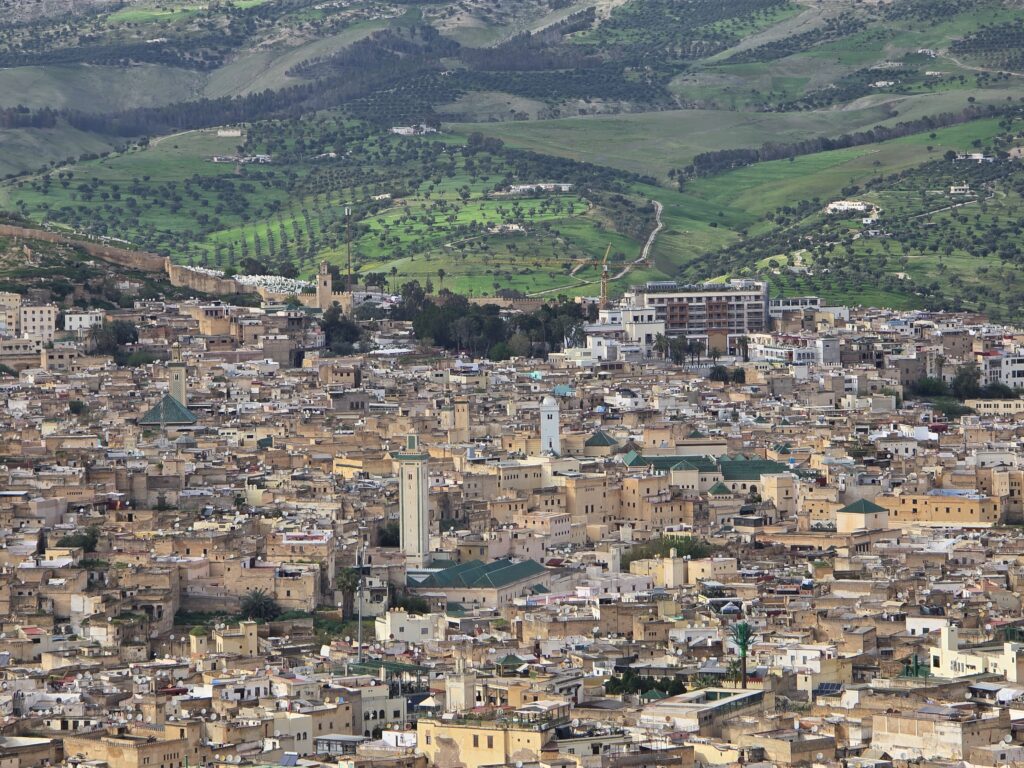
By the time we made our way back to La Maison Bleue, my head was swimming with images: green rooftops, the patchwork of the tanneries, the weight of old doors under my fingertips, and that final wide‑angle view from the fortress. Fez had gone from an abstract “must‑see city” on our itinerary to a place that felt textured and alive, its history not locked in museums but built into the very walls and thresholds we walked past.
Day Trip to Meknes & Volubilis from Fez: Gates, Jewish Heritage, Roman Ruins & a Winery Sunset
The next day, our driver Soufiane picked us up early for a full‑day adventure to Meknes and Volubilis, with an unexpected finale: dinner and a wine tasting at a local winery.
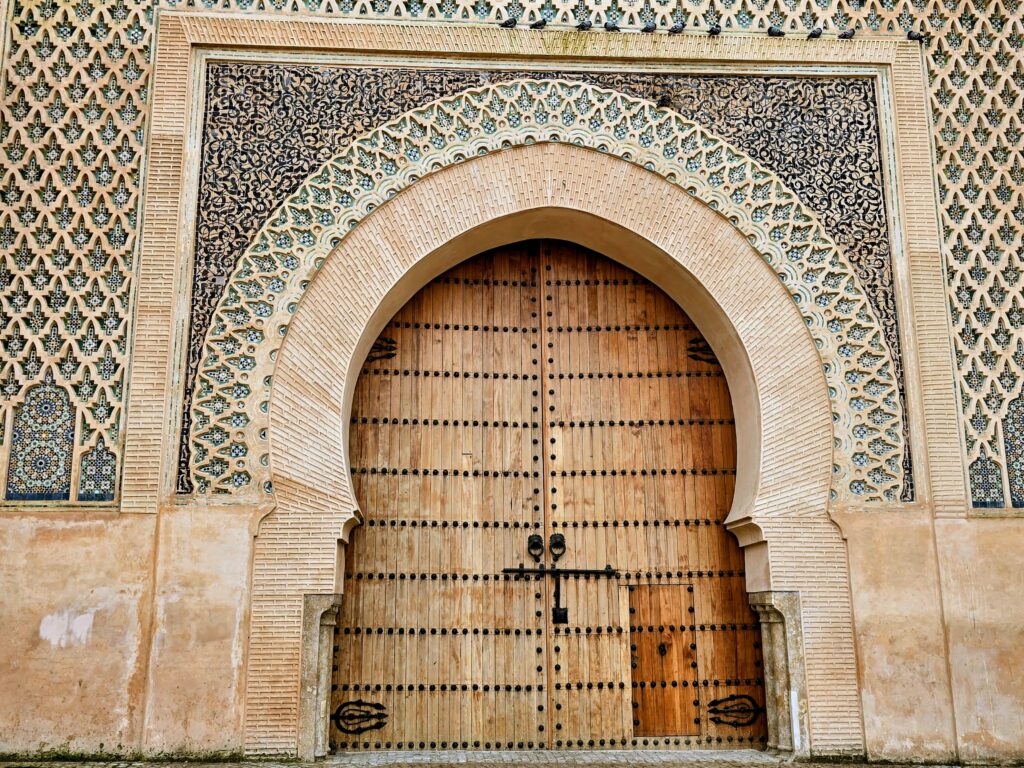
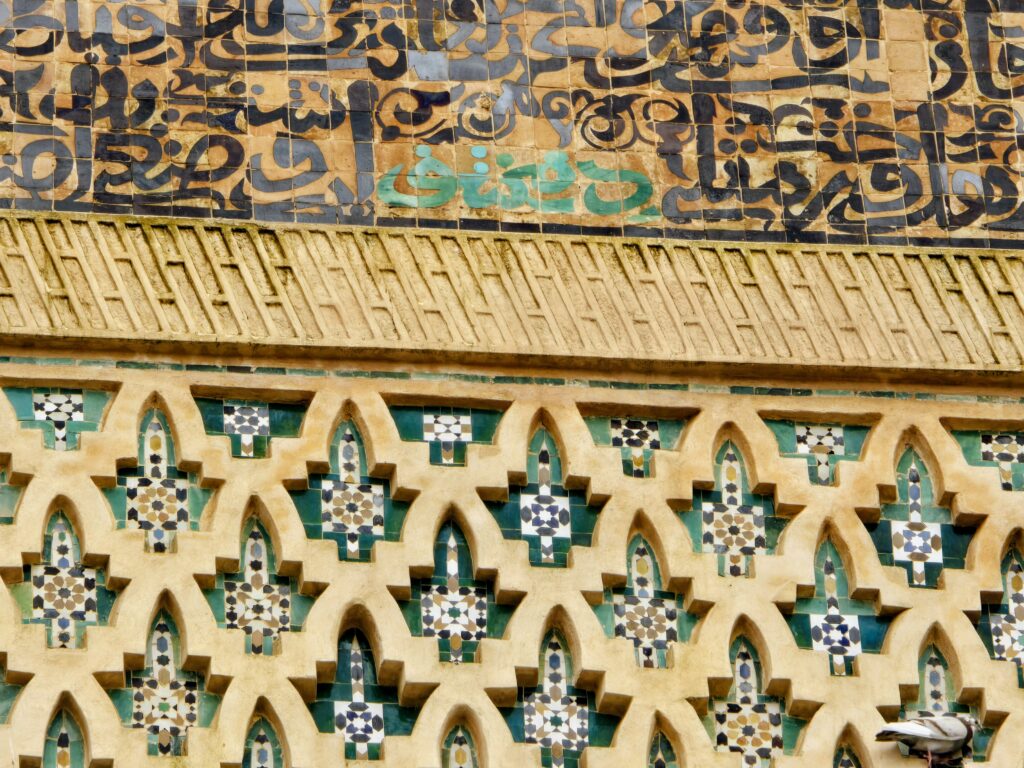
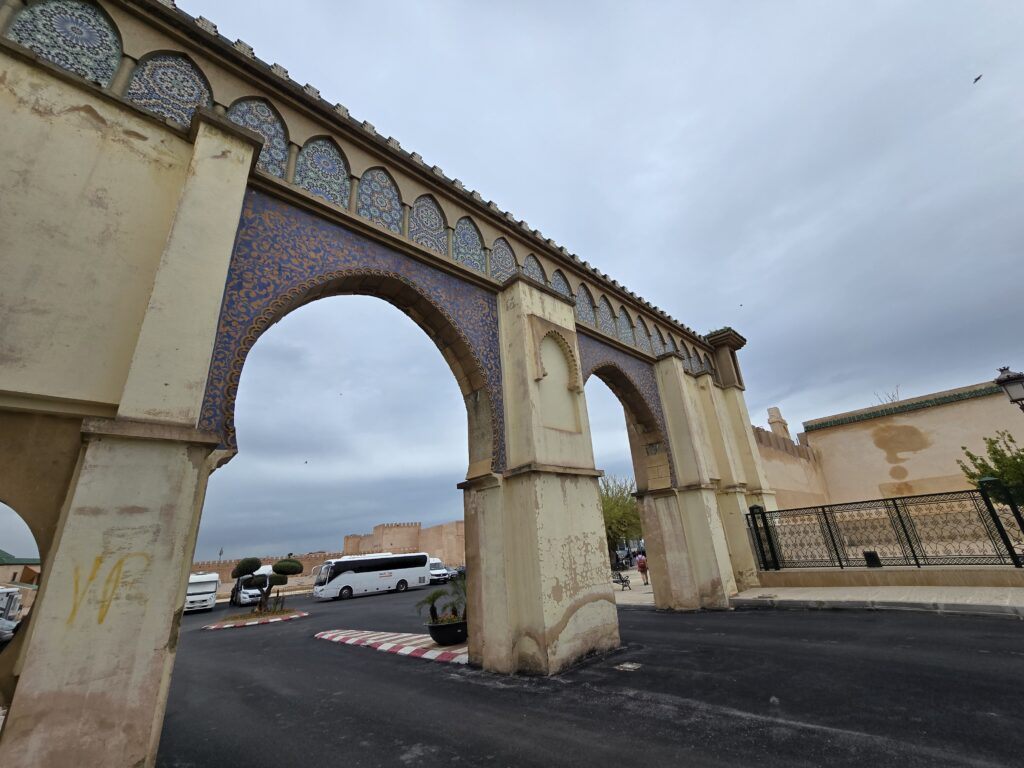
In Meknes, we were met by a local guide who began our walking tour at the city’s most famous gate to the medina. Standing beneath its massive arch, he explained how the gates of Meknes weren’t just entrances, but statements of power and protection—each one with its own proportions, inscriptions, and decorative details that hinted at the history behind the walls.
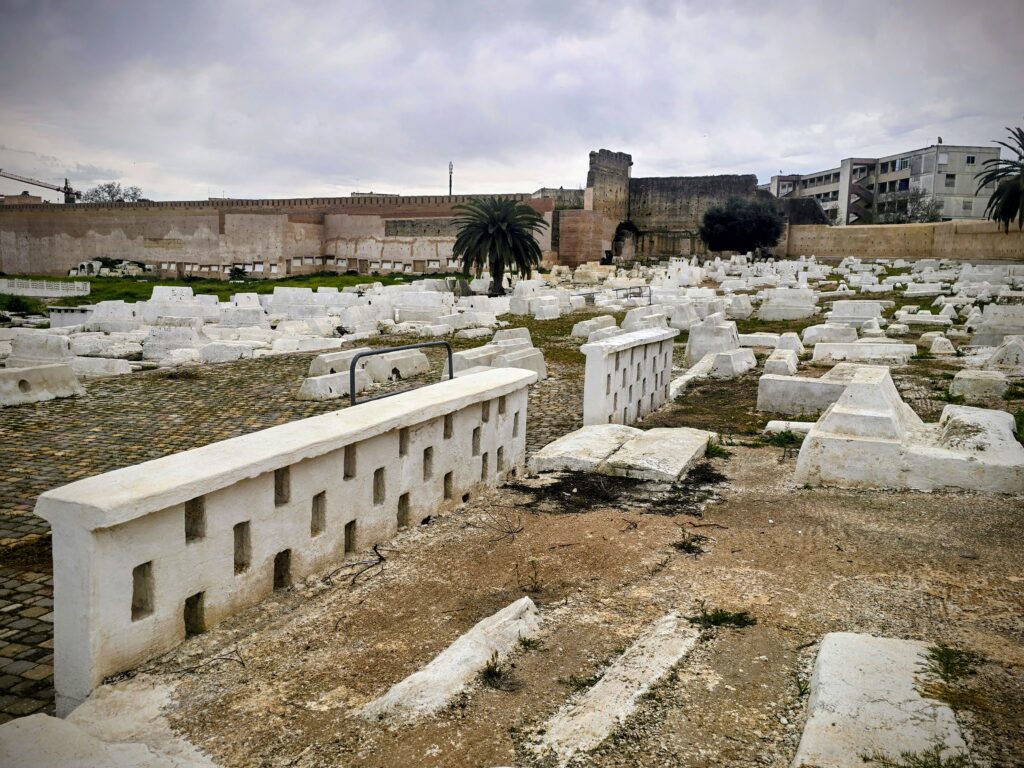
From there, we stepped through the gate and into the old Jewish quarter. The streets narrowed, the architecture shifted, and the stories changed. We visited the Jewish cemetery, its whitewashed tombs glowing in the sun, and then, in one of the most memorable moments of the day, we were granted private access to an older synagogue that is slated for restoration.
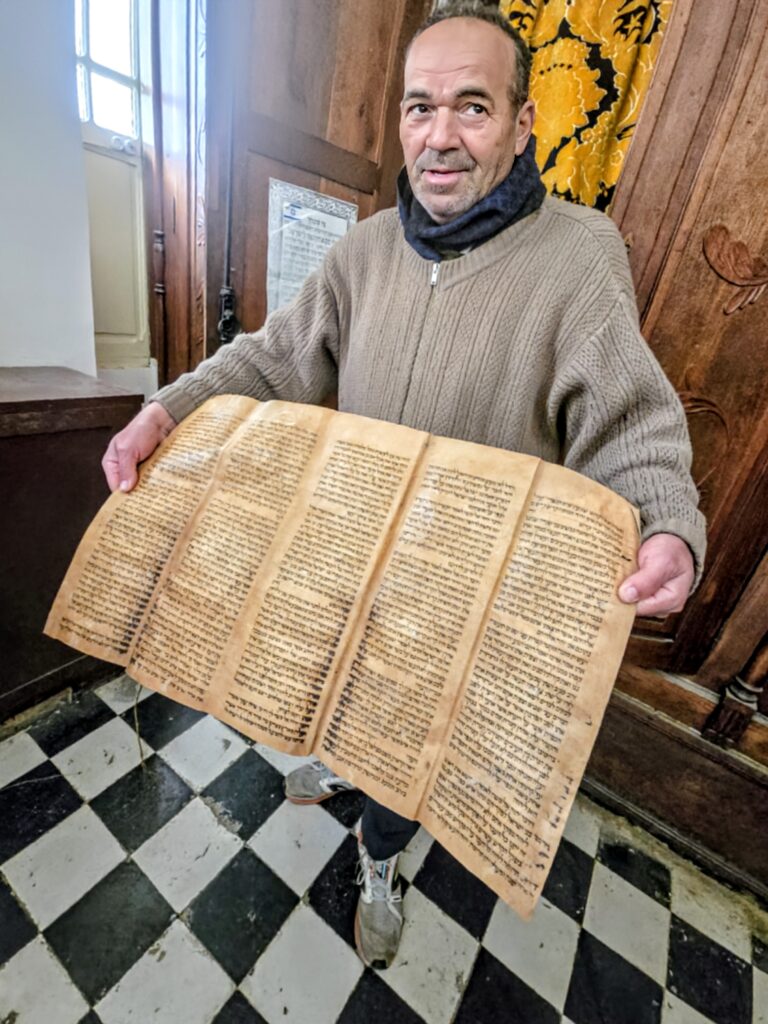
Inside, our guide patiently walked us through the layers of symbolism—Hebrew inscriptions, carved motifs, the placement of the bimah and ark. He showed us part of a Torah printed on goat skin, carefully stored and brought out for us to see. Even in its worn state, it felt precious, a tangible link to a community that had once filled this space with prayer and song.
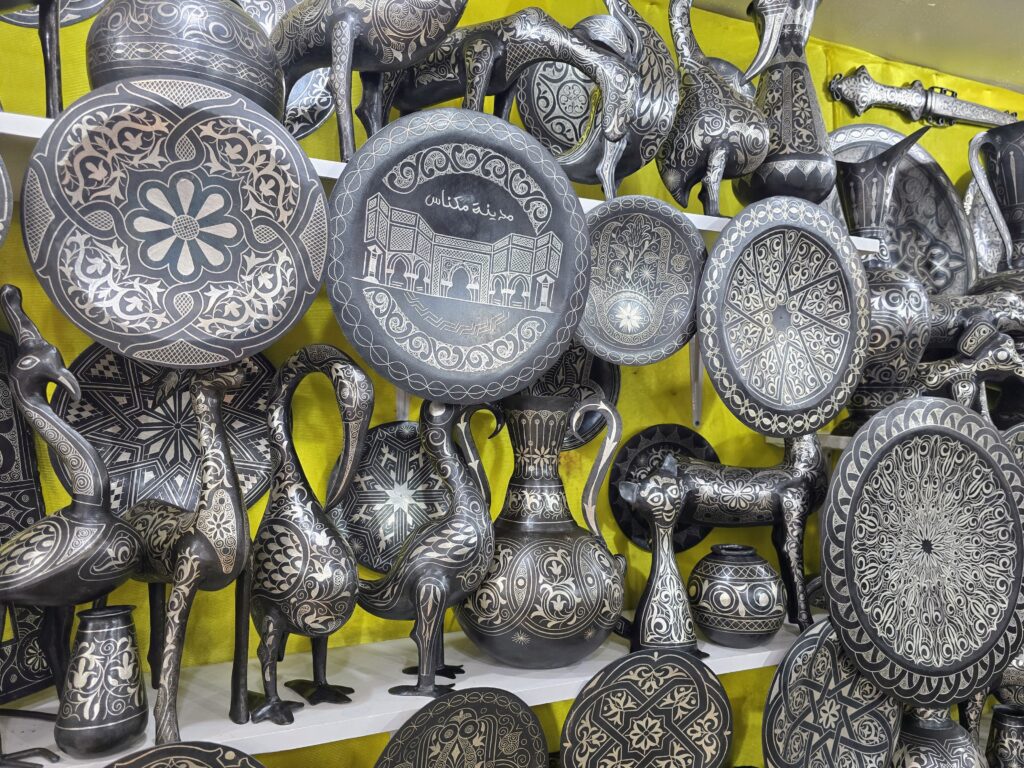
At some point in our wanderings, we stopped to watch an artisan demonstrate traditional silver thread work—fine, filigreed designs painstakingly hand‑twisted and inlaid. Watching him work was like seeing time slow down: each tiny movement deliberate, each pattern built line by delicate line, preserving techniques that have been passed down for generations.
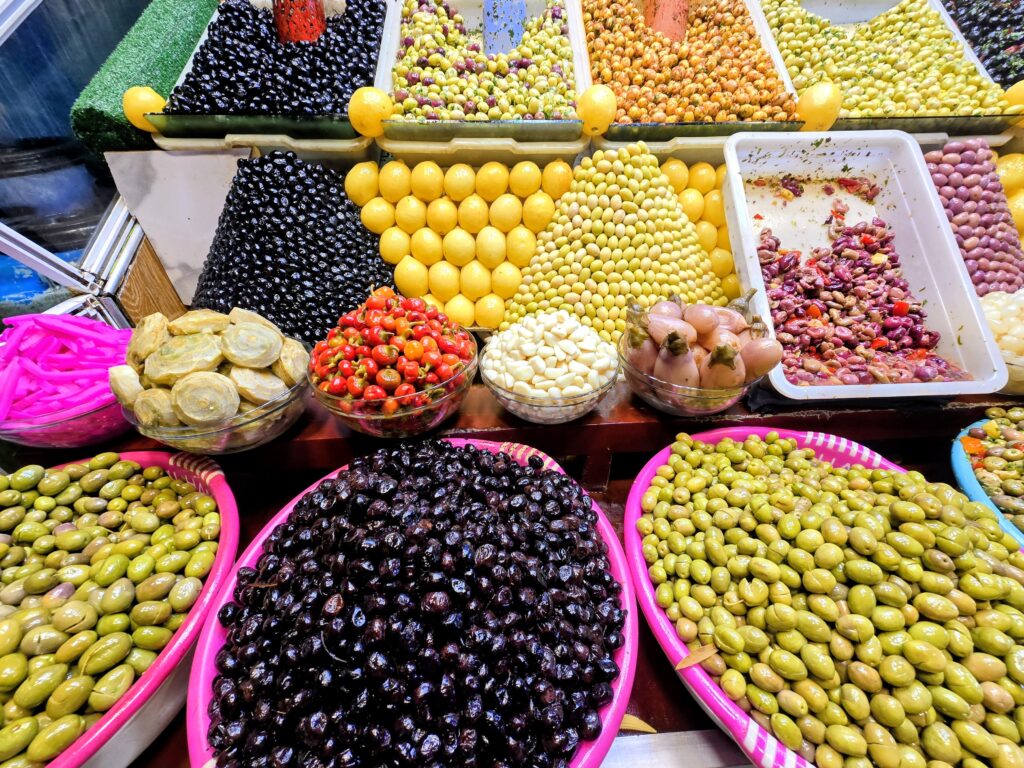
We also made our way to the main square and into the market that spills off it. Here, Meknes felt decidedly more alive than Fez had in the quiet of Ramadan. Stalls overflowed with glossy mountains of olives in every shade of green and purple, coils of fresh meat hung from hooks, and women bustled behind pastry counters, filling trays and boxes with delicate sweets in preparation for Eid al‑Fitr. You could almost feel the holiday anticipation in the air—this sense of everyone getting ready for something joyful just around the corner.
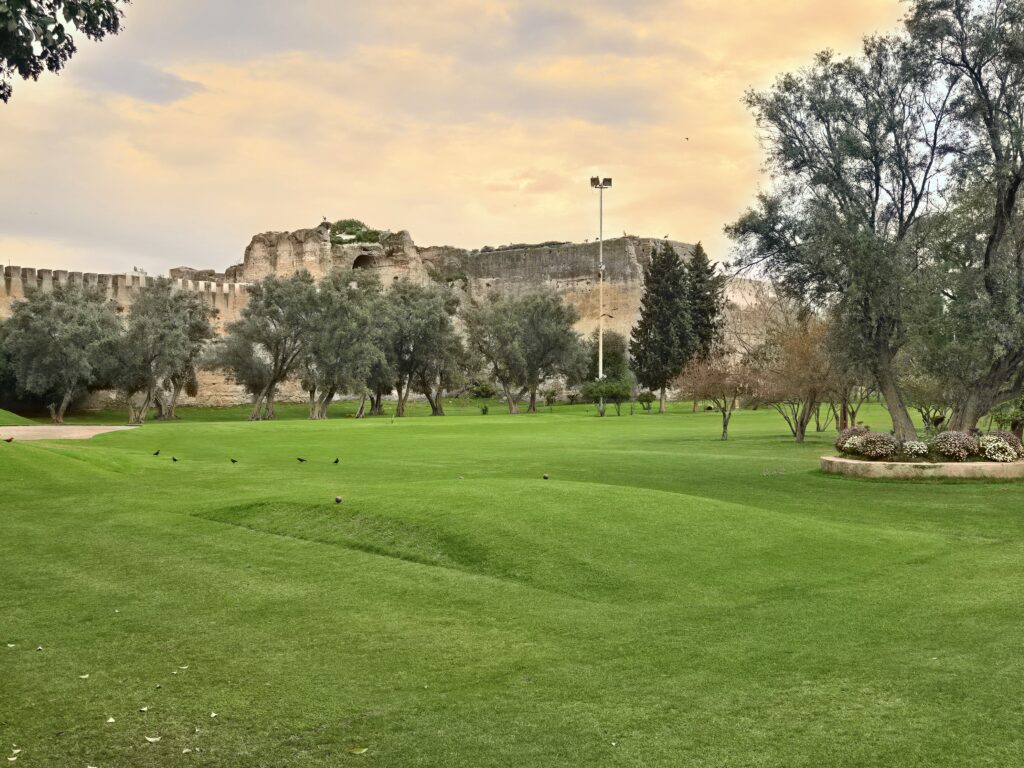
We walked the perimeter of the king’s palace. We couldn’t go in, of course, but we strolled along its imposing walls and peered toward the Royal Golf course. Unlike what the name might suggest, it isn’t a private playground for the monarchy; it’s open to the public and impeccably maintained, a surprisingly green expanse in the middle of so much stone and history.
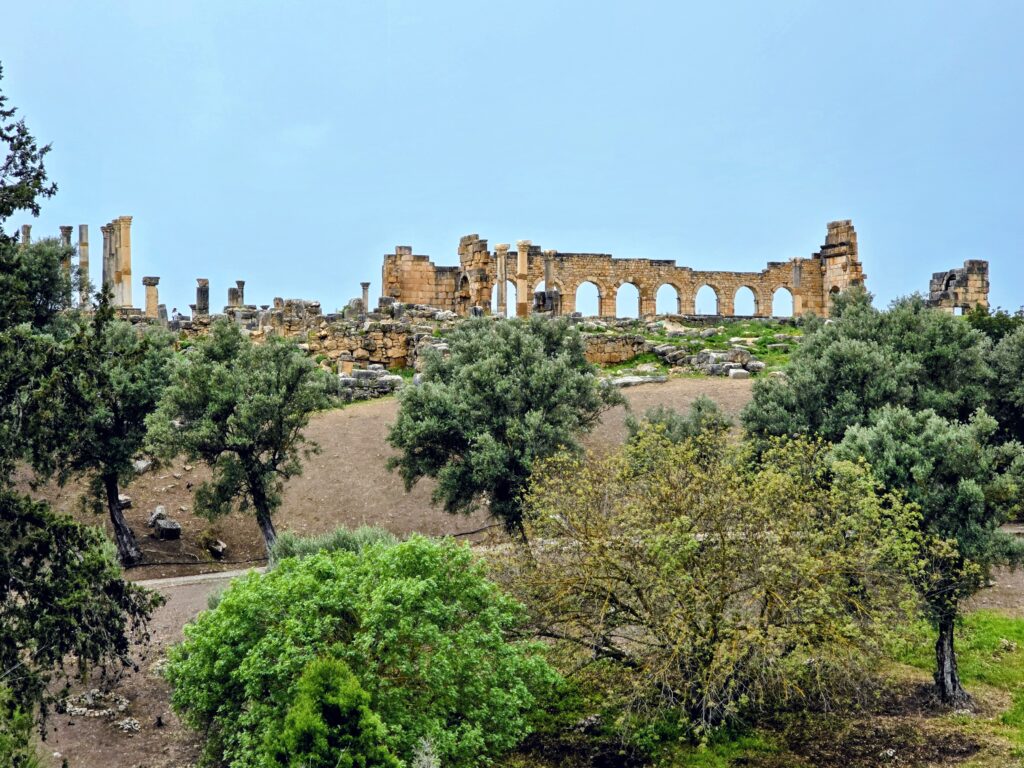
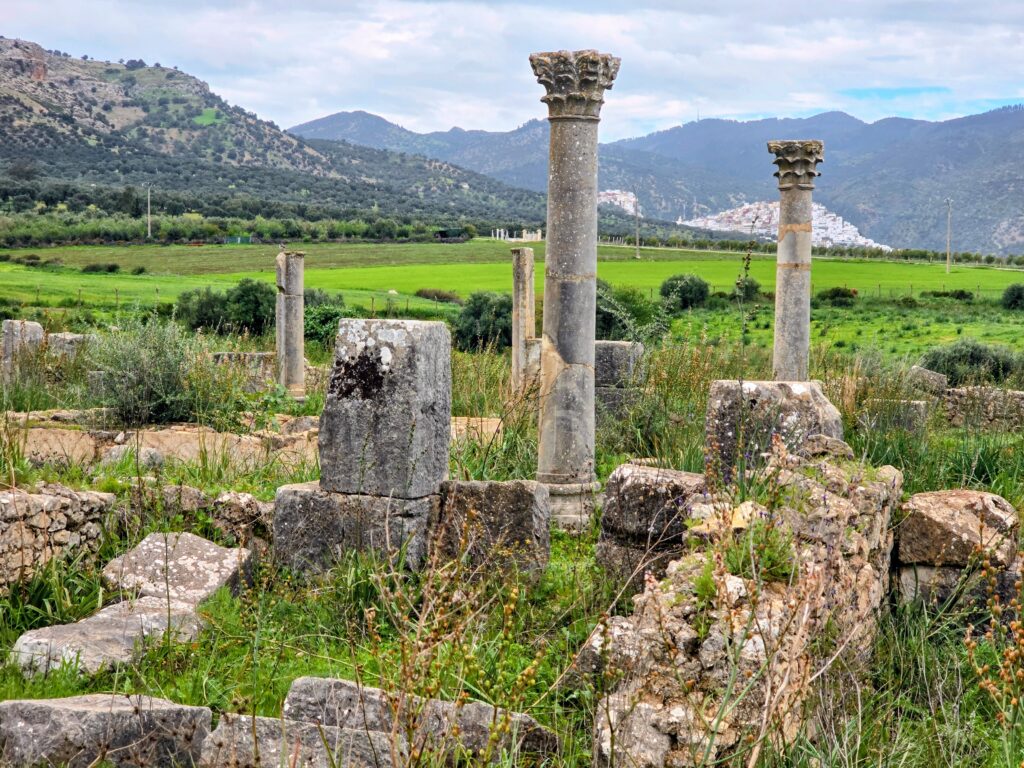
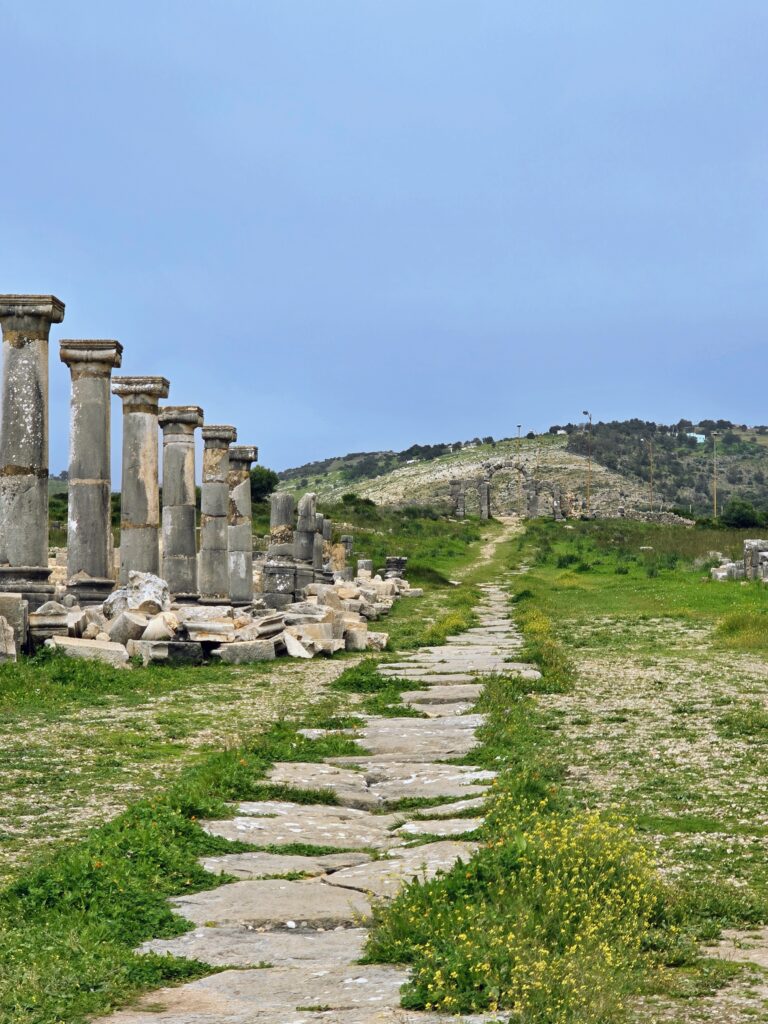
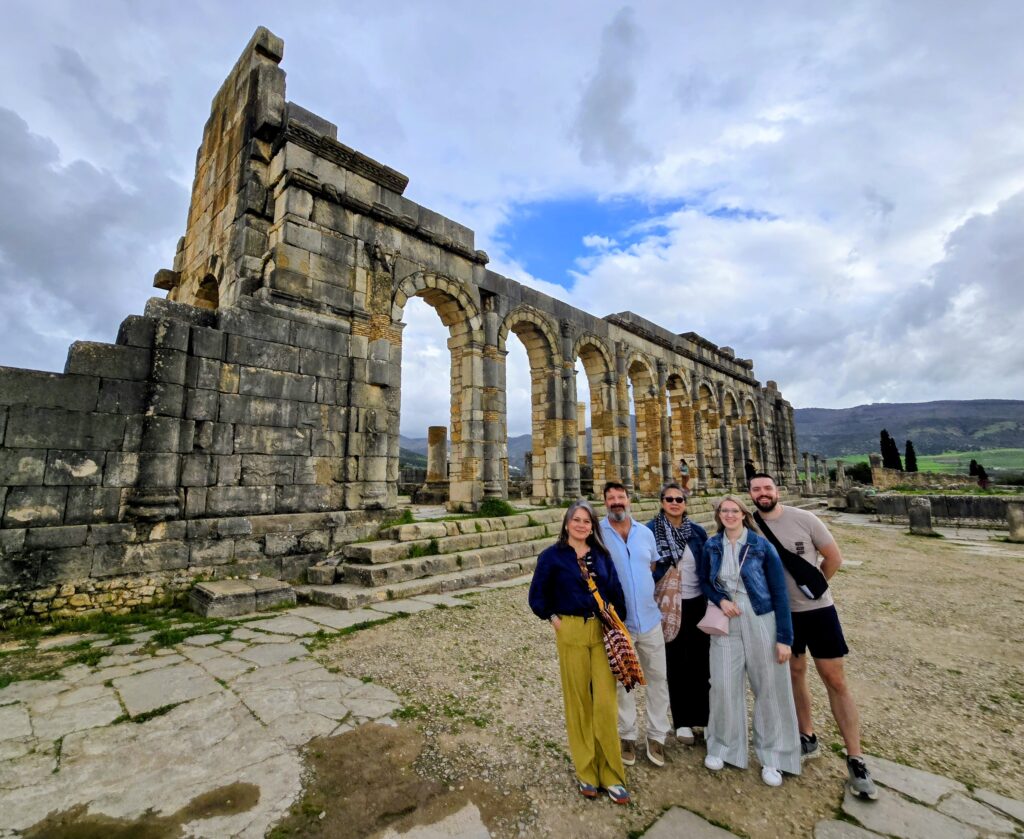
From Meknes, we drove on to Volubilis, where another private guide met us at the entrance to the Roman ruins. Even knowing it’s a UNESCO World Heritage site, nothing quite prepared us for the scale of it—an entire Roman city laid out across a hillside, with arches, columns, and fragments of villas tracing the outline of lives lived here almost two thousand years ago.
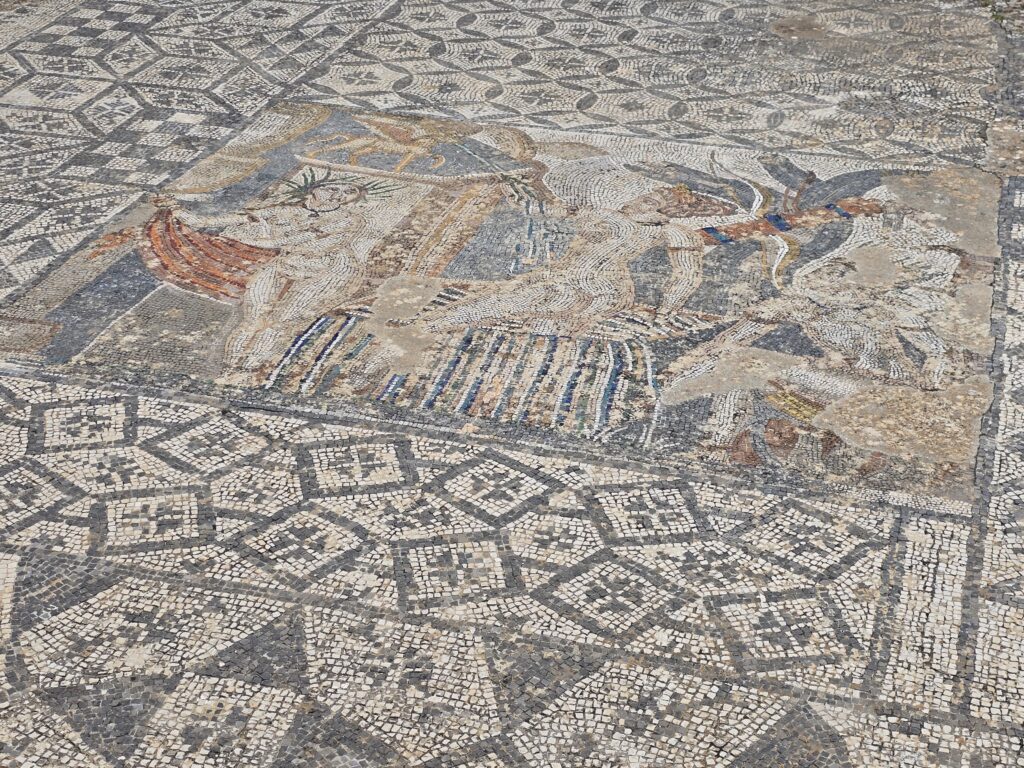
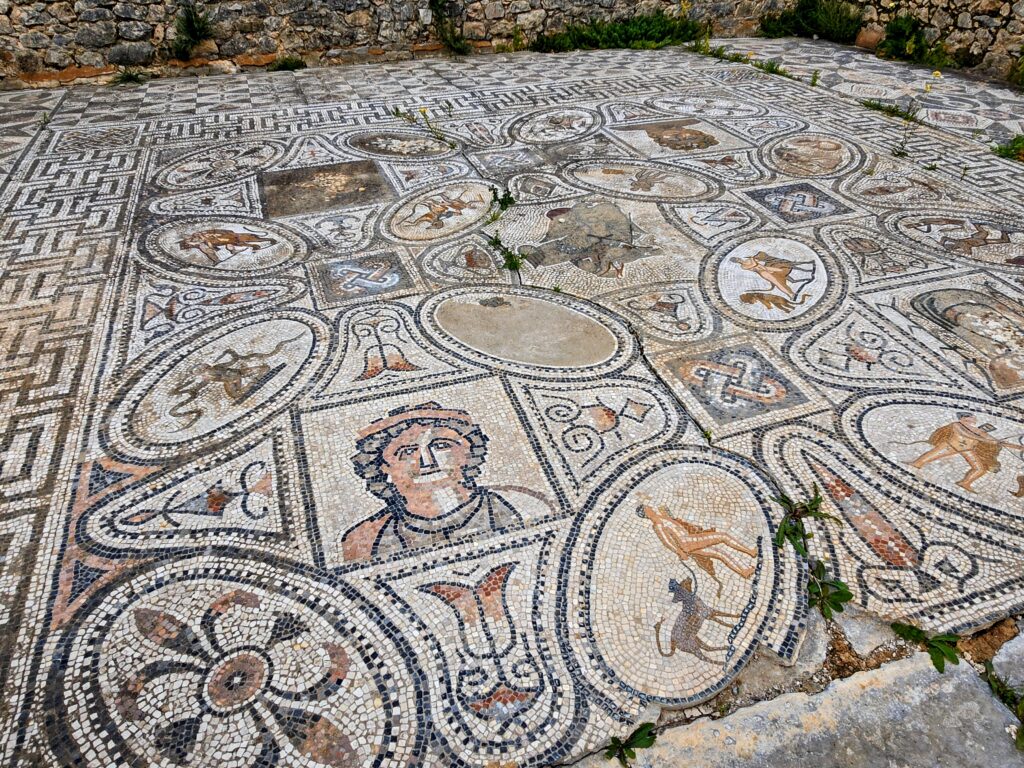
Much of Volubilis is under ongoing restoration, but what surprised us most was how close we could get to the mosaics. They aren’t tucked away behind glass or cordoned off in a museum; they’re right there under your feet, open to the sky and the elements. Our guide didn’t just gesture at a dolphin here or a bird there—he brought the floors to life.
In one villa, he traced the labors of Hercules in tiny tesserae, each scene capturing a different feat, frozen mid‑story. In another, he pointed out gods and goddesses arranged around pools and hunting scenes: Neptune with his horses, Bacchus amid vines, mythological figures woven into everyday domestic spaces. These weren’t abstract decorations; they were deliberate choices, clues to what the homeowners valued, believed, or wanted to be associated with.
Kneeling beside the mosaics, he translated the imagery for us, panel by panel, until it felt less like “ruins” and more like people we might have known—wealthy families commissioning floors that told their favorite stories, or advertised their status to whoever crossed the threshold.
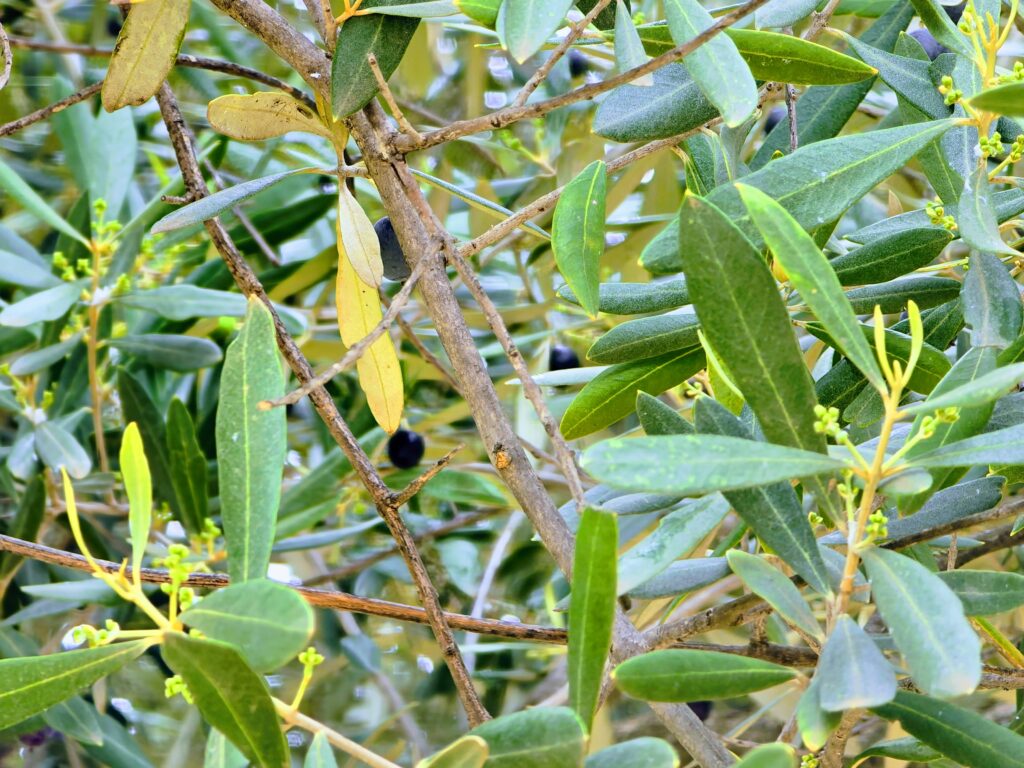
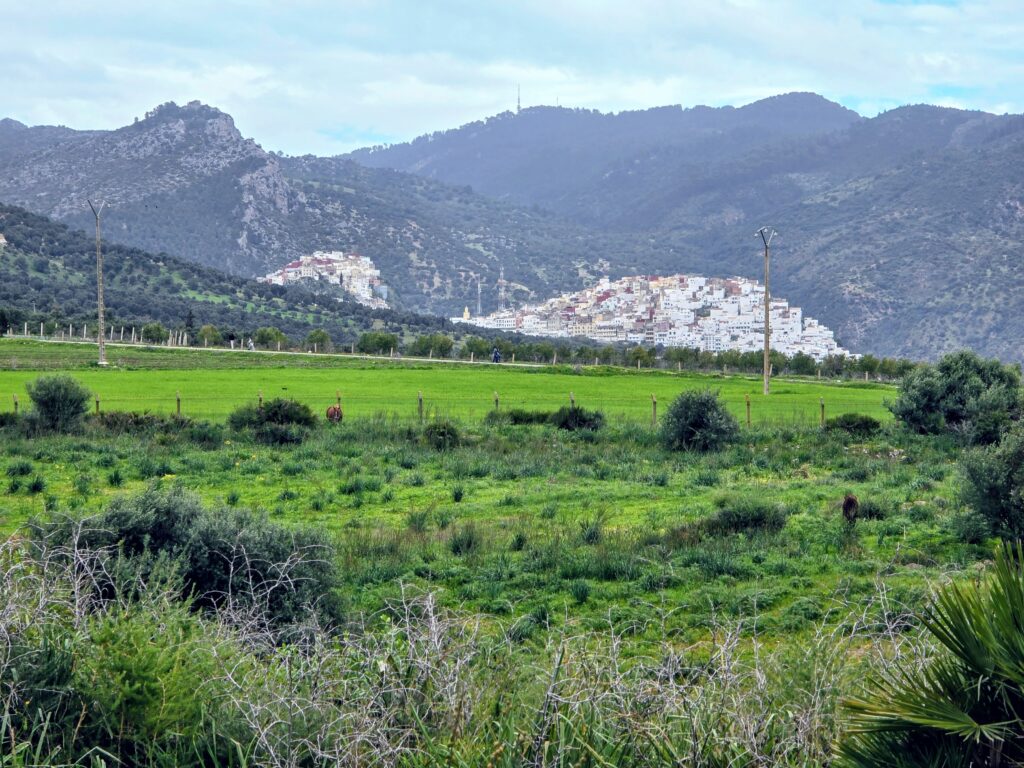
From the hillside, you can look out over fields and olive groves that stretch to the horizon, and in the distance, a nearby whitewashed village. From Volubilis, it appears almost like a seated camel outlined against the landscape—a small, quiet shape that somehow anchors the whole view. Standing among the broken columns with the wind moving through the grass, the past felt unusually close, layered over a present that’s still very much alive just beyond the ruins.
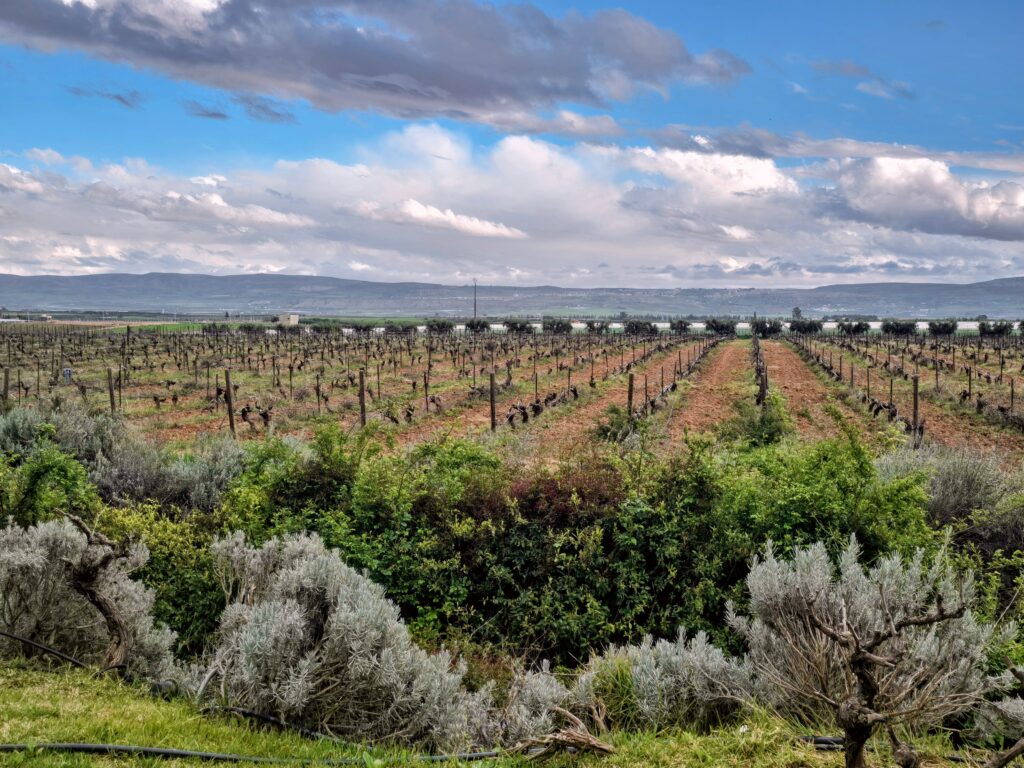
From Volubilis, we continued to our final surprise of the day: a large winery tucked into the countryside. I hadn’t really associated Morocco with vineyards before this trip, but the estate unfolded in neat rows of vines as far as we could see, with low buildings and gardens nestled among them.
The property also hosts hotel accommodations, and you can feel that as soon as you step onto the grounds—there’s a lingering, unhurried atmosphere that invites you to stay. A beautiful pool and landscaped gardens overlook the vineyards, the kind of place where you could easily imagine spending a slow afternoon with a book and a glass of wine, watching the light move across the hills.
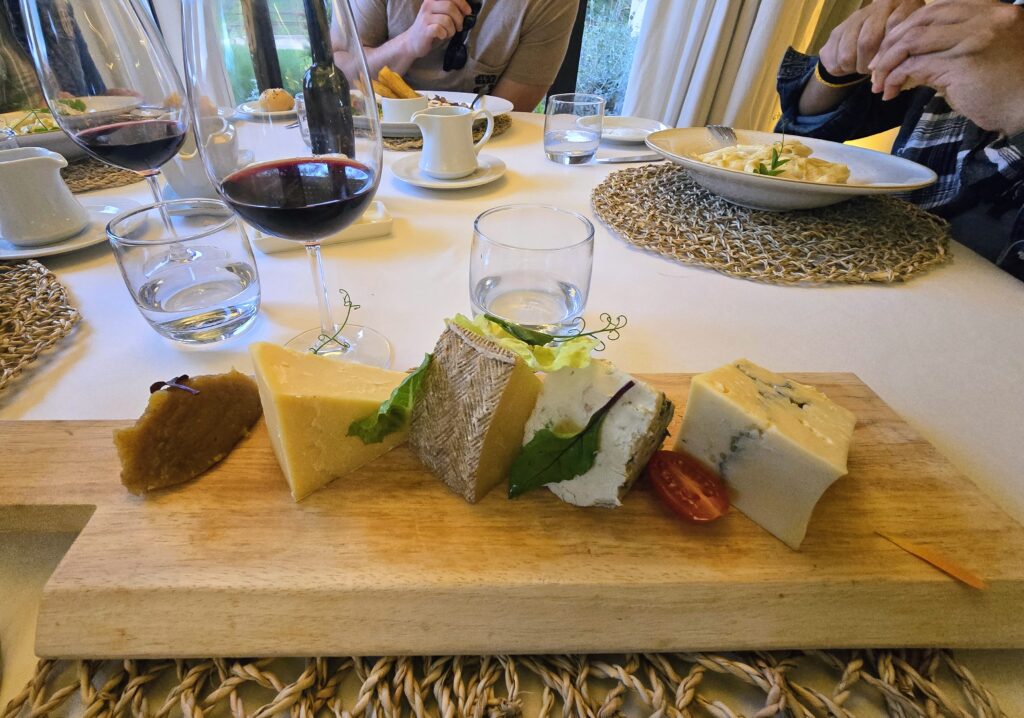
We settled in for a simple dinner and a tasting of their wines, an almost surreal contrast to the Ramadan quiet we’d been moving through all week. Outside the estate walls, daylight hours were still defined by fasting and restraint; here, for a brief evening, we were clinking glasses and toasting to a day that had taken us from Jewish quarters and royal gates to Roman mosaics and Moroccan vines.
Journey from Fez to the Sahara Desert: Ifrane, Atlas Macaques, Oasis Views & Desert Camp Arrival
We left Fez the next morning with the sense that the “city” portion of our trip was behind us and something completely different lay ahead. Soufiane, our endlessly patient driver, promised us that by the end of the day we would have crossed the Middle Atlas, seen our first oasis, switched into 4x4s, and be watching the sun set over Saharan dunes with a glass of champagne in hand. It sounded almost impossible—and yet, hour by hour, that’s exactly what happened.
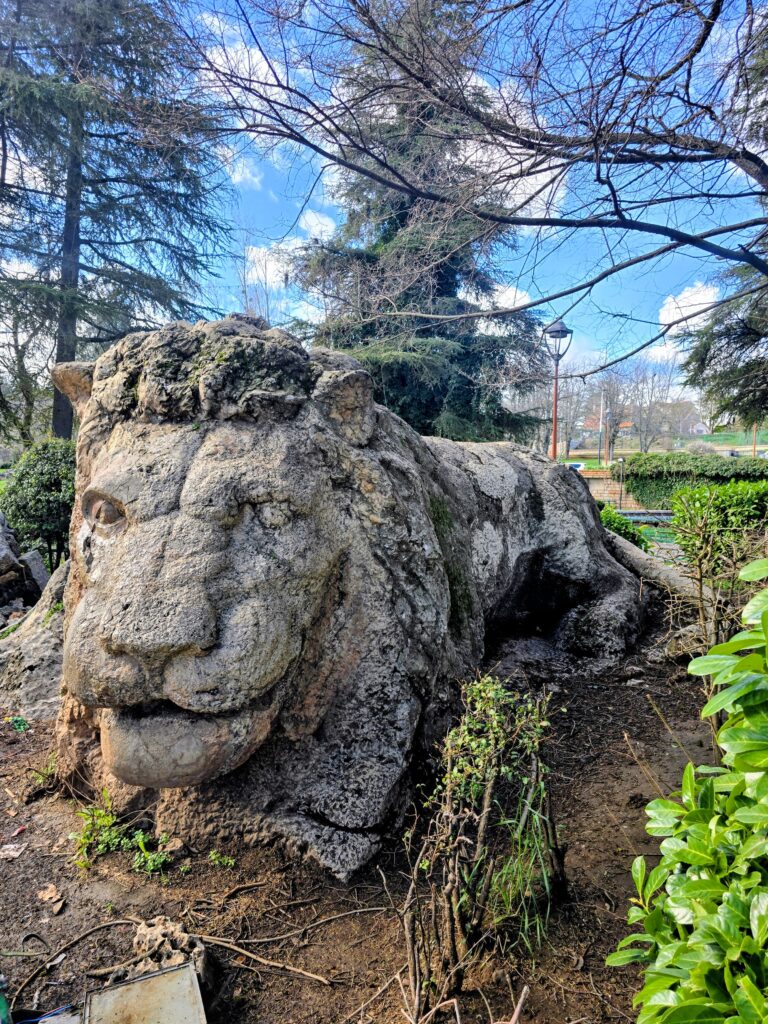
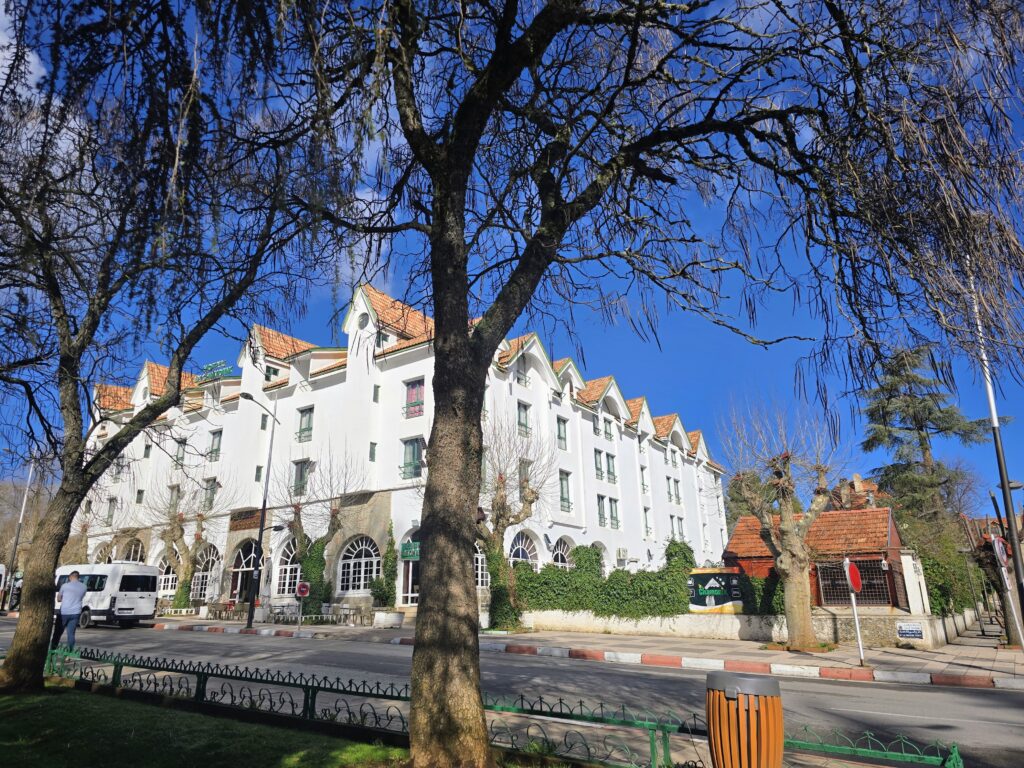
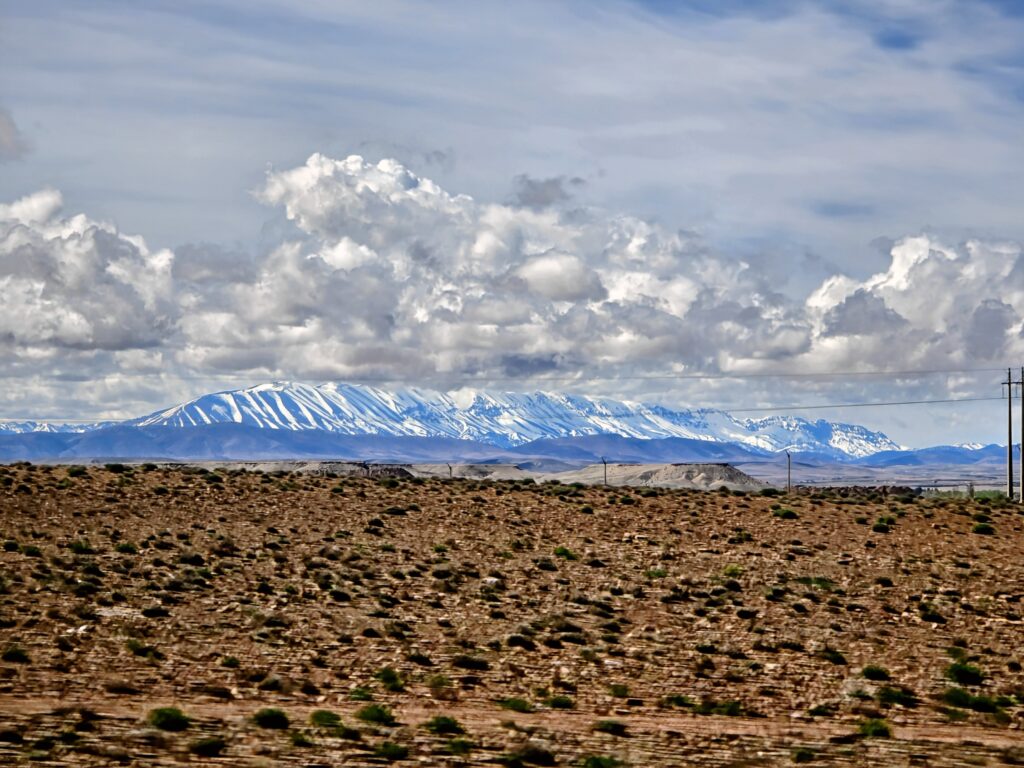
We climbed steadily into the Middle Atlas Mountains, leaving the ochre tones of Fez behind for pine forests and cool, crisp air. Our first major stop was Ifrane, often nicknamed the Switzerland of Morocco. It’s a startling sight if you’re expecting desert: chalet‑style houses with sloping roofs, immaculately clean streets, flower beds and roundabouts. For a moment, with the cool breeze and alpine vibe, it was easy to forget we were on our way to the Sahara.
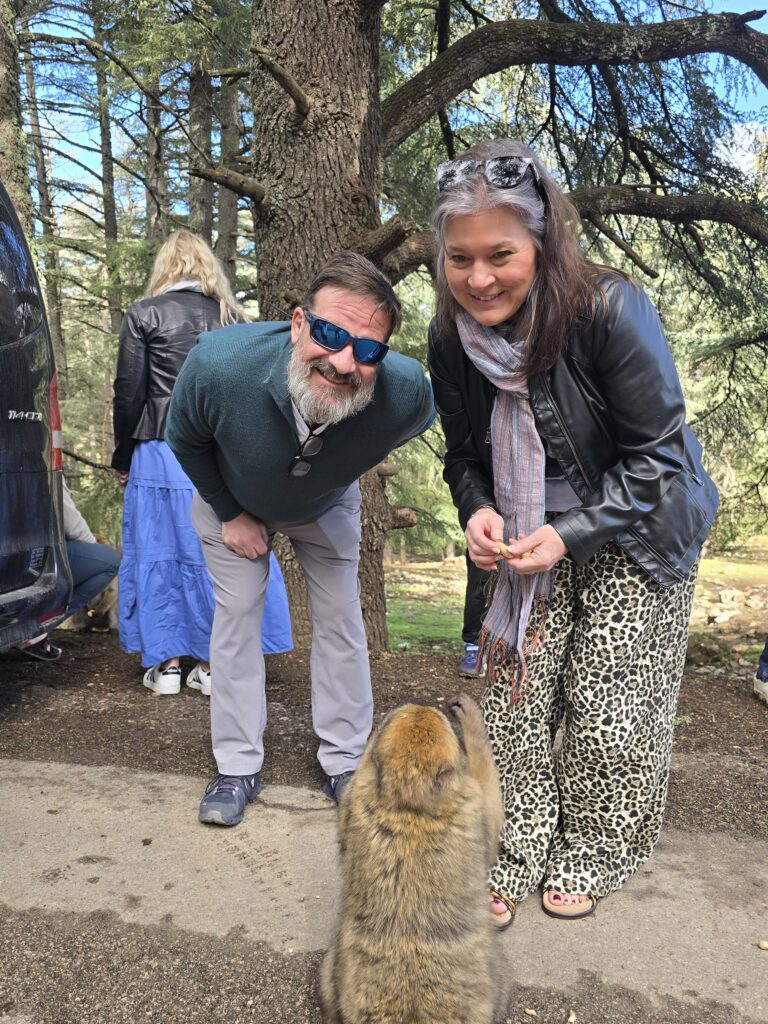
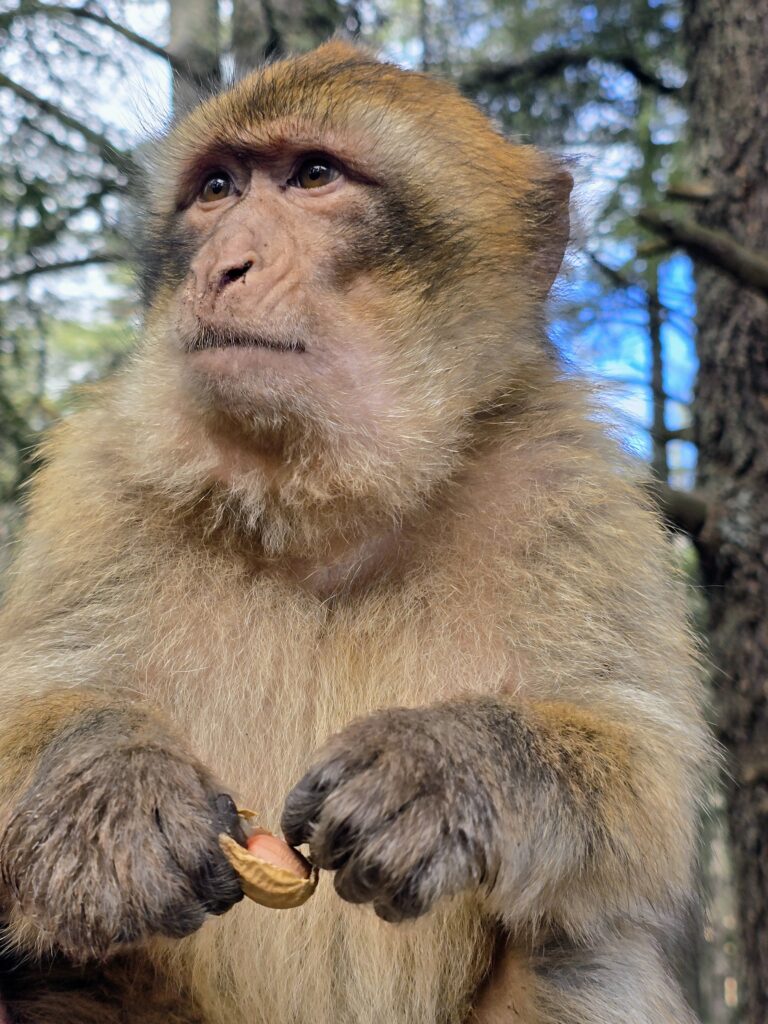
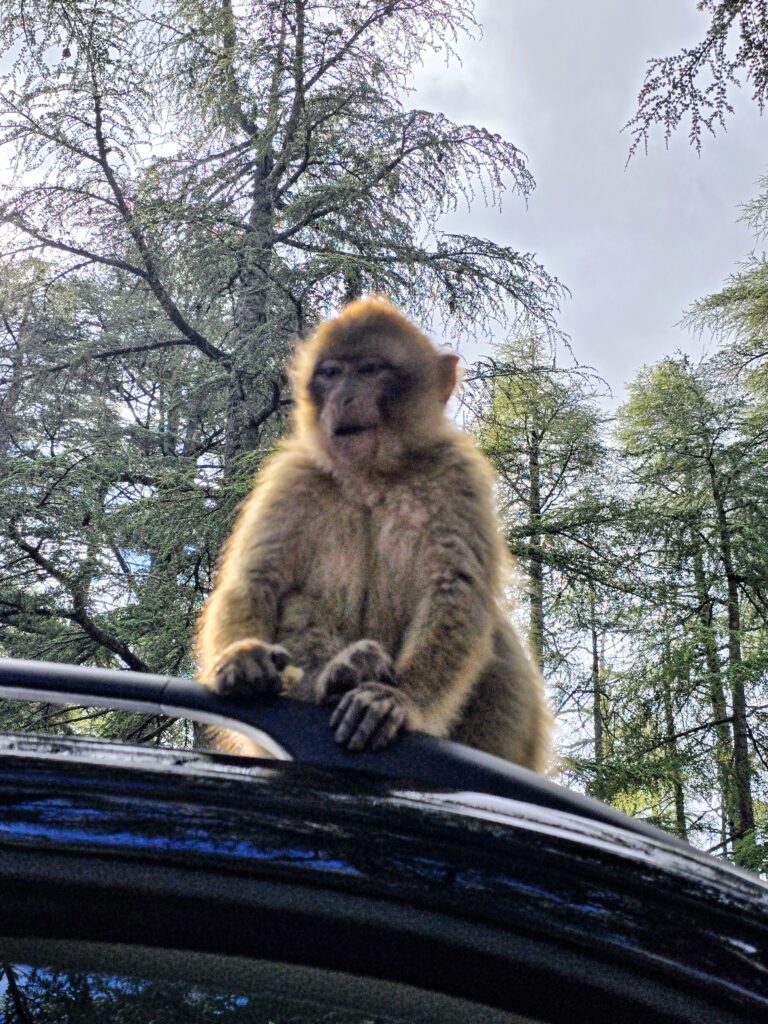
From Ifrane, the landscape shifted again as we drove deeper into the mountains and into the woods. Soufiane pulled over at a stand of tall cedars where we had a short, unexpectedly charming encounter with the local residents: Barbary macaques (often called Atlas macaques). They watched us from the branches at first, then edged closer—curious, expressive, far more interested in us (and the possibility of snacks) than we were prepared for. We didn’t stay long, but it was enough to feel like we’d crossed some invisible line from the urban Morocco we’d known so far into something wilder and older.
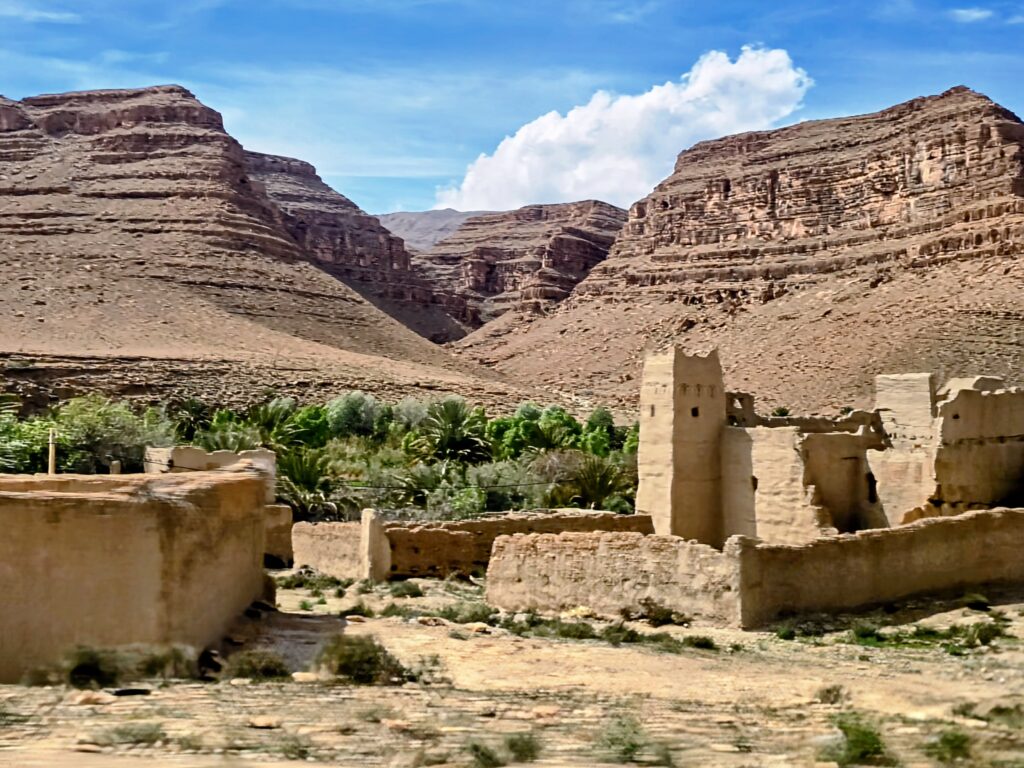
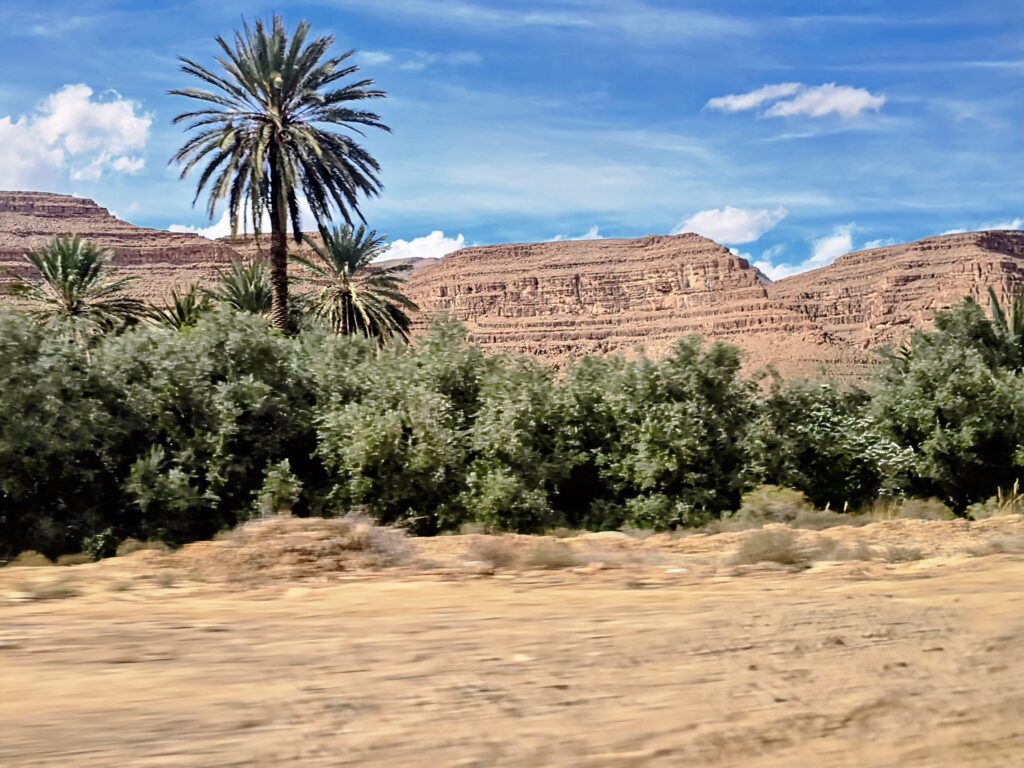
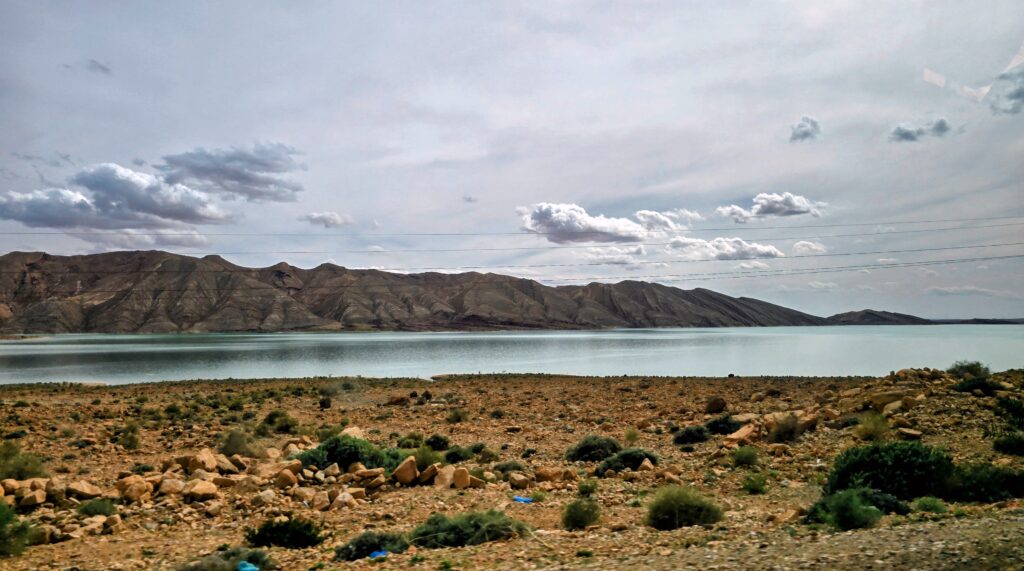
Back on the road, the scenery slowly opened up and dried out. Eventually, Soufiane pointed ahead to a ribbon of green that seemed to unspool along the valley floor: our first view of a long, palm‑filled oasis. After hours of rock, dust, and muted browns, that sudden streak of life felt almost unreal—date palms, small villages, and fields all hugging the watercourse that makes everything possible out here.
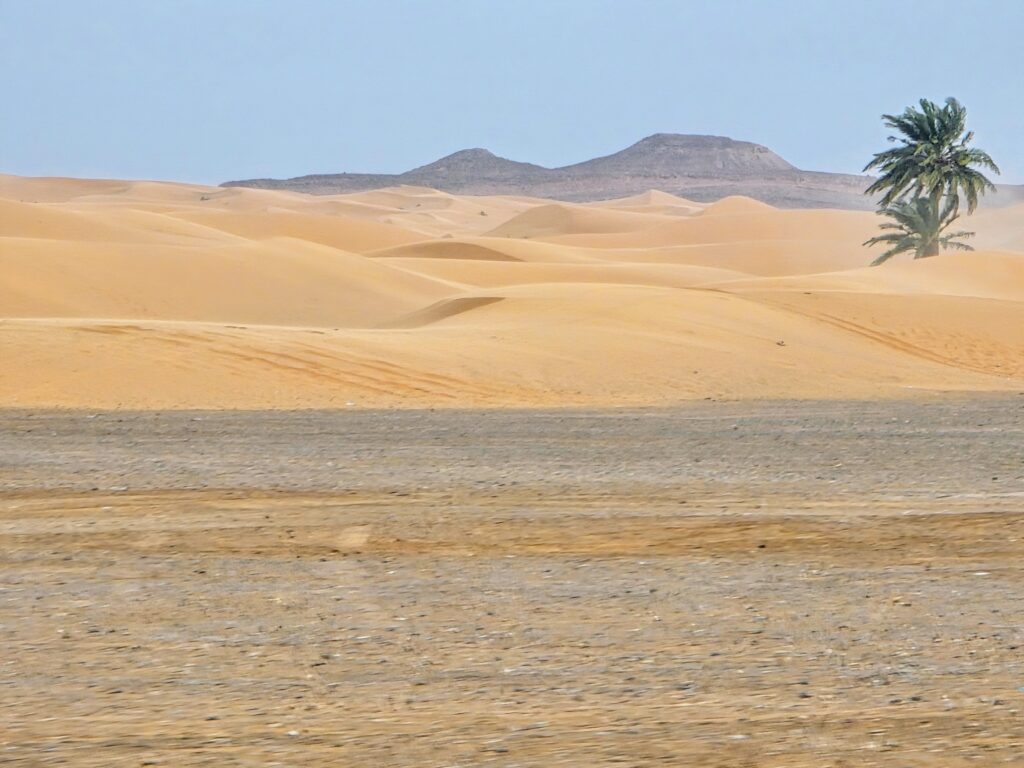
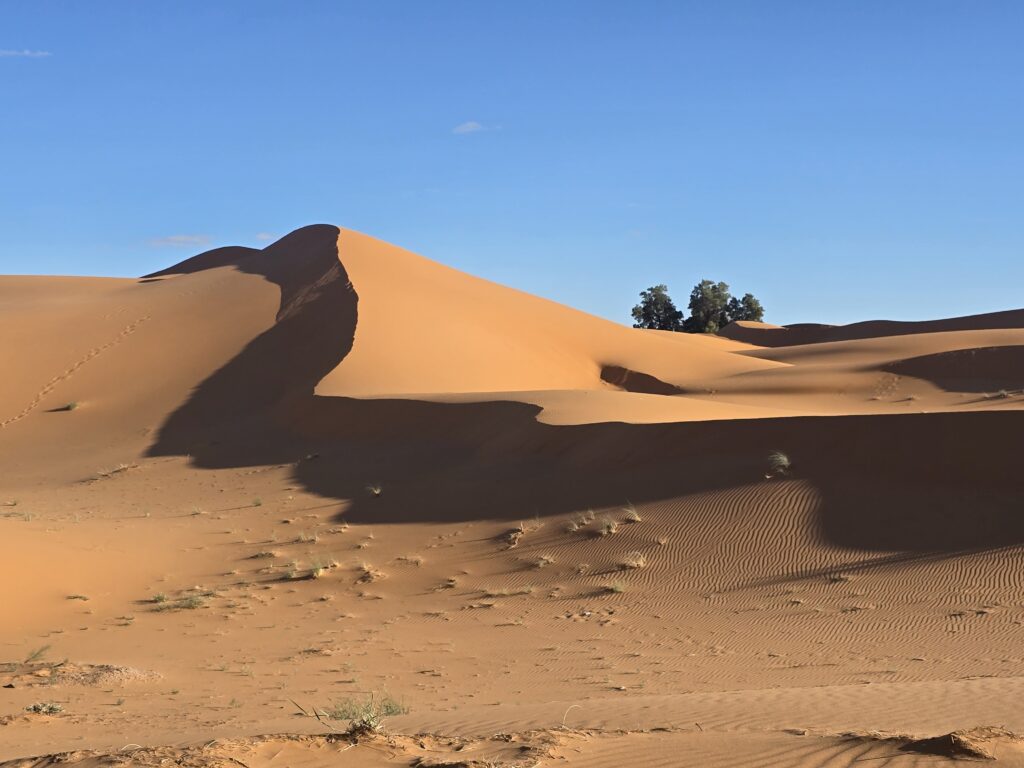
By late afternoon we reached the point where the pavement, and our van, would go no farther. Here we transferred into 4×4 vehicles for the final approach to our desert camp. The road dissolved into tracks and then into sand, the dunes rising higher around us, shifting with the light as we drove deeper in. It felt less like changing locations and more like crossing into another world.
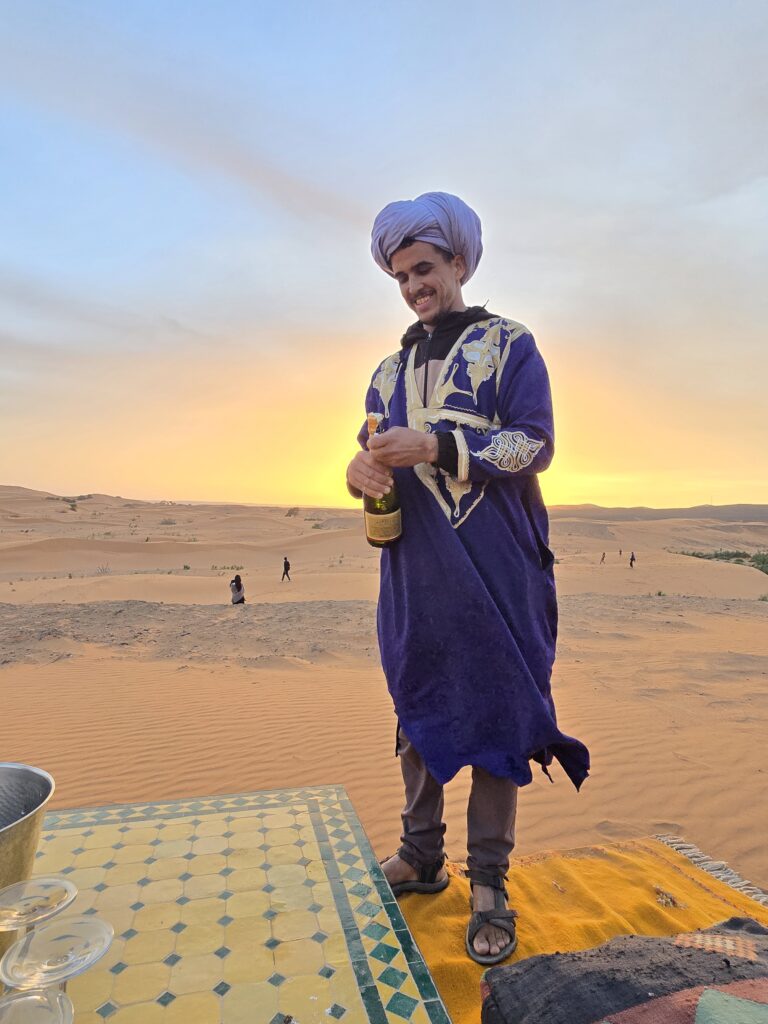
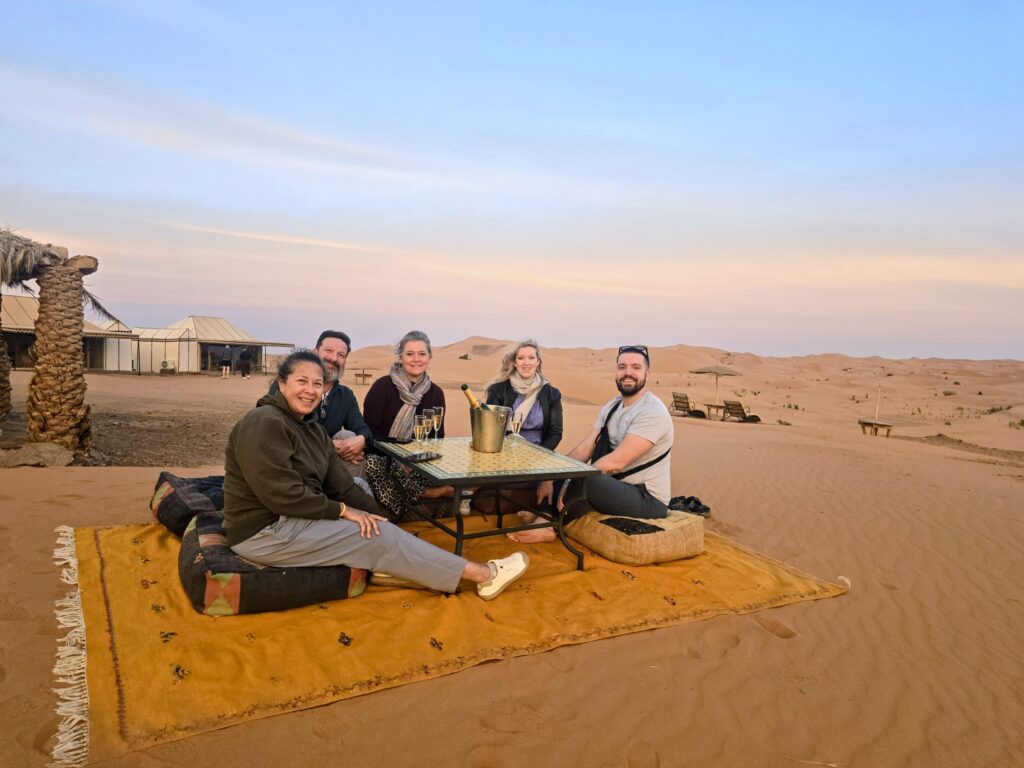
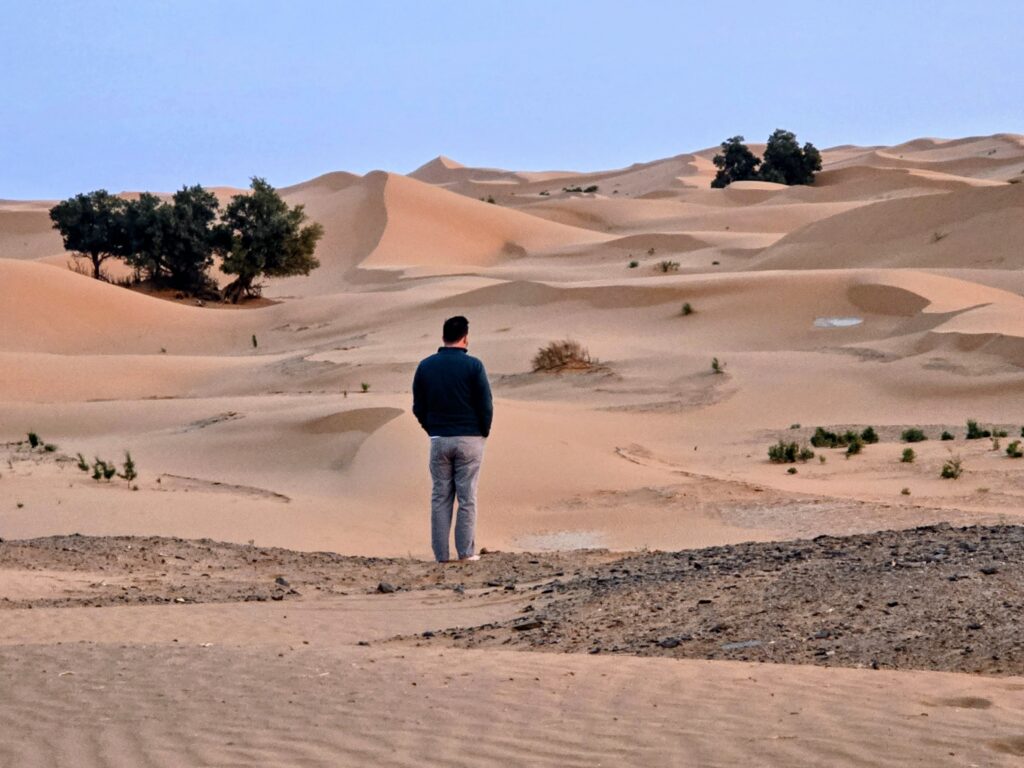
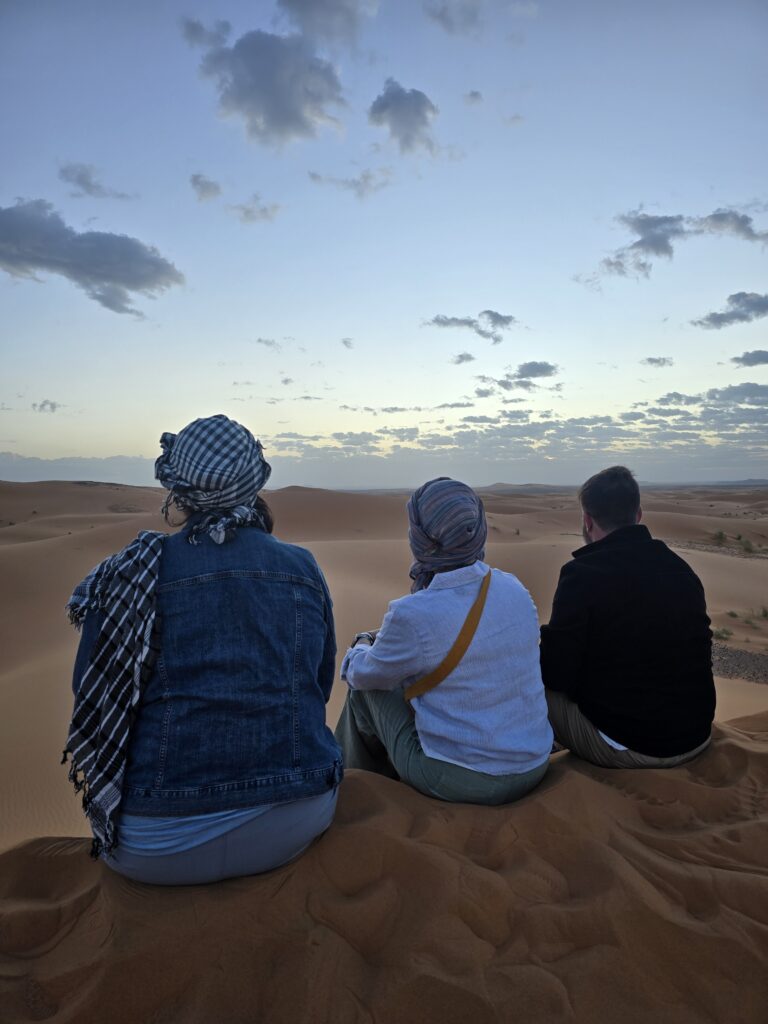
We arrived at camp just as the sky began to soften. Our bags disappeared into tents while we were led up a nearby dune for what might have been the most cinematic moment of the entire trip: a sunset champagne toast in the Sahara. The sand underfoot was still warm from the day; the air had finally cooled. As the sun slid down the horizon, the dunes around us turned from gold to rose to deep, velvety orange. Someone handed us glasses, and there we were—tiny silhouettes on a ridge, watching the light drain from the sky, clinking to a day that had started in mountain pines and ended in a sea of sand.
Erg Chebbi Luxury Desert Camp Experience: From Sunset Champagne to Camel Sunrise
By the time the last light slipped off the tops of the dunes, the temperature had dropped enough that we were grateful for the extra layers we’d brought up with us. The champagne glasses were collected, we brushed the sand from our shoes as best we could, and followed a lantern‑lit path back down toward camp. From above it had looked like a scattering of pale shapes in a hollow between the dunes; up close, it felt almost like a mirage someone had decided to furnish.
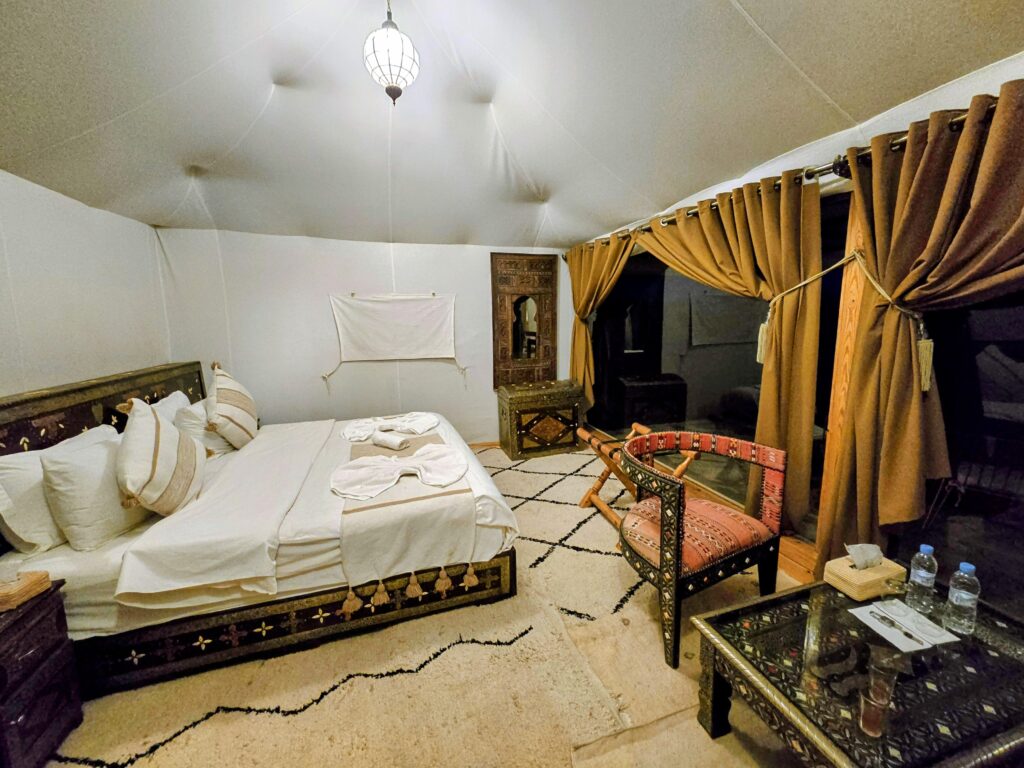
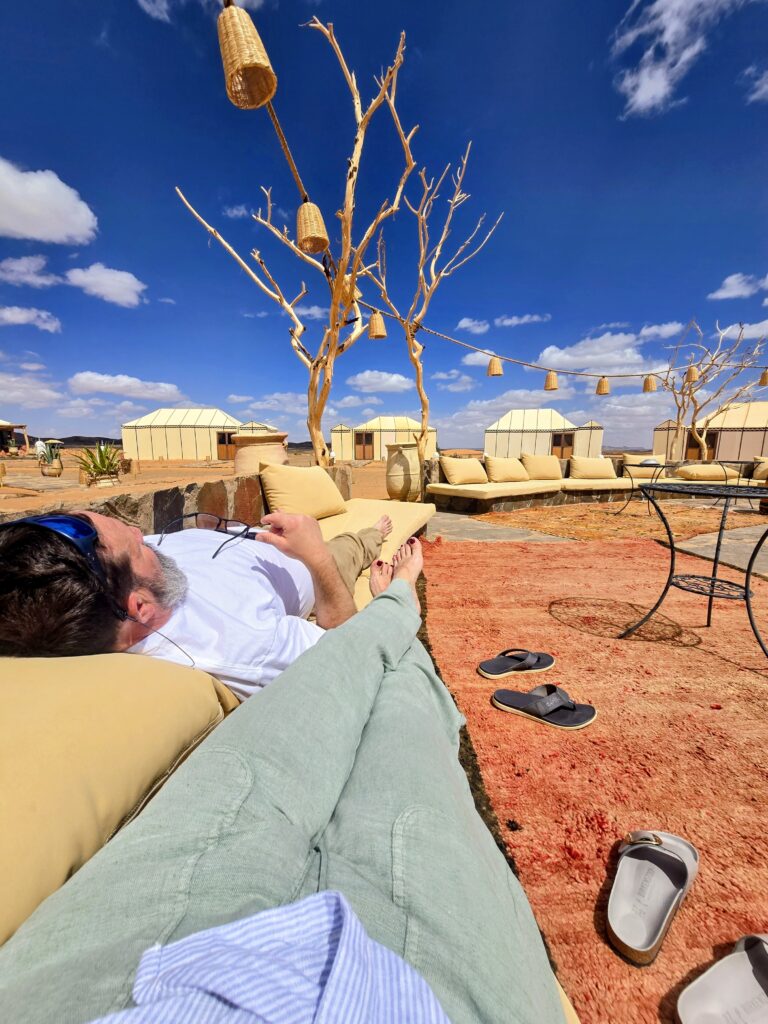
Calling it a “camp” didn’t quite do it justice. From the outside our tent was a simple canvas structure pegged into the sand; inside it was a wayward hotel room that had lost its way and decided to stay: thick rugs layered over the ground, a large bed with crisp white linens and heavy blankets, low tables and lamps casting a warm, honeyed light. Behind a canvas partition there was even a private bathroom with a real shower and flushing toilet—a small modern miracle in the middle of the Sahara.
Outside, a central open area formed the heart of camp, lined with poufs and cushions around low tables. Lanterns hung from ropes and sat in the sand at regular intervals, their flames ready for full darkness. Beyond that fragile bubble of light, the dunes rose on all sides, their edges already softening into shadow.
Dinner was served in a large communal toom, the tables set with patterned ceramics and linens. The meal felt both familiar and newly special—tagines fragrant with saffron and cumin, slow‑cooked meat falling apart at the touch of a fork, vegetables that tasted like they’d been given the whole afternoon, salads bright with herbs, fluffy couscous, and baskets of bread. Afterward we drifted naturally toward the fire, where a few of the camp’s Berber hosts appeared with drums. The rhythms started gently and then grew more insistent, drums passing from hand to hand, clapping drifting in and out. It never felt like a staged show so much as an after‑dinner ritual we’d been invited to share.
It was only our first of two nights in the desert, but it already felt like we’d slipped into a different rhythm. After the music faded, we took one last, lingering look at the sky—properly dark in a way we rarely see anymore, the constellations easy to pick out without an app—and then finally turned in, knowing we had an early start ahead and a camel trek waiting in the pre‑dawn chill.
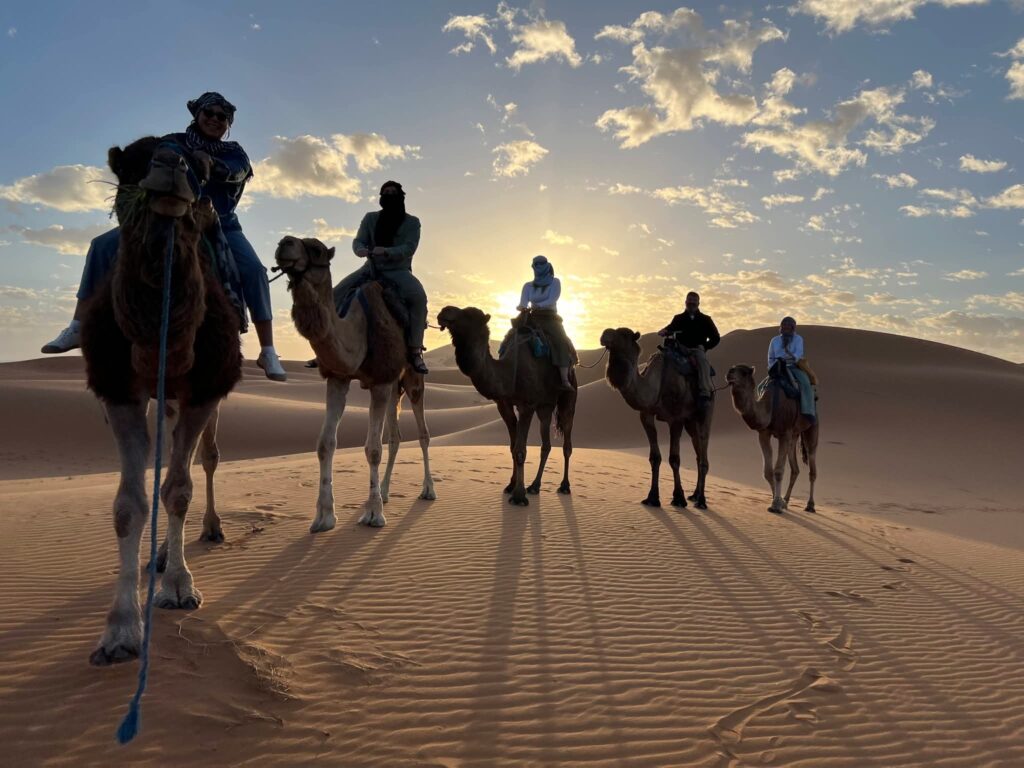
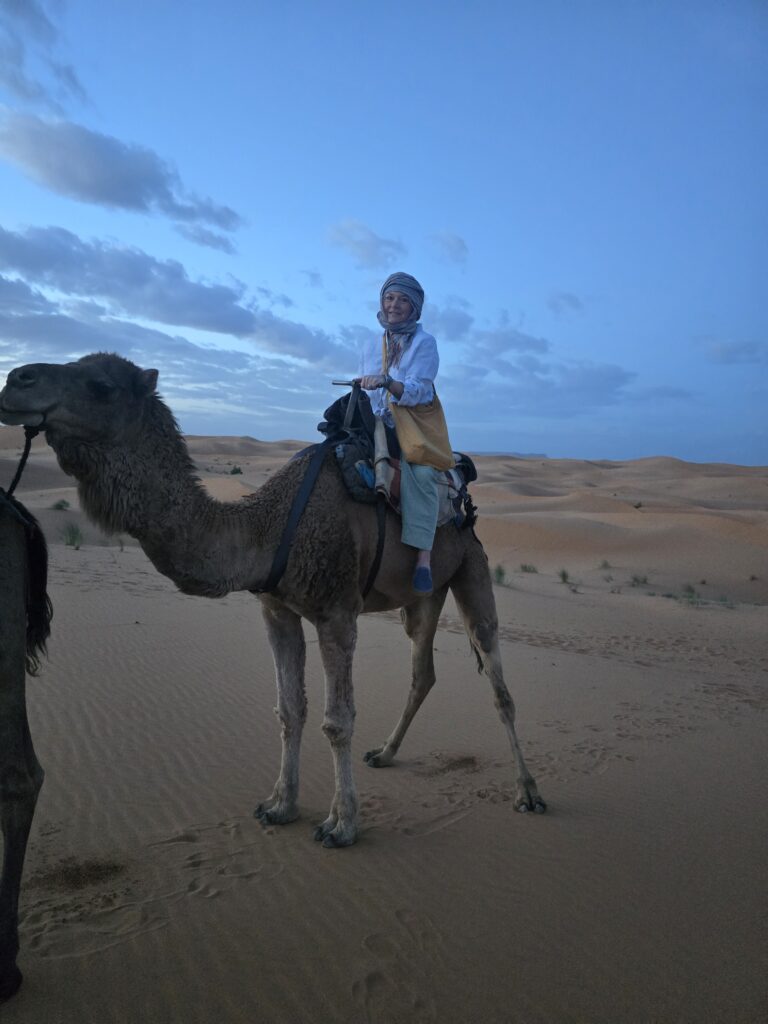
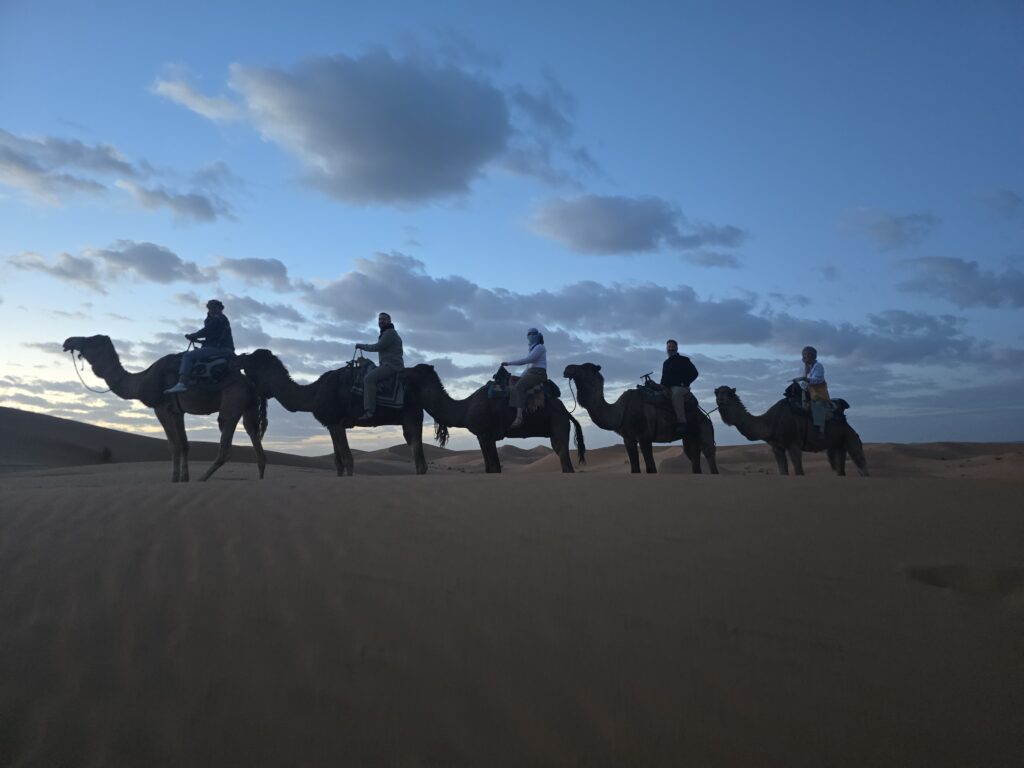
The wake‑up call came before the first hint of light. Wrapped in layers, we made our way to the camels kneeling in the sand, silhouettes against a barely brightening horizon. Mounting up in the half‑dark felt slightly surreal; the camp lights faded behind us as we swayed forward into the dunes, the only sounds the soft thud of hooves and the occasional creak of saddles. As we climbed higher, the eastern sky began to pale, then blush, until at last the sun eased itself over the edge of the Sahara. The dunes shifted through a familiar but still astonishing spectrum—slate to rose to gold—as we watched from our camel caravan, tiny figures in an endless landscape.
Back at camp, we warmed up over a generous buffet breakfast: platters of fresh bread and pastries, eggs, fruit, cheeses, and all the coffee and mint tea we could manage. It felt almost comically civilized after our quiet procession through the dawn. Once refueled, we traded camels for something with more horsepower and headed back into the desert for our dune buggy adventure.
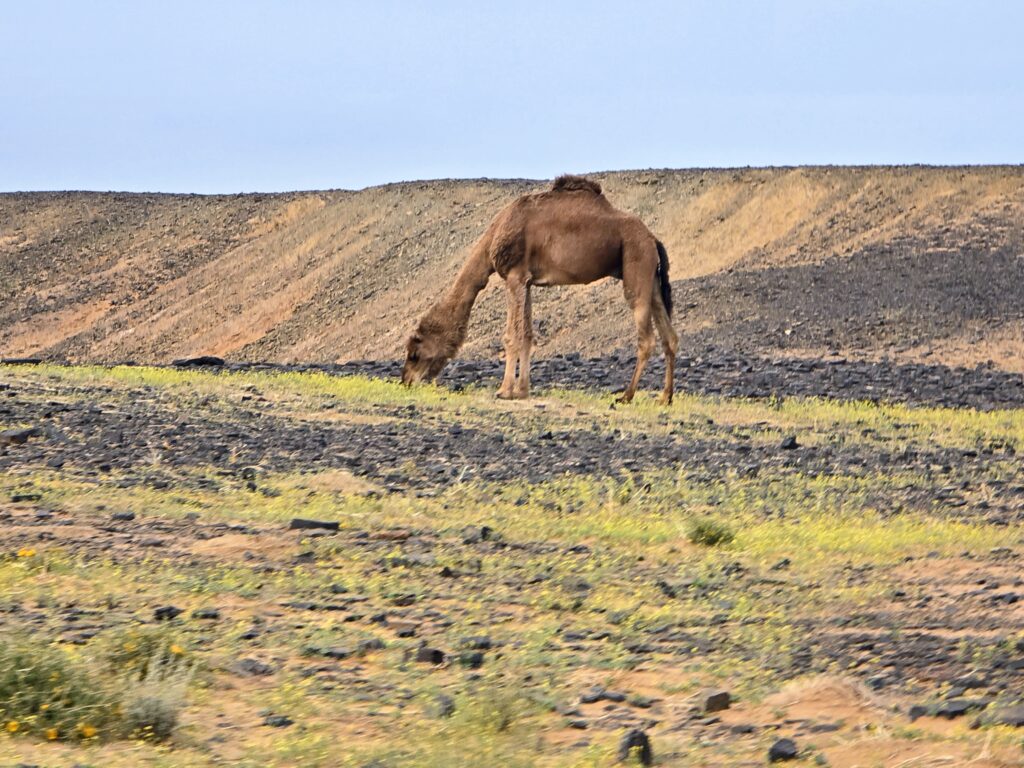
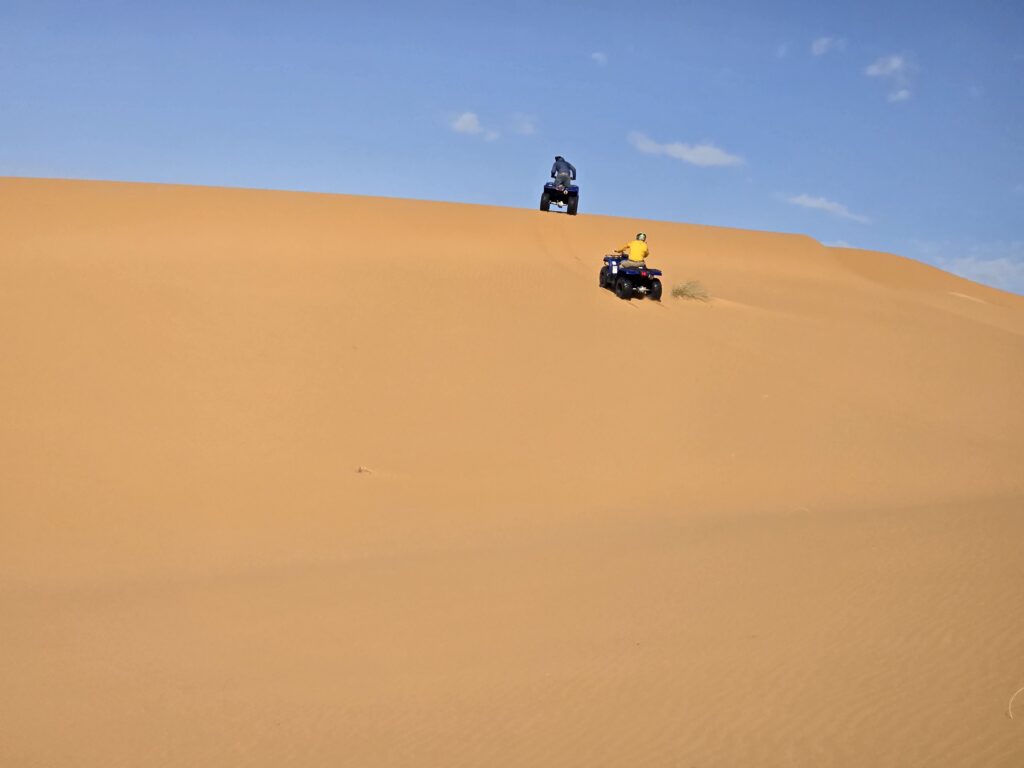
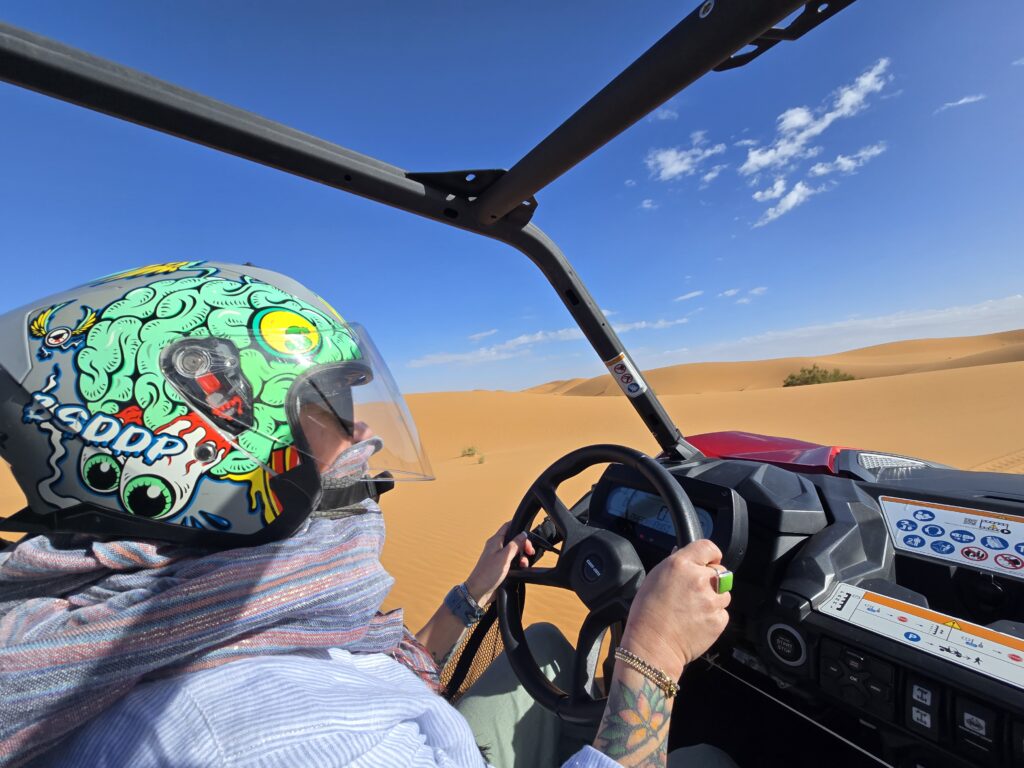
If the camels had been meditative, the buggies were the opposite—loud, fast, and undeniably fun. We tore over rippling stretches of sand, cresting both small and startlingly high dunes, the buggies tilting and sliding just enough to keep our adrenaline up. Now and then we cut the engines and sat in the sudden silence, watching distant camel caravans trace the ridgelines. At one point we spotted a small group up close, their long shadows stretching across the sand; later, a quick flicker of movement resolved into desert foxes darting away, a brief reminder that this seemingly empty landscape is very much alive.
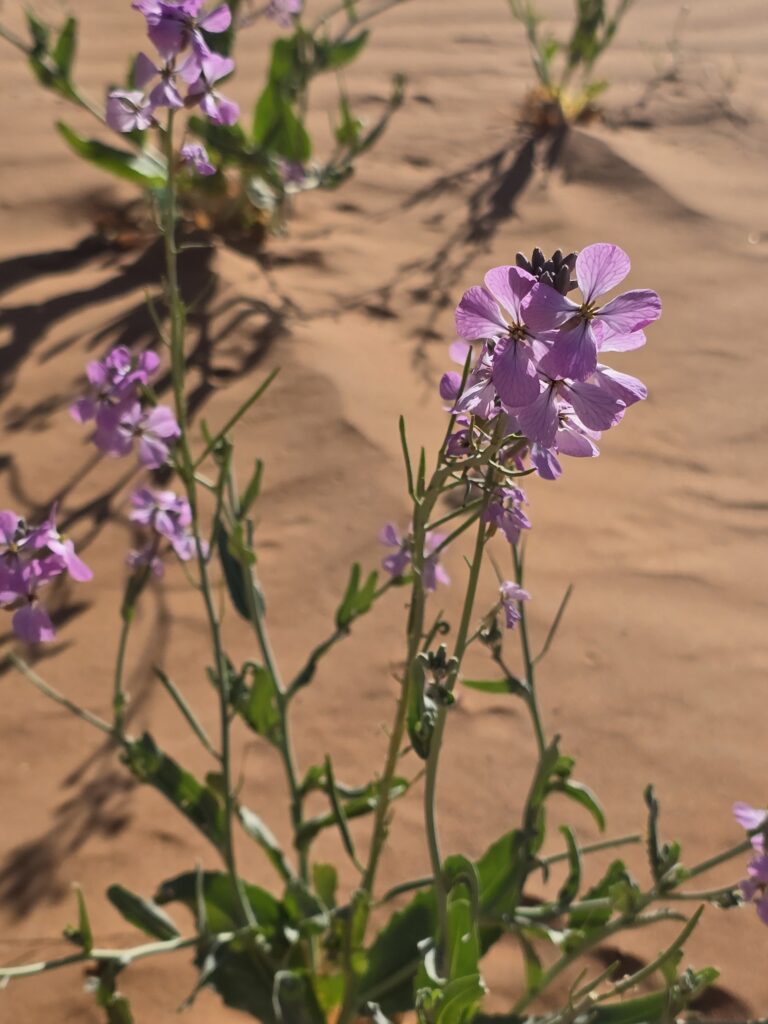
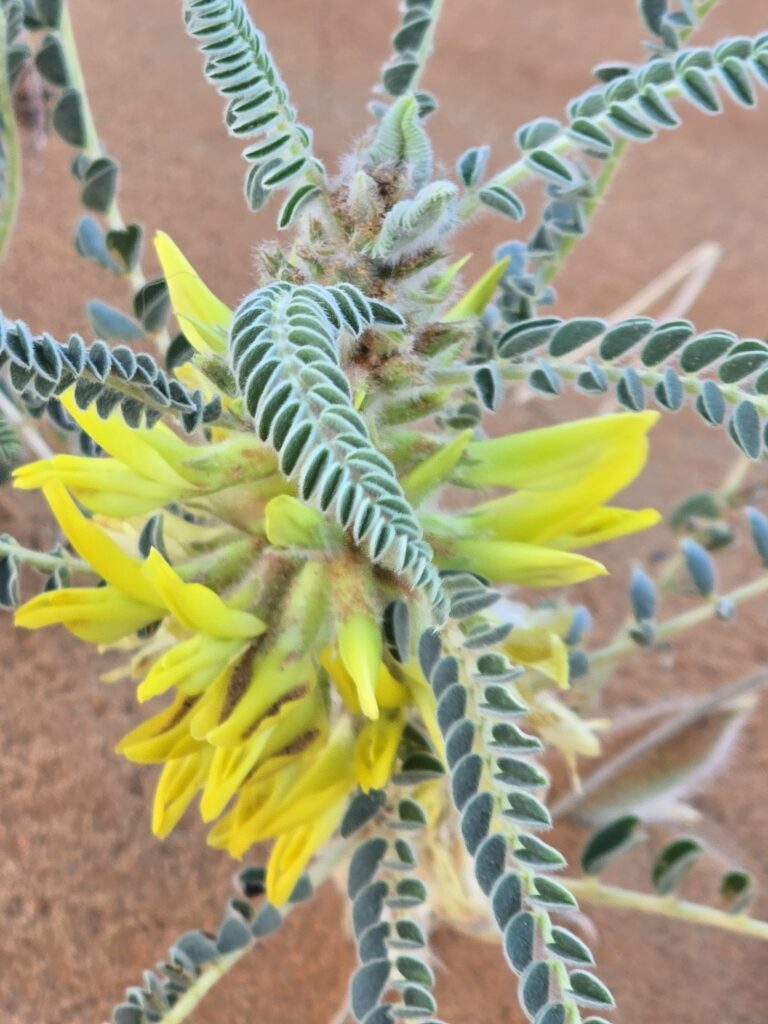
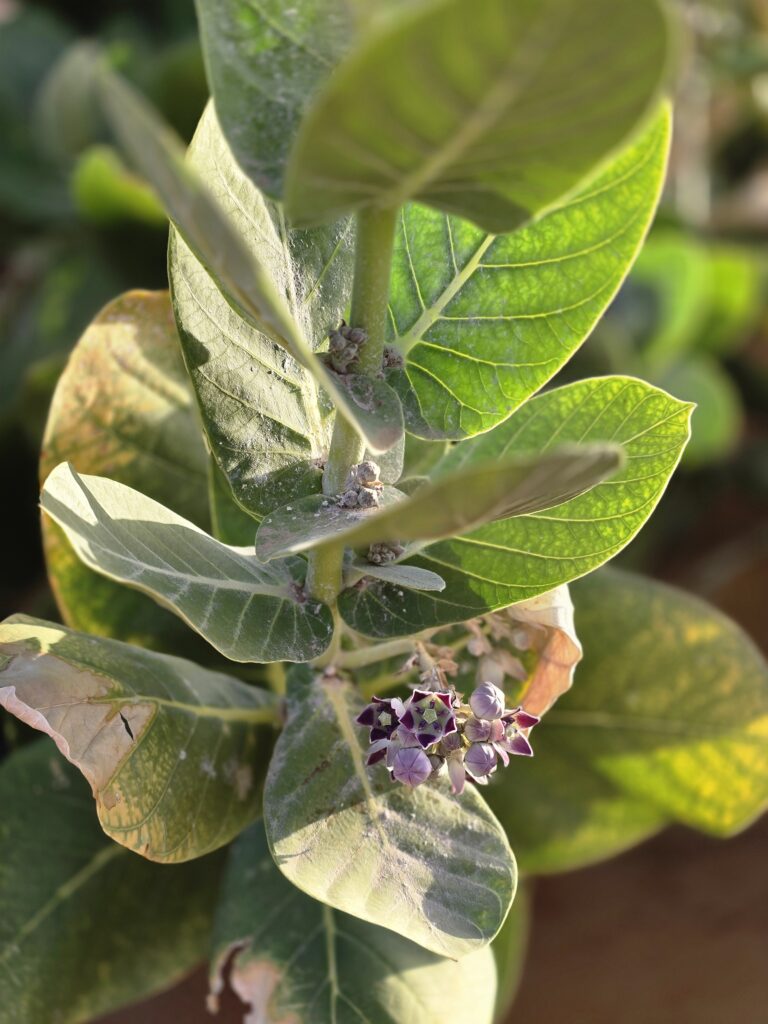
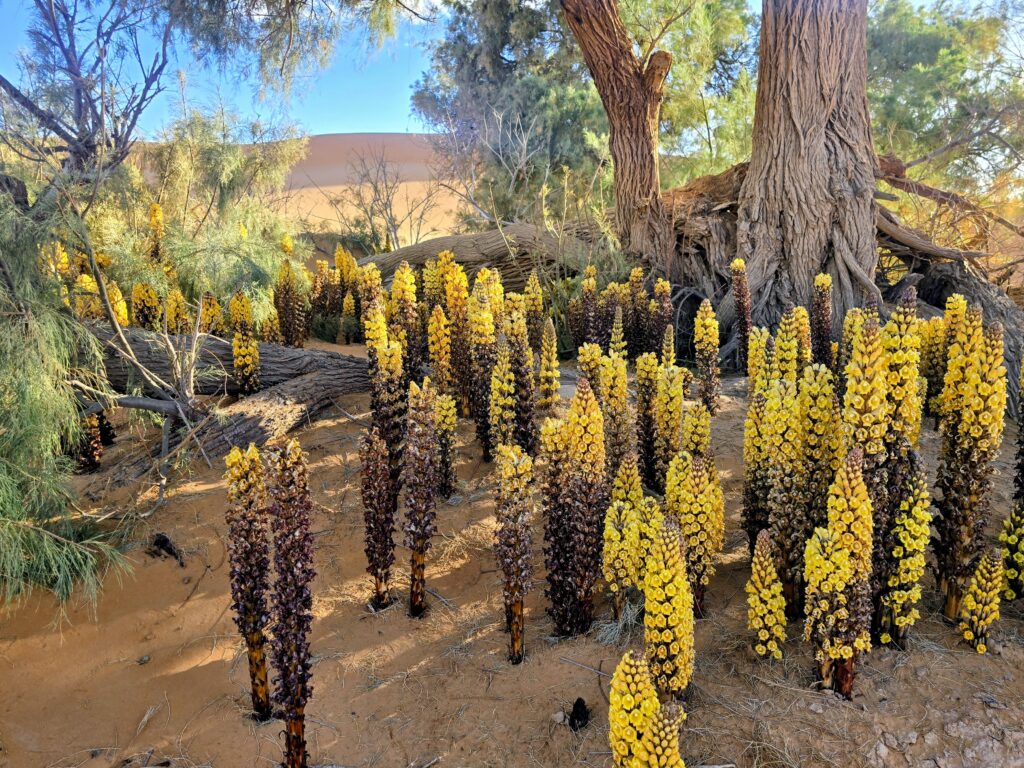
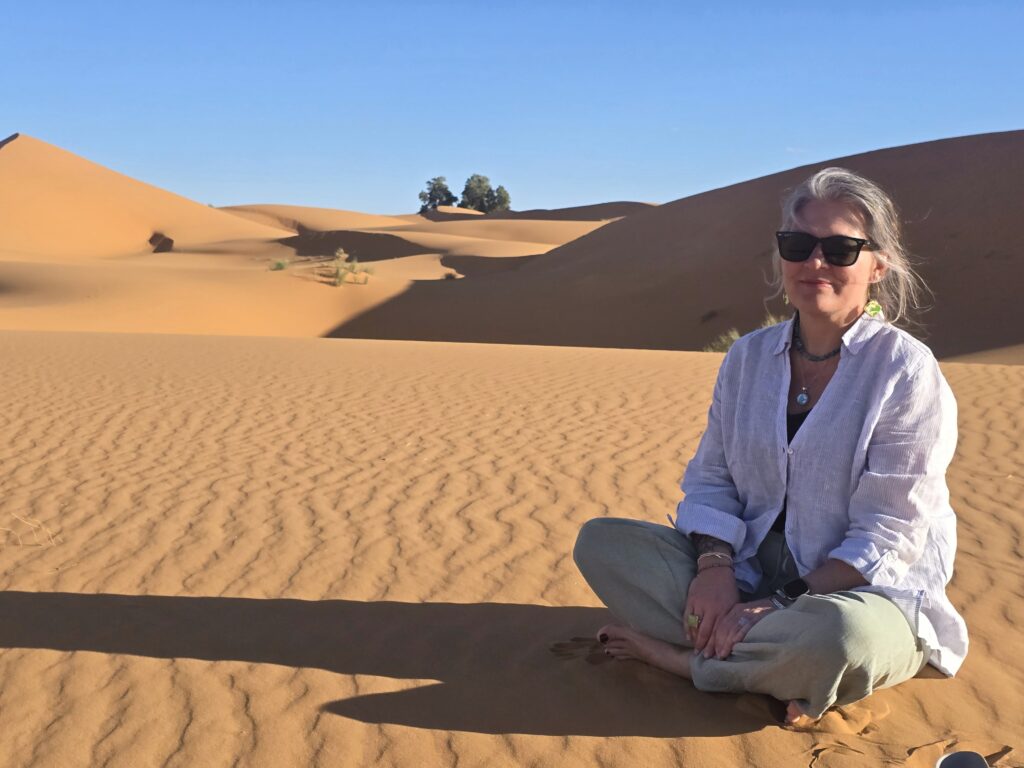
When we finally rolled back into camp, sun‑dusted and exhilarated, we were offered the chance to visit a nearby village. Tempting as it was, we chose the rare luxury of staying put. The rest of the day unfolded slowly: lounging with those almost unreal views as our backdrop, playing impromptu games of bocce in the sand, revisiting stories from our journey so far. Whenever the urge struck, we wandered out to nearby dunes at a more contemplative pace, noticing small patches of hardy desert flora clinging to the slopes—tiny bursts of green and texture in the vastness of sand.
It was the kind of stretch that doesn’t look particularly busy on paper, but felt full in all the best ways: movement and stillness, thrill and quiet, all held together by that endless horizon and the knowledge that we still had one more night to let the desert sink in.
Next Stop: Dades Valley and Marrakech – The Rest of Our Morocco Journey
We left Erg Chebbi with sand still in our shoes and that peculiar mix of satisfaction and reluctance that comes at the end of a place you’re not quite finished with. The desert had given us its full range in a short span of time—champagne sunsets and pre‑dawn camel treks, dune buggies and bocce ball, stargazing and long, quiet stretches of nothing but our own thoughts and the curve of the dunes.
But this was only the midpoint of our journey, not the end. As we climbed back into the 4x4s and turned our backs on the Sahara, the landscape began to shift yet again, trading waves of sand for rugged cliffs and deep, shadowed gorges. Ahead lay the Dades Valley and an overnight in a kasbah perched above a river of palms, and beyond that, five nights in Marrakech—a return to the hum of city life, though nothing like the Morocco we’d left behind in Fez.
If the first part of our trip was about contrasts—ancient medinas and alpine towns, cedar forests and Saharan dunes—the next chapter would be about layers: of history, architecture, flavor, and color. From fortress‑like kasbah walls glowing in late‑afternoon light to rooftop terraces in Marrakech, spice‑scented souks, and day trips that pushed us back out toward the mountains and the coast, Morocco still had plenty to reveal.
In the second part of this blog, we’ll trade desert silence for the call to prayer echoing through Marrakech, sleepy camp mornings for sunrise over the Dades Gorge, and starlit dunes for lantern‑lit riads. If Erg Chebbi was where the country asked us to slow down, Marrakech is where it will invite us to dive in.
Part two begins in the Dades Valley, where the road winds through “monkey fingers” rock formations and our kasbah stay offers a very different kind of desert edge. From there, we’ll make our way to Marrakech—for five days of wandering, tasting, and exploring that turned out to be just as memorable as our time in the dunes.

Leave a Reply